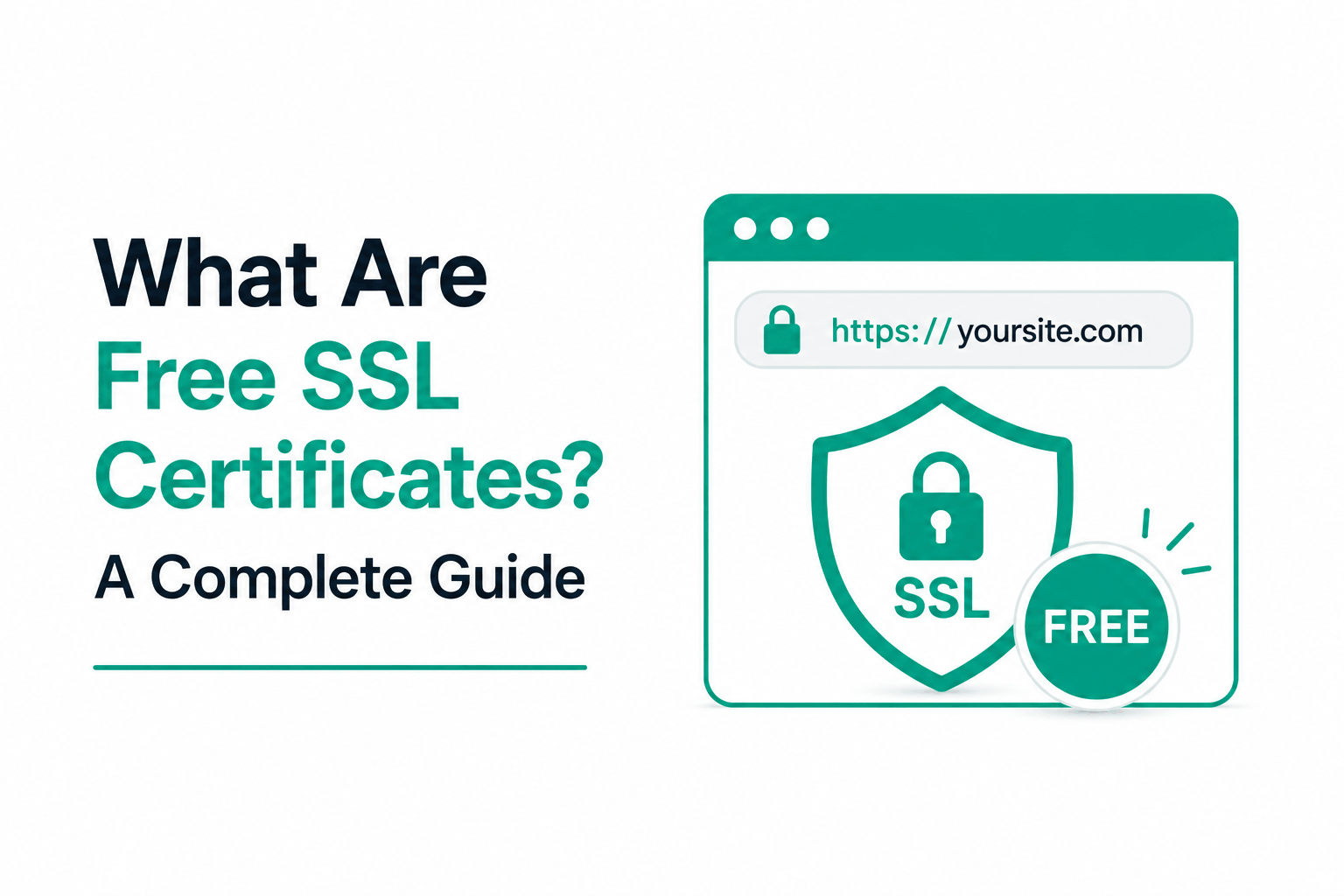
Free SSL certificates are Domain Validated (DV) TLS certificates issued at no monetary cost. The encryption they provide is technically identical to paid DV certificates from commercial CAs. A free SSL certificate encrypts data between a browser and your server with the same AES-256 cipher suite and the same TLS 1.3 protocol as any paid alternative. The security of the encrypted connection does not depend on what you paid for the certificate.
What free certificates do not provide: organization identity verification, extended validation, warranty claims, OV or EV validation levels, and in most cases no phone or priority support from the CA. They also come with operational requirements that many guides understate. The ‘free’ refers to monetary cost. The operational investment required to use free certificates reliably is real and scales with the number of certificates you manage.
This guide covers what free SSL certificates are, the main providers, the operational realities around automation and monitoring, and honest guidance on when free certificates are the right choice versus when paid certificates make more sense.
The Encryption Is the Same: What Free vs Paid Does Not Affect
The question most people have when they encounter free SSL certificates is whether the security is inferior. It is not, for the encryption itself. The AES-256-GCM cipher, the TLS 1.3 handshake, the RSA or ECDSA key pair, the SHA-256 hash algorithm: none of these differ between a free DV certificate and a paid DV certificate from the same CA. A visitor’s browser cannot distinguish between them during the connection. Google’s search crawler cannot distinguish between them. The padlock icon looks identical.
What free certificates lack is identity verification beyond domain control. The CA checks that you control the domain but does not verify who you are. The certificate shows the domain name but not a verified organization name. For most websites this distinction is invisible to visitors. For certain audiences (enterprise procurement, financial services, healthcare, or any context where users inspect certificate details) the absence of an organization name in the certificate is meaningful.
The Main Free SSL Certificate Providers
Let’s Encrypt
Let’s Encrypt is a nonprofit CA operated by the Internet Security Research Group (ISRG) and is the largest free SSL CA in the world, having issued over three billion certificates since launch. It issues 90-day DV certificates via the ACME protocol. ACME is an industry-standard protocol for automating certificate issuance and renewal, and virtually every major hosting platform, server tool, and cloud provider has built-in Let’s Encrypt support.
Let’s Encrypt supports wildcard certificates (*.yourdomain.com) through DNS-01 domain validation. HTTP-01 validation is the simplest method: Let’s Encrypt places a challenge file on your server and verifies you can serve it. DNS-01 requires creating a TXT record in your DNS and is required for wildcard certificates.
Let’s Encrypt rate limits: 50 certificates per registered domain per week, 5 duplicate certificate issuances per week, and 5 failed validation attempts per account per hour. These limits are sufficient for the overwhelming majority of deployments. Organizations with very large numbers of unique subdomains or high-volume certificate operations may hit them.
Let’s Encrypt discontinued sending certificate expiry notification emails in June 2025. Previously, the service emailed certificate owners at 20 days and 7 days before expiry as a backstop against automation failures. That safety net no longer exists. If your automated renewal fails silently and you have no external certificate monitoring, the first indication will be visitors seeing browser SSL errors. Set up independent monitoring before relying on Let’s Encrypt for any production site.
ZeroSSL
ZeroSSL is a commercial CA that offers a free tier alongside paid plans. The free tier allows up to 3 simultaneous 90-day certificates through the web dashboard. Through the ACME protocol (using ZeroSSL as the ACME directory), there is no limit on certificates. ZeroSSL’s primary differentiator is its web dashboard, which makes certificate management accessible without command-line tools, useful for users who prefer a visual interface to managing Certbot or acme.sh.
ZeroSSL supports multiple validation methods (HTTP file, DNS TXT, email) and has a REST API for programmatic certificate management. It is a reasonable alternative to Let’s Encrypt for teams that want web dashboard visibility alongside ACME automation.
Cloudflare Universal SSL
Cloudflare Universal SSL is different in character from Let’s Encrypt and ZeroSSL, and this distinction matters significantly for understanding what you are and are not getting.
Cloudflare Universal SSL terminates TLS at Cloudflare’s edge, not at your origin server. The certificate that browsers see is Cloudflare’s certificate, issued by Cloudflare’s CA, covering your domain. This certificate handles the encryption between your visitor’s browser and Cloudflare’s nearest data center. What happens between Cloudflare and your origin server depends on your SSL/TLS mode setting in Cloudflare’s dashboard.
With Cloudflare’s SSL/TLS mode set to Flexible: Cloudflare connects to your origin server over plain HTTP. The visitor’s browser sees HTTPS (the edge certificate), but the traffic from Cloudflare to your server is unencrypted. This is the default for many Cloudflare users and is technically a security gap if your server and Cloudflare are not on the same network.
With Full or Full (Strict) mode: Cloudflare connects to your origin over HTTPS. Full mode accepts any certificate, including self-signed. Full (Strict) mode requires a CA-trusted certificate on the origin: either a certificate from a public CA (Let’s Encrypt, paid CA) or a Cloudflare Origin Certificate (a free certificate from Cloudflare that is trusted only by Cloudflare’s edge, not by public browsers).
Cloudflare Universal SSL is most accurately described as a CDN-edge certificate that also provides DDoS protection, WAF, and performance features. It is not a substitute for a certificate on your origin server if the origin needs to be directly trusted by browsers.
Cloudflare Universal SSL and Let’s Encrypt serve different architectural roles. Let’s Encrypt provides a certificate that your server presents directly to browsers. Cloudflare Universal SSL provides a certificate that Cloudflare’s edge presents to browsers on your behalf. If you use both Cloudflare in front and Let’s Encrypt on the origin, you have end-to-end encrypted connections from browser to edge (via Cloudflare’s certificate) and from edge to origin (via your Let’s Encrypt certificate). This is the recommended setup when using Cloudflare: set the SSL/TLS mode to Full (Strict) and run Let’s Encrypt or a paid certificate on the origin.
Buypass Go SSL
Buypass is a Norwegian CA that offers free 180-day DV certificates through ACME. The 180-day validity is a meaningful differentiator: it halves the renewal frequency compared to Let’s Encrypt’s 90-day certificates. For teams where renewal automation is partially set up but not fully reliable, less frequent renewals reduce the risk window.
Buypass does not issue wildcard certificates on the free tier. This limits its applicability for multi-subdomain deployments. For single-domain or multi-SAN (Subject Alternative Name) certificates where wildcard coverage is not needed, Buypass is a viable alternative with lower renewal overhead.
Google Trust Services
Google operates its own CA (Google Trust Services) and offers free DV certificates. The certificates are primarily issued through Google’s own services (Google Cloud, Firebase Hosting, Google-managed certificates) but are also accessible via ACME for other uses. Google Trust Services certificates are trusted by all major browsers and platforms, as Google’s root certificates are in all major trust programs.
For organizations already using Google Cloud Platform, Firebase Hosting, or other Google services, the certificates are often managed automatically without any explicit setup. Google-managed certificates on Google Cloud Load Balancers are renewed automatically and require no operator intervention.
Cloud provider managed certificates
AWS Certificate Manager (ACM), Azure App Service managed certificates, and Google-managed certificates are often the best free SSL option for organizations already using those cloud platforms, despite being less prominent in general SSL guides.
AWS ACM issues free DV certificates for use with AWS services (CloudFront, ALB, API Gateway, Elastic Beanstalk). The certificates are automatically renewed and cannot expire while the AWS service is running. There is no renewal automation to set up, no expiry monitoring needed, and no operator intervention required. The limitation is that ACM certificates cannot be exported to non-AWS services; they are tied to the AWS infrastructure.
Azure App Service provides a free managed certificate for App Service apps and custom domains. Renewal is automatic. Google-managed certificates for Cloud Load Balancers and Firebase function similarly. For organizations committed to these cloud platforms, the managed certificate is often the operationally simplest choice.
Free SSL Provider Comparison
| Provider | Validity | Wildcard | ACME | Web dashboard | Best for | Key limitation |
| Let’s Encrypt | 90 days | Yes (DNS-01) | Yes (standard) | No (CLI tools) | Automated server deployments; widest platform support | No expiry emails since June 2025; rate limits at scale |
| ZeroSSL | 90 days | Yes | Yes | Yes (3 certs free) | Teams wanting visual management alongside automation | 3 cert limit on web UI; ACME required for unlimited |
| Cloudflare Universal SSL | Variable (managed) | Yes (via Cloudflare) | No (Cloudflare-managed) | Yes (Cloudflare dashboard) | Sites already using Cloudflare CDN | Edge certificate only; origin may need separate cert |
| Buypass Go SSL | 180 days | No | Yes | No | Deployments wanting lower renewal frequency | No wildcard support on free tier |
| Google Trust Services | 90 days | Yes | Yes | Via Google Cloud | GCP users; ACME for others | Primarily designed for Google Cloud integration |
| AWS ACM | Managed (auto-renews) | Yes | No (AWS-managed) | AWS Console | AWS infrastructure; ALB, CloudFront, API Gateway | Cannot export to non-AWS services |
The Hidden Cost: Automation Is Not Optional
The operational reality of free SSL certificates is that their short validity periods make manual renewal untenable at anything beyond a handful of certificates. A 90-day certificate that you renew manually requires action every 60 to 70 days to stay ahead of the expiry (renewing in the last 30 days is already cutting it close if anything goes wrong). For five websites this is a manageable calendar reminder. For fifty certificates it is a part-time job. For five hundred it is impossible.
Let’s Encrypt was designed with ACME-based automation as the primary workflow, not as an afterthought. The entire ecosystem around certbot, acme.sh, Caddy’s built-in ACME client, Traefik’s automatic TLS, and the integrations in every major hosting panel exists because free SSL requires automation to be practical.
Automation failures are the primary cause of certificate-related outages on sites using free SSL. The cron job that runs certbot stops running after a server reboot. A DNS API credential rotates and the DNS-01 challenge starts failing silently. A redirect gets added that breaks the HTTP-01 challenge path. The certificate renews successfully but the web server is not reloaded so the new certificate is not loaded. All of these fail silently unless external monitoring catches the approaching expiry.
The most important operational step after setting up free SSL is setting up external certificate monitoring that is independent of your server. A monitoring tool that checks the public-facing certificate from outside your network and alerts when it is within 14 or 21 days of expiry will catch automation failures before they cause user-facing outages. Since Let’s Encrypt stopped sending expiry emails in June 2025, external monitoring has become the only safety net for automation failures.
When Free SSL Is the Right Choice vs When to Pay
Free DV certificates are the right choice for the majority of websites, blogs, developer tools, SaaS products, APIs, and internal services. For these use cases, free and paid DV certificates provide identical trust and security. There is no technical justification for paying for a DV certificate when Let’s Encrypt, ZeroSSL, or a cloud-provider managed certificate is available.
Paid certificates are justified in specific situations where free certificates cannot satisfy the requirement:
- Organization identity in the certificate (OV): Paid OV certificates include the verified organization name in the certificate details. This is visible to users who inspect the certificate and to security tools that evaluate certificate identity depth. Some enterprise procurement processes and regulated industries require OV. Free certificates are DV only.
- Extended Validation: EV certificates require the most rigorous CA verification and are required for specific compliance contexts and for signing Windows kernel-mode drivers (though EV SSL and EV code signing are different products). Free certificates are never EV.
- No automation capability: If your server environment genuinely cannot support ACME automation (some legacy hosting panels, appliances with no scripting access, platforms with no Let’s Encrypt integration), the frequent renewal of free certificates becomes manual. A paid 1-year certificate from a commercial CA means one annual renewal event rather than four or six.
- Warranty and CA support: Paid certificates from commercial CAs include warranty claims (largely symbolic but occasionally required by procurement) and access to dedicated support. Let’s Encrypt and ZeroSSL free tiers offer community support forums, not phone or SLA-backed support.
- Specific platform requirements: Some hosting providers, appliances, and enterprise software only support certificates from specific commercial CAs for integration reasons. Verify your platform’s requirements before assuming free is compatible.
Free SSL and SEO, E-Commerce, and User Trust
Google treats all HTTPS sites equally in search ranking signals regardless of whether the certificate is free or paid, DV or OV. The ranking benefit of HTTPS comes from the presence of a valid certificate, not its validation level or cost. A site with a correctly installed Let’s Encrypt certificate has the same HTTPS ranking signal as a site with a paid DigiCert OV certificate.
For e-commerce specifically, user trust depends primarily on the presence of a valid HTTPS connection (the padlock icon) rather than on certificate validation level. Modern browsers do not display a visible difference between DV and OV certificates in the address bar. The green address bar with organization name that existed for EV certificates was removed by Chrome in 2019 and Firefox shortly after. Users see the padlock regardless of certificate type.
Where certificate validation level still matters for e-commerce and financial services is in the details level inspection by security-conscious users or enterprise purchasing systems. A user who clicks through to inspect the certificate and finds only a domain name rather than a verified organization name is less reassured than one who sees a verified company name. For high-value transaction contexts, OV certificates provide this additional identity signal.
Frequently Asked Questions
Are free SSL certificates safe?
Yes, in the sense that the encryption is identical to paid DV certificates. Free DV certificates from Let’s Encrypt, ZeroSSL, and Cloudflare use the same TLS protocol, cipher suites, and key sizes as paid certificates from commercial CAs. The security of the encrypted connection between a browser and a server does not depend on what the certificate cost. What free certificates lack is organizational identity verification: the CA verifies domain control but not who the organization behind the domain is.
What is the difference between a free and paid SSL certificate?
The primary differences are validation level, certificate lifespan, and support. Free certificates are DV (Domain Validated): the CA verifies only that you control the domain. Paid certificates can be DV, OV (organization verified), or EV (extended verification). Free certificates typically have 90-day validity; paid certificates can have up to 15 months (the CA/B Forum maximum since March 2026). Paid certificates come with CA support and warranty claims. The encryption strength and browser trust are identical between free and paid DV certificates.
Why does Let’s Encrypt issue 90-day certificates instead of 1-year?
Let’s Encrypt intentionally chose 90-day validity to encourage automation. Short validity periods force operators to implement automated renewal rather than relying on manual annual renewal. Frequent renewals also limit the window of exposure if a certificate’s private key is compromised: the certificate becomes invalid sooner, reducing the risk period. The 90-day period was chosen as a balance between security benefit (short validity) and operational tolerance (not so short that minor automation delays cause constant outages). The CA/B Forum is moving toward even shorter validity periods: the maximum validity for all publicly trusted certificates will be 47 days by March 2029.
Does using a free SSL certificate affect my search rankings?
No. Google’s search ranking algorithm treats HTTPS as a positive signal but does not differentiate between certificate validation levels or cost. A site with a Let’s Encrypt DV certificate receives the same HTTPS ranking benefit as a site with a paid DigiCert EV certificate. What matters for search rankings is the presence of valid HTTPS, not the certificate type. Google has confirmed this multiple times in their search documentation.
Can I use a free SSL certificate for an e-commerce site?
Yes for the encryption itself. A free DV certificate from Let’s Encrypt provides the same HTTPS encryption for credit card transactions and login forms as any paid certificate. Payment processors (Stripe, PayPal, Braintree) do not distinguish between certificate types when evaluating merchant integration. Where a paid OV certificate adds value for e-commerce is in the certificate details panel: users who inspect the certificate see a verified organization name rather than just a domain. For most e-commerce sites this distinction is invisible to typical users, but for high-value transactions where users are particularly security-conscious, OV provides additional identity assurance.