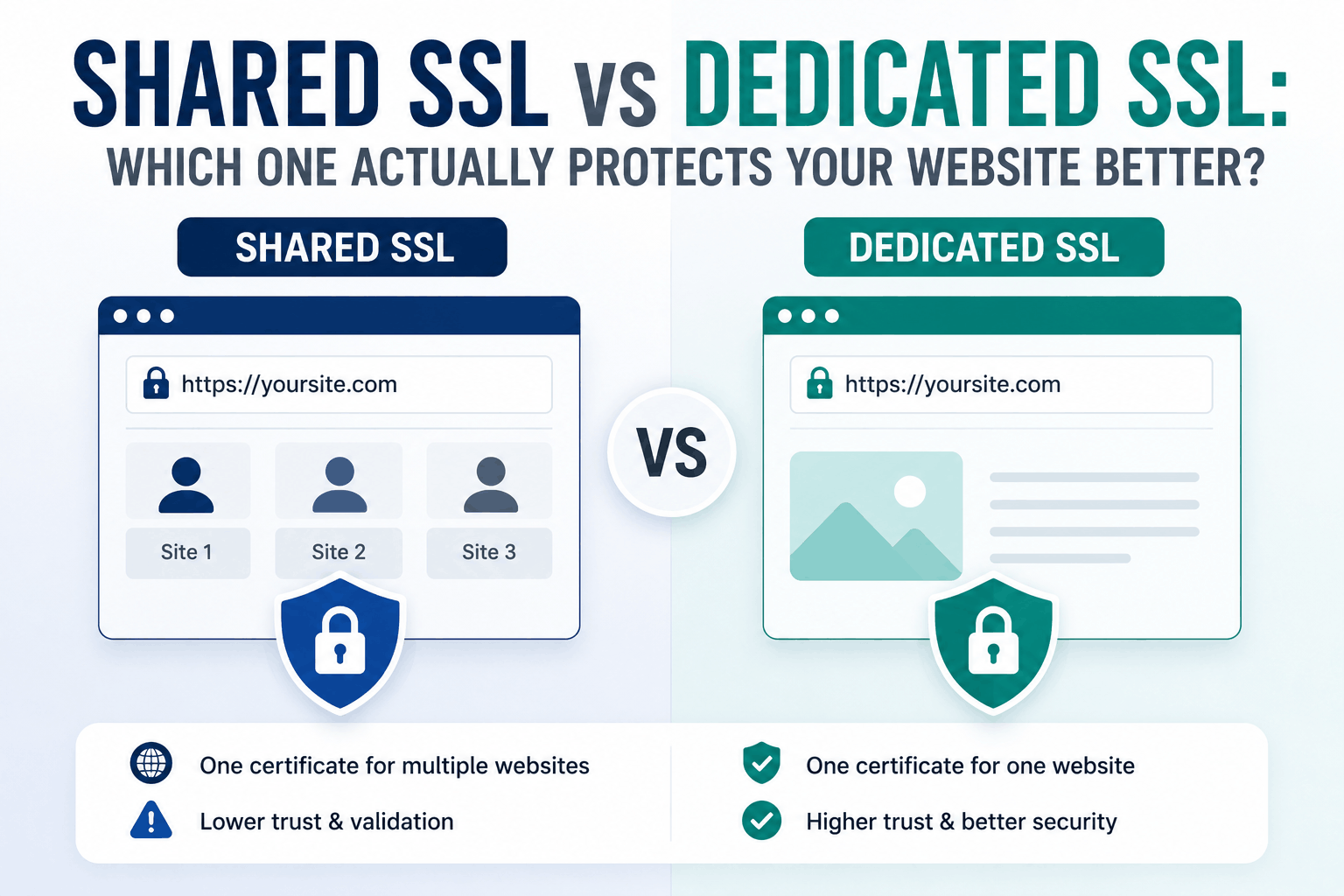
Most articles comparing shared and dedicated SSL certificates were written between 2015 and 2020, and they describe a hosting landscape that has substantially changed. Two developments have made the old shared-versus-dedicated decision largely irrelevant for new deployments: SNI technology, which allows multiple domains on the same IP address to each have their own dedicated certificate, and Let’s Encrypt, which made free trusted certificates available for every domain automatically through cPanel’s AutoSSL and equivalent systems on other hosting platforms.
In 2026, virtually every domain on a shared hosting account can have its own dedicated DV certificate at no cost, obtained and renewed automatically. The original reason to use a shared certificate for web hosting, which was that dedicated certificates were expensive and required a dedicated IP address, no longer applies in most contexts.
That said, the shared versus dedicated distinction has not disappeared. It has shifted to a different context: CDN platforms like Cloudflare, Fastly, and Akamai issue certificates that technically cover multiple customer domains on a single certificate. Understanding what this means, whether it matters, and when a dedicated certificate provides genuine advantages is the relevant question for site owners today.
The Historical Model: Why Shared Certificates Existed
Before SNI (Server Name Indication) was widely supported, TLS had a fundamental limitation: only one certificate could be active per IP address. When a client connected to a server on port 443, the server had to present a certificate before knowing which domain the client was requesting, because the HTTP Host header is inside the TLS connection. With a single certificate per IP address, only one domain could have HTTPS.
For shared hosting environments where dozens or hundreds of websites shared the same server and IP address, this created a problem. The solution was shared SSL: the hosting provider installed one certificate for their own hostname (secure.yourhostingcompany.com, or similar), and customers who needed HTTPS accessed their sites through that hostname. The URL in the browser changed from yourdomain.com to something like secure12.hostingprovider.com/~username. The connection was encrypted, but the address displayed in the browser was the hosting provider’s hostname, not the customer’s domain.
This was always a poor user experience and a trust problem: the URL changed to an unfamiliar hostname, and visitors saw the hosting provider’s name rather than the site owner’s name in the certificate. It was also technically the hosting provider’s certificate, not the domain owner’s.
The shared certificate model described above is essentially obsolete for web hosting. SNI allows multiple domains to have individual certificates on the same IP address, and modern browsers have supported SNI since Chrome 6 (2010), Firefox 2 (2007), and Safari 3 (2007). The only relevant legacy compatibility concern is older Android 2.x devices and Internet Explorer on Windows XP, both of which are statistically negligible in any modern analytics dataset.
How SNI Made Separate Certificates Feasible at Scale
Server Name Indication is a TLS extension that allows a client to include the hostname it is connecting to in the initial ClientHello message, before the TLS handshake is complete. The server reads this hostname and selects the appropriate certificate for that domain, even when multiple domains share the same IP address.
SNI is why every domain on a shared hosting account can have its own Let’s Encrypt certificate today. The server receives the connection, reads the SNI extension to identify the domain, and presents that domain’s specific certificate. Each domain has its own dedicated certificate with its own name in the Subject, its own expiry date, and its own private key. The hosting provider manages the issuance and renewal automatically through AutoSSL or equivalent systems.
The result: on any modern shared hosting account, the dedicated certificate is the standard and the free option. The historical shared certificate model has been replaced by automated individual certificate provisioning.
Modern Shared Certificates: CDN Multi-Domain SAN Certificates
The term shared SSL certificate is still used in one meaningful modern context: Content Delivery Networks. When a website uses Cloudflare’s free plan, Fastly’s shared SSL, or similar CDN services, the CDN issues a certificate that covers the customer’s domain but also covers many other customer domains in the same certificate’s Subject Alternative Names list. This is technically a shared certificate in the sense that one certificate covers thousands of domains.
Cloudflare’s free Universal SSL certificate, for example, has been observed covering hundreds of customer domains in a single SAN list. The certificate is issued to a Cloudflare subdomain (sni.cloudflaressl.com or similar) with all covered domains listed as SANs. Visitors see the domain name in the browser address bar, and the certificate does list the domain in the SAN entries. But the certificate is Cloudflare’s, not the site owner’s, and it includes thousands of other sites.
| Type | What it means in 2026 | Visitor sees | Domain owner controls | When it matters |
| Old shared SSL (hosting subdomain) | Largely obsolete. Still exists on some legacy cPanel installs that have not enabled AutoSSL. | Hosting provider’s URL instead of domain URL. Trust problem. | Nothing. CA and renewal are hosting provider’s responsibility. | Not recommended. Use AutoSSL instead. |
| CDN shared certificate (Cloudflare free Universal, Fastly shared) | Single certificate covers multiple customer domains via SAN list. Cloudflare/CDN manages issuance and renewal. | Your domain name in the address bar. Certificate details show CDN SAN certificate. | Nothing. CDN issues and renews. No ability to customize validity, CA, or certificate type. | Sufficient for most sites. Limitation when you need OV/EV validation, specific CA, or control over certificate lifecycle. |
| Dedicated certificate (own domain, own cert) | Certificate issued specifically for your domain. You or your hosting provider manages it. Can be free (Let’s Encrypt via AutoSSL) or purchased. | Your domain name. Certificate details show your domain, not a CDN or hosting provider. | Full control: certificate type, CA, validity period, renewal, installation. | Always better for regulated industries, e-commerce, OV/EV requirements, or when CDN control is unacceptable. |
What a Dedicated Certificate Provides That Shared Does Not
For most general websites, the difference between a CDN shared certificate and a dedicated certificate has no meaningful security or SEO impact. Both encrypt the connection with equal strength. Both display the domain name in the browser address bar. The encryption properties are identical.
The differences that matter in specific contexts:
Certificate contents and identity verification
A Cloudflare free Universal certificate is a DV certificate. It verifies domain control only. It does not contain the site owner’s organization name, physical address, or any verified identity information beyond the domain itself. A dedicated OV or EV certificate contains the verified legal entity name and organizational details.
For regulated industries, B2B contexts, and organizations where the certificate’s identity fields are inspected by partners, auditors, or compliance systems, a dedicated OV or EV certificate is required. A CDN shared DV certificate does not satisfy these needs.
Certificate lifecycle control
With a CDN shared certificate, the CDN manages issuance, renewal, and revocation. The site owner cannot choose when the certificate renews, which CA issues it, or the exact validity period. If the CDN has a certificate infrastructure problem, all sites on shared certificates are affected simultaneously.
With a dedicated certificate, the owner controls the certificate lifecycle. You choose the CA, the validity period (within limits), and when renewal happens. This control matters for organizations with certificate lifecycle management requirements, compliance audit timelines, or specific CA policies imposed by their industry.
Private key ownership
A CDN shared certificate’s private key is held by the CDN, not the site owner. The CDN terminates TLS at its edge using this key and then connects to the origin server separately. The site owner has no access to the private key and cannot use it for any other purpose.
A dedicated certificate’s private key belongs to the site owner. The site owner stores it, uses it to configure the web server, and is responsible for its security. This is both a benefit (control) and a responsibility (secure storage).
CDN traffic visibility
When the CDN holds the certificate and the private key, all TLS traffic is decrypted at the CDN edge before being forwarded to the origin. The CDN can read all HTTPS traffic in plaintext at its edge servers. This is inherent to how CDN caching and optimization work: the CDN must decrypt to cache, inspect, and route content.
For sites with strict data confidentiality requirements (healthcare data, legal privileged communications, financial data subject to specific regulations), the implication that CDN infrastructure has access to decrypted traffic in transit requires evaluation. A dedicated certificate on the origin server, combined with Cloudflare Full (Strict) mode or equivalent CDN-to-origin TLS, maintains encryption on the CDN-to-origin leg but does not prevent the CDN edge from decrypting inbound visitor traffic.
When a Dedicated Certificate Is the Right Choice
For a personal blog, a portfolio site, or a small informational website, the free CDN certificate or AutoSSL-provided Let’s Encrypt certificate is the appropriate choice. Dedicated certificates add no user-visible benefit and introduce certificate management overhead.
A dedicated certificate provides genuine value when:
- OV or EV validation is required: Regulated industries, B2B partners requiring verified organizational identity, PCI DSS compliance documentation, or audit requirements that specify certificate identity fields require OV or EV. CDN free certificates are DV only.
- Specific CA policies apply: Some enterprise security policies or regulated industry frameworks specify which CAs are acceptable. A CDN may not use the required CA. A dedicated certificate can be obtained from any CA on the approved list.
- Certificate lifecycle must be independently controlled: Organizations with compliance-driven certificate management programs, certificate monitoring requirements, or specific renewal windows need control over the certificate lifecycle that CDN-managed certificates do not provide.
- The CDN decryption model is unacceptable for data handling: Organizations whose data handling policies do not allow a third-party CDN to decrypt traffic at their edge need to evaluate whether CDN usage is compatible with their obligations, regardless of certificate type.
- E-commerce with high-value transactions: While DV certificates are technically sufficient for encryption, organizations handling high-value transactions may prefer OV or EV for the additional identity assurance they provide to customers and fraud detection systems.
- Internal enterprise applications: Applications used only by employees and not on the public internet typically use certificates from an internal private CA rather than either public shared or dedicated certificates.
Frequently Asked Questions
What is the difference between a shared and dedicated SSL certificate?
Historically, a shared SSL certificate was a hosting provider’s certificate used for multiple customer domains through a subdomain of the hosting provider’s own hostname. This model is largely obsolete because SNI technology and free Let’s Encrypt certificates allow every domain to have its own dedicated certificate at no cost. In the modern CDN context, a shared certificate refers to a certificate issued by a CDN (like Cloudflare’s free Universal SSL) that covers multiple customer domains in a single SAN list, managed entirely by the CDN. A dedicated certificate is issued specifically for your domain, giving you control over the certificate type, CA, validity, and private key.
Do I need a dedicated SSL certificate for my website?
For most websites in 2026, the free Let’s Encrypt certificate provided automatically by your hosting provider (via cPanel AutoSSL or equivalent) is a dedicated DV certificate for your domain and is fully appropriate. If you use a CDN like Cloudflare’s free plan, you are using a CDN-managed shared certificate, which is also sufficient for most sites. You need a dedicated certificate when: OV or EV validation is required by your industry or compliance framework, you need control over the certificate lifecycle and CA selection, or your data handling requirements make CDN-decrypted traffic unacceptable.
Is a shared SSL certificate less secure than a dedicated one?
In terms of encryption strength, no. The encryption algorithm and key length are identical between shared and dedicated certificates. The connection security (TLS version, cipher suite) depends on the server configuration, not the certificate type. The meaningful difference is identity assurance: a CDN shared certificate is a DV certificate verifying only domain control, while a dedicated OV or EV certificate contains verified organizational identity. For encryption-only purposes, both are equivalent. For identity assurance purposes, dedicated OV or EV provides more.
What is SNI and why did it make the old shared certificate model obsolete?
SNI (Server Name Indication) is a TLS extension that allows the client to send the hostname it is connecting to as part of the initial TLS handshake, before the server responds with a certificate. Before SNI, the server had to present a certificate before knowing which domain was being requested, so only one certificate (and therefore one domain) could be served per IP address. SNI allows the server to select the appropriate certificate based on the hostname in the ClientHello, enabling multiple domains with individual certificates to share the same IP address. This removed the technical reason for the shared-certificate-on-provider-hostname model and allowed every shared hosting account domain to have its own dedicated certificate.
Is Cloudflare’s free SSL a shared certificate?
Yes, in the technical sense. Cloudflare’s free Universal SSL certificate is a single certificate with multiple customer domains listed in the Subject Alternative Names, issued and managed by Cloudflare. Visitors see your domain name in the browser address bar, and your domain appears in the certificate’s SAN entries. However, the certificate is Cloudflare’s, the private key is held by Cloudflare, and the certificate is renewed by Cloudflare on their schedule. For most websites, this is perfectly adequate. Cloudflare also offers dedicated certificates (their Advanced Certificate Manager product) that issue a certificate covering only your domains if you prefer dedicated certificate control.
Do I still need a dedicated IP address for SSL?
No. SNI eliminates the need for a dedicated IP address for HTTPS. Multiple domains can share the same IP address and each can have its own certificate through SNI. Hosting providers occasionally still sell dedicated IP addresses as an add-on and suggest SSL as one of the reasons to buy one, but this has not been technically necessary for any supported browser since the mid-2010s. If a hosting provider is telling you that you need a dedicated IP address to use HTTPS or to install an SSL certificate, their server infrastructure is either very old or their sales materials are outdated.