The FBI’s Internet Crime Complaint Center reported $2.9 billion in Business Email Compromise losses in 2023 alone. These are not sophisticated technical attacks. They are email impersonation: an attacker sends an email that appears to come from a trusted executive, partner, or vendor, and convinces the recipient to transfer funds, share credentials, or disclose sensitive data. The email looks legitimate. The attacker has never compromised any server or intercepted any connection. They simply sent an email claiming to be someone they are not.
The reason this works at scale is structural. SMTP, the protocol that carries email between servers, has no native sender authentication mechanism. The From field in an email header is a text string that any sender can set to any value. When you receive an email from ceo@yourcompany.com, SMTP provides no guarantee that the message actually originated from anyone at your company. SPF, DKIM, and DMARC address this at the domain level: they authenticate that the message came from an authorized mail server for the claimed domain. They cannot authenticate that the specific individual whose name appears in the From field actually sent the message.
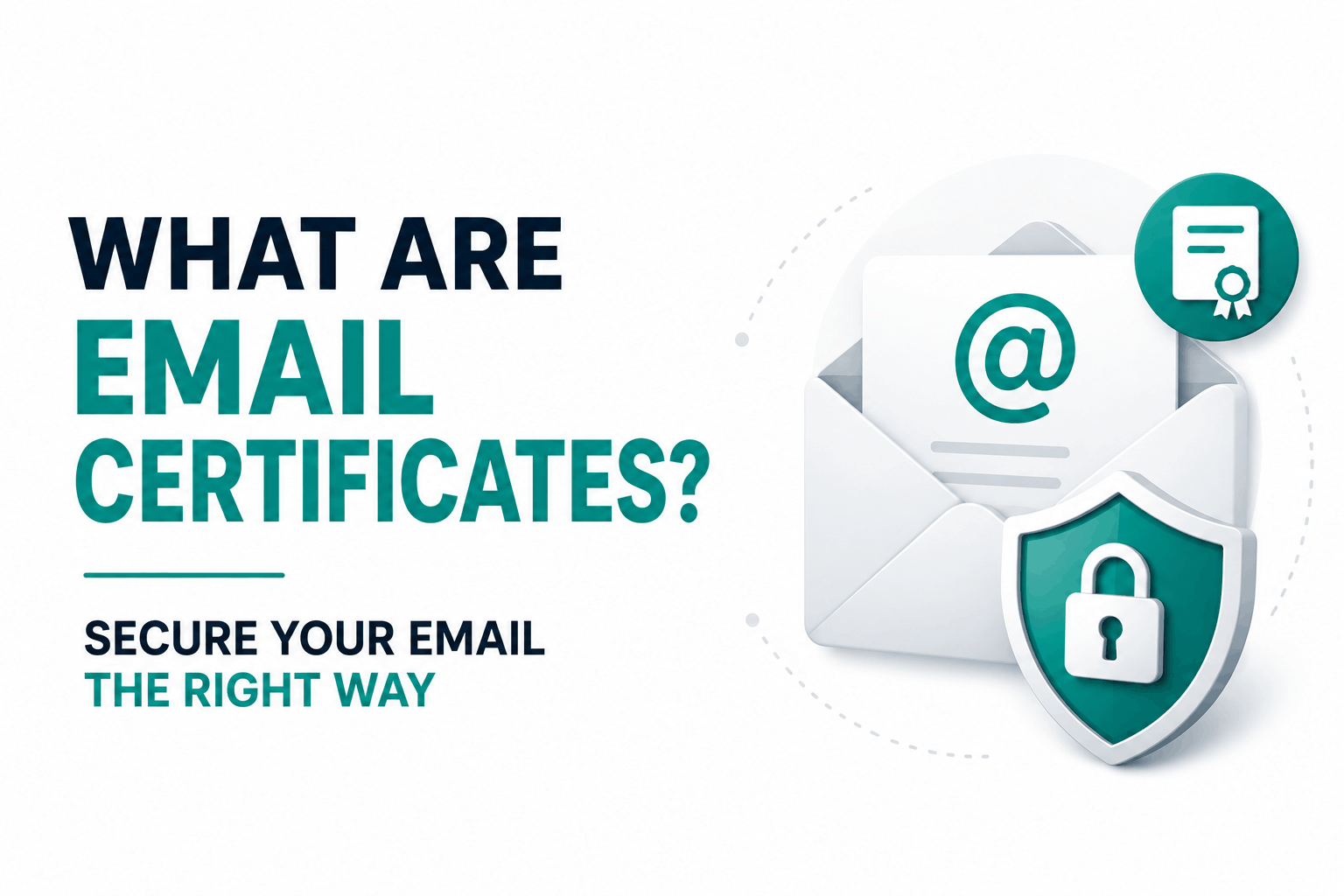
Email certificates address exactly this gap. An S/MIME digital signature on an email cryptographically proves that the message was sent by whoever holds the private key associated with the verified email address in the certificate. Forgery is not a configuration trick away. It requires breaking the underlying asymmetric cryptography, which is computationally infeasible. This article explains why that matters, how email certificates work, and what organizations need to consider for deployment.
The Email Threat Landscape: Why Default Email Is Insecure
Email security is a layered problem with several distinct threat categories. Understanding which layer is addressed by which control helps clarify what email certificates do and do not protect against.
Business Email Compromise
Business Email Compromise attacks impersonate trusted parties to authorize fraudulent financial transactions or data disclosures. The attacker typically researches an organization’s hierarchy and relationships, then sends email appearing to come from a CEO, CFO, trusted supplier, or legal counsel. The request is urgent, plausible, and asks the recipient to act without following normal verification procedures. FBI data shows BEC consistently generates the highest financial losses of any cybercrime category, far exceeding ransomware in total dollar impact.
S/MIME digital signatures directly address BEC when deployed across an organization’s executive and financial staff. A finance employee who receives a wire transfer request from the CFO can verify the S/MIME signature before acting. If the CFO’s emails are always signed, an unsigned email claiming to be from the CFO is immediately suspect. If the signature verification fails, the email is fraudulent regardless of how convincing the content appears.
Email impersonation and phishing
Phishing attacks use email impersonation to direct recipients to malicious websites, extract credentials, or deliver malware. The email appears to come from a bank, a cloud service provider, an internal IT department, or any other trusted entity. Standard spam filters and anti-phishing tools detect known malicious URLs and signature patterns but struggle with novel campaigns that have not yet been catalogued. S/MIME signatures provide a verifiable positive identification mechanism: if a sender is supposed to sign their emails and a message arrives unsigned, that is a meaningful signal regardless of whether the URL in the message has been seen before.
Email interception and content exposure
Email in transit travels through multiple servers. TLS between mail servers (STARTTLS) encrypts the connection between adjacent mail servers but each server decrypts the message as it relays it. A mail server operator, a compromised relay, or anyone who gains access to a mail server in the transmission path can read unencrypted message content. S/MIME email encryption addresses this: the message is encrypted at the sender’s client before transmission and decrypted only at the recipient’s client. No intermediate server, including the mail service provider itself, can read the content of an S/MIME-encrypted message.
The distinction between SMTP-level TLS and S/MIME encryption matters operationally. SMTP TLS (STARTTLS) is hop-by-hop: it protects the connection between mail servers but each server stores and processes the message in plaintext. S/MIME is end-to-end: the message is encrypted from the sender’s device to the recipient’s device. For organizations handling genuinely sensitive information (legal matters, healthcare data, financial terms, personnel matters) in email, SMTP TLS is insufficient. S/MIME encryption is the only mechanism that ensures no intermediate party can read the content.
Why SPF, DKIM, and DMARC Are Not Enough
Most organizations with mature email security programs have deployed SPF (Sender Policy Framework), DKIM (DomainKeys Identified Mail), and DMARC (Domain-based Message Authentication, Reporting and Conformance). These are valuable and important controls. They do not address the same problem as email certificates. Understanding the difference prevents a false sense of security.
| Control | What It Authenticates | What It Cannot Authenticate | Protects Against |
| SPF | That the sending mail server’s IP address is authorized to send email for the claimed domain | The identity of the individual sender. Any authorized mail server can send as any user on the domain. | Domain spoofing from unauthorized mail servers |
| DKIM | That the message was signed by a mail server holding the DKIM private key for the domain | The identity of the individual sender. DKIM is applied by the mail server, not by the individual user. | Message tampering in transit; domain spoofing |
| DMARC | That the From domain aligns with the SPF or DKIM authenticated domain | Individual sender identity. A malicious insider or compromised account passes DMARC automatically. | Domain impersonation from external, unauthorized sources |
| S/MIME digital signature | The specific individual sender: proves the message was signed by whoever holds the private key for the verified email address in the certificate | Nothing about the message content being true or safe to act on | Individual-level impersonation; message tampering; non-repudiation of sent messages |
The critical gap: an attacker who compromises an employee’s email account, or who registers a look-alike domain that passes SPF/DKIM/DMARC checks for that domain, still produces emails that pass all three domain-level controls. BEC attacks frequently use exactly this vector: either a compromised legitimate account or a convincing display-name impersonation that technically passes domain-level checks.
S/MIME adds individual-level verification on top of domain-level verification. Even a message from a compromised account, if the account holder uses S/MIME, will lack the correct S/MIME signature if the attacker does not also have the private key. The signature is the cryptographic proof that the specific individual sent the message, not just that a message came from an authorized server for the domain.
How Email Certificates Work
An email certificate is an X.509 digital certificate issued by a Certificate Authority that binds a verified email address to a public/private key pair. The certificate holder’s private key remains on their device. The public key is distributed in the certificate, which can be shared freely.
Two operations are enabled by the certificate: digital signing and encryption. Both are independent and both are valuable, but for different reasons.
Digital signing: proving you sent it and it was not changed
When an email is digitally signed, the sender’s email client computes a hash of the message content and signs that hash with the sender’s private key. The signature, along with the sender’s certificate, is attached to the outgoing message.
The recipient’s email client receives the message and automatically verifies the signature by extracting the sender’s public key from the attached certificate, decrypting the signature to recover the hash the sender computed, independently computing the hash of the received message, and comparing the two. A match confirms both that the message was signed by the holder of the private key matching the certificate, and that the message has not been altered since signing. If verification succeeds, the email client shows a trust indicator: a signature badge, a verified sender name, or similar, depending on the client.
Encryption: ensuring only the intended recipient can read it
Email encryption with S/MIME requires the sender to have the recipient’s public key before composing the message. When the message is encrypted, the sender’s client generates a random symmetric session key, encrypts the message content with AES using that session key, then encrypts the session key itself using the recipient’s public key. Both the encrypted message and the encrypted session key are transmitted to the recipient.
The recipient’s client uses their private key to decrypt the session key, then uses the session key to decrypt the message content. Only the recipient can perform the first decryption step because only the recipient holds the matching private key. No intermediate server, no mail service provider, and no attacker intercepting the message in transit can decrypt it without the recipient’s private key.
Obtaining the recipient’s public key is the practical friction point in S/MIME deployment. The most common mechanism in enterprise environments is LDAP or Active Directory, where certificates are published and automatically retrieved by email clients. For external recipients, public key exchange typically happens through prior signed email: a recipient’s certificate is attached to their signed messages and stored by the sender’s client for future encryption. Organizations that want to encrypt email to external parties typically need to establish a signed-email exchange first or use a gateway-based encryption solution.
Certificate Types: What Each Level of Validation Provides
The CA/B Forum S/MIME Baseline Requirements, published in September 2023 and enforced by all major CAs, define four certificate validation profiles. The appropriate type depends on how the certificate will be used and what identity assurance is required.
| Profile | CA Verifies | What Appears in Certificate | Best Use Case |
| Mailbox Validated (MV) | Control of the email address only (automated challenge) | Email address. No name, no organization. | Individual users who need signing capability with minimal friction and cost. Basic phishing resistance. |
| Organization Validated (OV) | Email address plus organization registration, address, and operational status | Organization name, country, and email address. | Corporate email where the organization name in the certificate adds trust value for recipients. |
| Sponsored (SV) | Email address plus individual’s name, sponsored by a verified organization | Individual name, email address, organization as sponsor. | Enterprise deployments where IT issues certificates on behalf of named employees with organizational backing. |
| Individual Validated (IV) | Email address plus government-verified individual identity | Individual’s verified legal name and email address. | Legal, financial, and compliance contexts where personal identity in the certificate is required for non-repudiation purposes. |
Why Email Certificates Matter by Sector
The importance of email certificates varies by sector based on the nature of communications handled, regulatory requirements, and the fraud risk profile of the organization.
Financial services and banking
Financial institutions handle high-value transaction instructions, wire transfer authorizations, account changes, and investment instructions over email. BEC attacks targeting financial instructions are among the highest-value attacks in the threat landscape. S/MIME signatures on authorized personnel’s email create a verifiable authentication signal that recipients, whether internal staff or external counterparties, can use to validate instructions before acting. Regulatory frameworks including the SEC’s Regulation S-ID and FFIEC guidance on authentication increasingly recognize cryptographic email authentication as a relevant control.
Healthcare
HIPAA’s Security Rule requires covered entities to implement technical security measures for electronic protected health information (ePHI) in transit, including encryption where appropriate. While HIPAA does not mandate a specific encryption technology, S/MIME email encryption is a recognized and auditor-accepted implementation of the addressable encryption requirement for email containing ePHI. Healthcare organizations that email clinical information, lab results, referrals, or other ePHI without end-to-end encryption face HIPAA Security Rule exposure. A data breach involving unencrypted ePHI in email triggers breach notification requirements and potential enforcement action.
Legal and professional services
Law firms, accountants, and consultants handle confidential client information under professional confidentiality obligations. Email is the dominant channel for client communication. Most professional confidentiality frameworks now recognize electronic communications as within scope: unencrypted email containing privileged or confidential information may not satisfy the standard of reasonable care for protecting that information. Several bar associations have issued formal guidance that attorneys should consider encryption for sensitive client communications. S/MIME email signatures also provide non-repudiation for advice given and instructions received, which has evidentiary value in disputes about what was communicated.
Government and defense contractors
Government email systems have long used S/MIME as a standard for signed and encrypted communications. The Common Access Card (CAC) used by US Department of Defense personnel contains S/MIME certificates. Defense contractors handling Controlled Unclassified Information (CUI) under CMMC requirements must implement appropriate protections for CUI in transit, including in email. S/MIME is the standard mechanism for email-based CUI protection in the defense industrial base.
Deploying Email Certificates: What Organizations Need to Plan
Deploying S/MIME across an organization requires planning in several areas that have nothing to do with the certificates themselves. The certificates are the easiest part.
Email client compatibility
Outlook on Windows and Mac, Apple Mail on macOS and iOS, and Thunderbird all support S/MIME natively. Gmail web interface does not support S/MIME for standard consumer accounts; Google Workspace Business and Enterprise editions support S/MIME when enabled by the administrator. Mobile email clients vary significantly in S/MIME support. Organizations deploying S/MIME should audit which email clients their users actually use and confirm S/MIME support before committing to a rollout that leaves users without support on their most-used device.
Certificate distribution at scale
Manually issuing and distributing certificates to hundreds or thousands of employees is not operationally feasible. Enterprise S/MIME deployments use one of three approaches: Microsoft Active Directory Certificate Services (AD CS) for organizations running Windows infrastructure, integration with a CA’s API for automated certificate issuance keyed to the HR or identity management system, or a certificate lifecycle management platform that handles issuance, distribution, and renewal across multiple CAs and systems. Publishing issued certificates to Active Directory or LDAP enables automatic public key retrieval for encrypted email within the organization.
Private key management and escrow
Each user’s private key must be accessible on the devices from which they send email. Organizations that use managed devices and enterprise MDM can push certificates to managed devices automatically. Bring-your-own-device environments are more complex: the private key must be on each personal device, which raises both logistics and security questions about private key storage on unmanaged hardware.
Key escrow policy for encryption keys is a business continuity requirement that must be defined before rolling out encryption. If a user’s private key is lost (device failure, employee departure without transferring the key), email encrypted to that user before the key was lost cannot be decrypted. Organizations with email archiving or legal discovery obligations must have key escrow in place before encrypting email at scale.
Phased rollout approach
Most organizations start S/MIME deployment with signing only, without encryption. Signing provides immediate value (BEC resistance, non-repudiation, trust signaling) without the operational complexity of key exchange required for encryption. Encryption is added once signing is established, public keys are exchanged within the organization, and processes for managing encryption keys are in place. A signing-first approach reduces the risk of encrypted email being unreadable due to key management failures during the initial deployment phase.
For organizations new to S/MIME deployment, start with the highest-risk roles: executives, finance staff, and anyone who regularly authorizes payments or handles sensitive data. Deploying S/MIME for the CFO, CEO, and accounts payable team immediately reduces BEC exposure for the highest-value targets without requiring organization-wide rollout first. Once those users are signing their email, counterparties and internal recipients can verify their messages, and the cultural groundwork for broader deployment is established.
Frequently Asked Questions
What is an email certificate and why is it important?
An email certificate is an X.509 digital certificate that enables S/MIME functionality: digital signing and encryption of email messages. It is important because standard email has no native sender authentication. The From field in an email can be set to any value by anyone. Email certificates provide cryptographic proof of sender identity: a signed email can only be produced by whoever holds the private key associated with the verified email address in the certificate. This directly addresses Business Email Compromise attacks, which rely on sender impersonation, and provides end-to-end encryption for sensitive email content that SMTP-level TLS alone does not provide.
How do email certificates prevent phishing and BEC?
Digital signatures on email provide a positive authentication signal that recipients can verify. An attacker who does not have the legitimate sender’s private key cannot produce a valid S/MIME signature for that sender’s email address. In an organization where executives and finance staff sign all their email, an unsigned email or a failed signature verification on a message claiming to be from those individuals is an immediate red flag regardless of how convincing the email content appears. This forces BEC attackers to either compromise the private key itself (which is significantly harder than sending a spoofed email) or to impersonate individuals who are not yet using S/MIME.
Is email encryption different from HTTPS?
Yes. HTTPS (TLS) encrypts the connection between your browser and a web server: data in motion between two endpoints over a specific connection. S/MIME email encryption encrypts the message content itself, end-to-end from the sender’s email client to the recipient’s email client. The message stays encrypted while it sits on mail servers, during relay between servers, and at rest in the recipient’s mailbox until they decrypt it. SMTP TLS encrypts the connection between mail servers but each server decrypts the message as it processes it. S/MIME is the only mechanism that prevents mail servers (including your email provider) from reading the content of your messages.
What is the difference between S/MIME and DMARC?
DMARC (Domain-based Message Authentication, Reporting and Conformance) authenticates at the domain level: it verifies that a message came from an authorized mail server for the claimed sending domain. It prevents domain spoofing from external sources but cannot distinguish between different users within the same domain, cannot detect compromised legitimate accounts, and cannot authenticate look-alike domains that have their own valid DMARC records. S/MIME authenticates at the individual user level: it proves the specific person whose email address appears in the certificate signed the message. Both controls are valuable and complement each other. DMARC is domain-level authentication; S/MIME is individual-level authentication. Organizations that want comprehensive email security need both.
Does deploying S/MIME require changing email service providers?
No. S/MIME operates at the email client level and is independent of the email service provider. Microsoft 365, Google Workspace, on-premises Exchange, and any other email system can carry S/MIME signed and encrypted messages because the S/MIME content is embedded in the message itself as a MIME attachment. The email service provider does not need to support or be aware of S/MIME for it to work. The requirements are: a compatible email client on the sender’s device (Outlook, Apple Mail, Thunderbird), an S/MIME certificate issued by a trusted CA, and for encryption, a mechanism for exchanging recipients’ public keys. Google Workspace requires administrator enablement for S/MIME but does not require switching platforms.