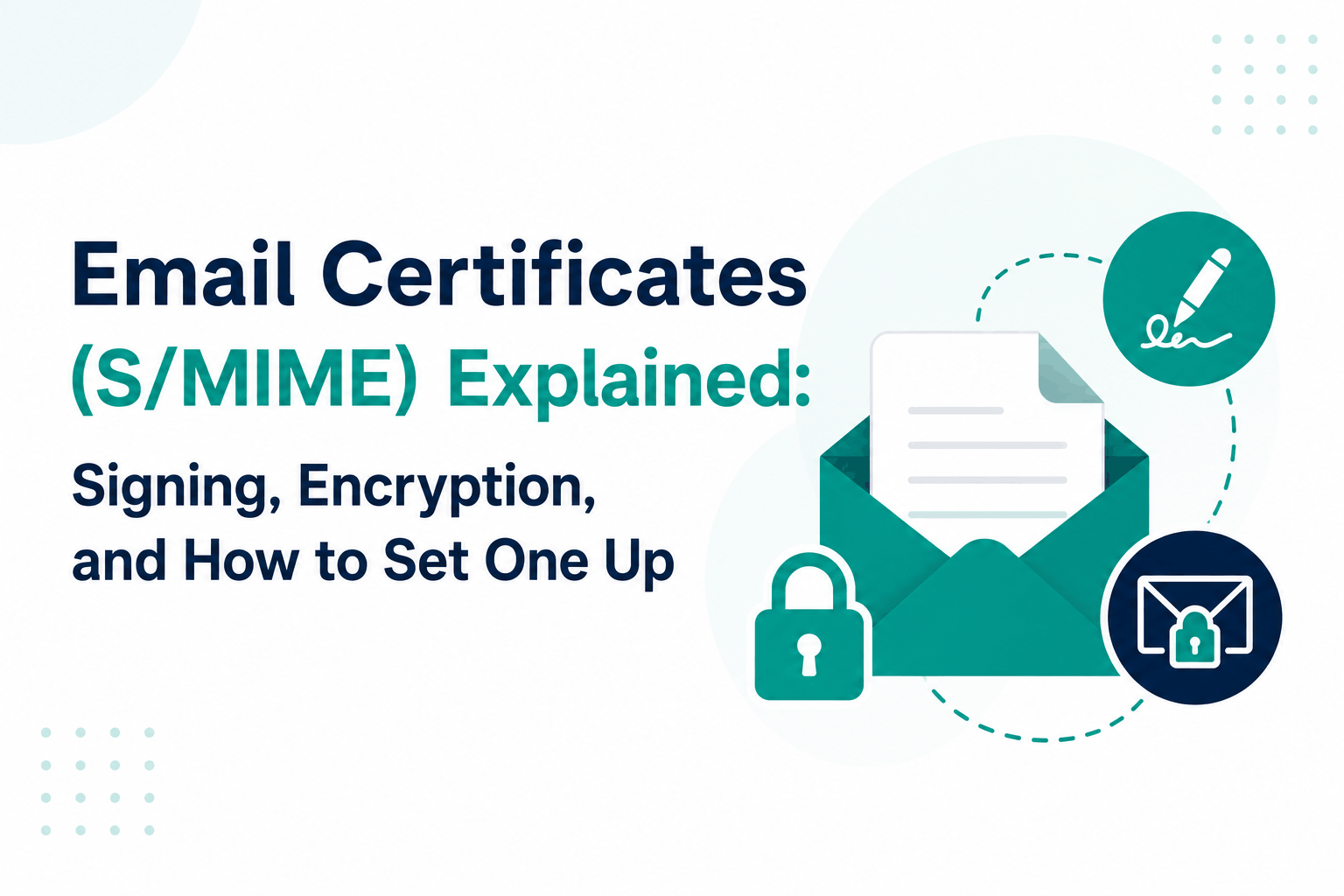
An email certificate, more precisely called an S/MIME certificate (Secure/Multipurpose Internet Mail Extensions), is a digital certificate that does two separate things for an email: it can prove the message genuinely came from the claimed sender and was not altered in transit, and it can encrypt the message content so only the intended recipient can read it. These are two independent functions, not one combined feature, and understanding the difference matters for using S/MIME correctly.
Two Separate Functions: Signing and Encryption
S/MIME certificates can be used for either or both of the following, and a single email can be signed only, encrypted only, or both at once:
Digital signing: proves authenticity and integrity, without hiding content
A digitally signed email is cryptographically tied to the sender’s certificate. The recipient’s email client checks the signature and confirms two things: the message genuinely came from the certificate holder, and the content was not altered after it was signed. A signed email is not automatically encrypted; anyone who intercepts it can still read the plain content. What signing adds is verified authenticity, not secrecy.
Encryption: hides the content, requires the recipient’s public certificate in advance
Encrypting an email scrambles its content so that only someone holding the matching private key, normally just the intended recipient, can read it. This is the function most people actually mean when they think of email security. There is an important practical requirement the encryption function depends on that is easy to miss: to encrypt a message to someone, your email client needs that recipient’s public certificate first. You cannot send an encrypted email to someone whose public certificate you do not already have. In practice, this is usually solved automatically: once someone sends you a single digitally signed email, most email clients extract and store their public certificate for future use, after which you can send encrypted replies to them.
This dependency is the most common practical obstacle to actually using S/MIME encryption day to day: you generally need to receive at least one signed email from someone before you can send them an encrypted one. This is why many organizations start by enabling signing for all outgoing mail as a baseline, since signing alone has no such prerequisite, and encryption then becomes available naturally as certificates are exchanged through normal correspondence.
How S/MIME Actually Works: The PKI Basics
S/MIME runs on the same Public Key Infrastructure (PKI) principles used for website SSL/TLS certificates, applied to individual email addresses instead of domains. Each user has a key pair: a private key that stays only on their own device, and a public key embedded in a certificate that the Certificate Authority has signed after verifying the user controls the associated email address.
The verification step for personal S/MIME certificates is typically email-based validation: the CA confirms control of the email address (similar in concept to Domain Validation for website certificates, but verifying an email mailbox rather than a domain), then issues a certificate binding that public key to that specific email address. Higher-assurance organizational S/MIME certificates can additionally verify the requesting individual’s identity or their employer’s organizational identity, similar to OV and EV verification for website certificates.
How S/MIME Differs From SSL/TLS on a Mail Server
It is common to assume that having HTTPS on a webmail site, or TLS configured on a mail server, makes S/MIME unnecessary. This is not quite right, and the distinction is specific.
- TLS protects the connection, hop by hop: when your email client connects to your mail server, and when mail servers relay a message to each other, TLS (where supported and properly configured) encrypts that specific connection. Most major email providers today do support TLS for these connections (often called opportunistic TLS), which is a meaningful improvement over the situation years ago when this was far less consistent. But TLS protects each hop individually. If a message passes through several servers on its way to the recipient, and any one of those hops does not support TLS, or the message sits at rest on an intermediate server, the content is only as protected as that specific link or storage point allows.
- S/MIME protects the message itself, end to end: encryption applied via S/MIME travels with the message content regardless of how many servers it passes through or how it is stored along the way. A message encrypted with S/MIME remains unreadable to anyone without the recipient’s private key, whether it is in transit, sitting in an intermediate server’s storage, or sitting in the recipient’s own inbox.
- S/MIME also provides something TLS-only transport never does: sender verification: TLS confirms you are talking to the genuine mail server; it says nothing about whether the email account itself was used by the person it claims to be from. S/MIME’s digital signature specifically verifies the message’s claimed sender and that the content has not been altered, a property called non-repudiation in cryptography, which TLS alone cannot provide.
The accurate framing for 2026: TLS and S/MIME solve different, complementary problems. TLS being more widely deployed today than it once was reduces, but does not eliminate, the gap S/MIME fills. Anyone with a genuine need for end-to-end message confidentiality, verified sender authenticity, or protection that does not depend on every server along the message’s path being correctly configured, has a real reason to use S/MIME regardless of how good transport-level TLS adoption has become.
How to Get and Set Up an S/MIME Certificate
- Choose a Certificate Authority that issues personal S/MIME certificates. Major providers include Sectigo, DigiCert, and SSL.com; some providers offer free, basic email-validated certificates as an entry option, with paid tiers offering longer validity or organizational identity verification.
- Submit a request proving control of the email address you want the certificate for. This typically involves the CA sending a verification email to that address, which you respond to or click a link within.
- Receive and install the certificate. Most CAs deliver the certificate as a downloadable file (often a .p12 or .pfx file containing both the certificate and its matching private key) that you import directly into your email client or device certificate store.
- Configure your email client to sign outgoing messages. In Outlook, Apple Mail, and Thunderbird, this is typically a setting under the account’s security or certificate options, where you select the installed certificate and choose to sign messages by default.
- Encryption becomes available to specific recipients once you have their public certificate. This usually happens automatically the first time they send you a signed email; your client stores their public certificate for future encrypted replies.
Email clients with native S/MIME support include Microsoft Outlook (desktop), Apple Mail on macOS and iOS, and Mozilla Thunderbird. Native, full-featured S/MIME support in browser-based webmail interfaces (the web version of Gmail or Outlook.com, for example) has historically been limited or absent compared to desktop and mobile native mail applications, which is worth checking specifically if your primary email use is through a web browser rather than a dedicated mail client.
What Happens If You Lose Your Private Key
The private key is what makes decryption possible, and it is generated and meant to stay only on your own device or in your own secure key store. If it is lost (a device failure with no backup, for example), the practical consequences split into two different categories worth understanding separately.
- Future signing and encryption capability: easily restored. Request a new certificate from the same or a different CA, install it, and you can resume signing and being sent newly encrypted mail going forward.
- Previously received encrypted messages: this is the genuinely serious consequence. Any message that was encrypted specifically to your old public certificate can only be decrypted using the matching old private key. If that key is gone with no backup, those specific previously received encrypted messages become permanently unreadable. This is precisely why securely backing up your private key (most CAs and clients provide a password-protected export file for this purpose) is worth doing deliberately rather than treating it as optional.
Back up your private key file in a secure location (a password manager that supports file attachments, an encrypted backup drive) at the time you first install your S/MIME certificate, not after you discover you need it. Losing access to your own historical encrypted correspondence is a real and permanent consequence, not a hypothetical inconvenience.
Other Practical Limitations to Know About
- Recipient client compatibility: if your recipient’s email client does not support S/MIME, they may see a confusing attachment (typically named smime.p7s) instead of a cleanly rendered signed message, even though the underlying email content is still readable. This is a compatibility issue rather than a security failure, but it can be confusing for recipients unfamiliar with S/MIME.
- Certificate management overhead: S/MIME requires you to obtain, install, and eventually renew a certificate per email address, and requires your correspondents to do the same if you want mutual signing and encryption. This is more setup than most casual personal email use cases require, which is part of why S/MIME adoption has remained concentrated in organizational and professional contexts (legal, healthcare, government, financial services) where verified sender identity and message confidentiality carry specific compliance or liability value, rather than becoming a universal consumer default.
- It does not replace endpoint security: S/MIME protects the message in transit and at rest from interception. It does nothing to protect against malware delivered as an attachment, phishing attempts that do not rely on message tampering, or a compromised device where messages are read after legitimate decryption. S/MIME is one layer of a broader email security posture, not a complete solution on its own.
Frequently Asked Questions
Is an S/MIME certificate the same thing as the SSL certificate on my website?
No, though both are built on the same underlying PKI technology and both are issued by Certificate Authorities. A website’s SSL/TLS certificate verifies a domain and secures the connection between a browser and a server. An S/MIME certificate verifies an individual email address and secures, or signs, individual messages sent from that address. They serve different purposes and are issued, installed, and managed separately, even when purchased from the same Certificate Authority.
Do I need a paid S/MIME certificate, or are free options adequate?
For personal use focused primarily on signing outgoing mail and basic encrypted correspondence, a free, email-validated certificate from an authorized provider is generally adequate, since the cryptographic strength of the certificate itself does not differ from a paid tier. Paid certificates typically add longer validity periods (reducing how often you need to renew) or higher-assurance identity verification (organizational or individual identity confirmation beyond just email control), which matters more in professional or compliance-driven contexts where the recipient or a regulator may want assurance beyond simple email address verification.
Can I use S/MIME and PGP at the same time?
They are separate, generally incompatible standards for achieving similar goals (email signing and encryption), each with its own certificate or key format and trust model. S/MIME relies on Certificate Authorities issuing certificates within a PKI hierarchy, the same trust model used for website SSL/TLS. PGP (Pretty Good Privacy) and its open standard OpenPGP rely on a decentralized web of trust rather than centralized CAs. Most email clients that support one do not natively support the other within the same message, so the practical choice typically depends on what your correspondents and organization have already standardized on, rather than technical superiority of one over the other for most everyday use cases.