Comodo SSL is one of the most widely recognized names in website security, primarily because of its long history in the SSL/TLS certificate industry and its aggressive pricing strategy. Although the Comodo brand is now technically operated under Sectigo, the certificates, infrastructure, and browser trust remain unchanged. This is why users still search for Comodo SSL certificate reviews when evaluating cost-effective SSL options.
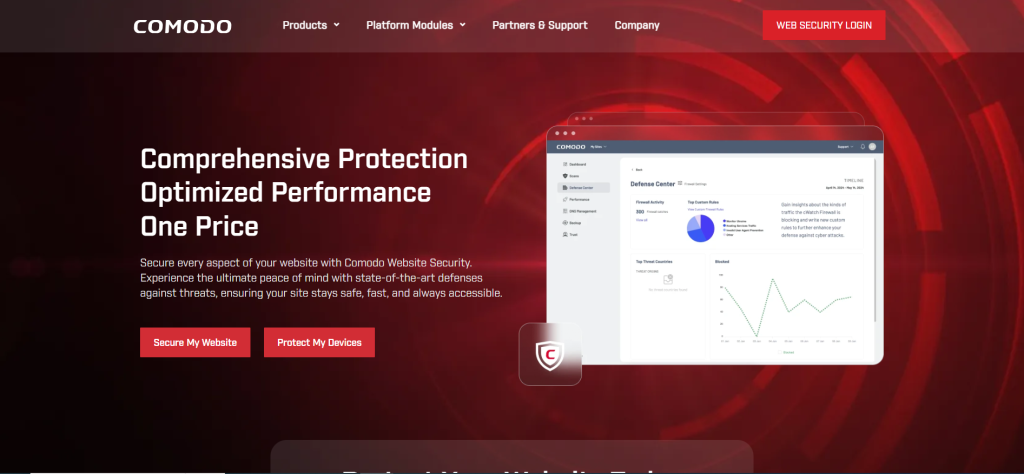
For many website owners, Comodo SSL represents an entry point into HTTPS encryption without paying premium certificate authority prices. It’s commonly used by small businesses, bloggers, eCommerce store owners, and digital agencies that manage multiple websites for clients.
However, Comodo SSL is not a fully managed or beginner-focused solution. Unlike hosting providers that automatically issue and install SSL certificates, Comodo requires users to go through a manual purchase, validation, and installation process. This additional control can be an advantage for experienced users—but a challenge for beginners.
Comodo SSL review is a buyer-focused analysis that explains how secure, usable, and cost-effective Comodo SSL certificates are—based on real-world use, comparisons, and user feedback.
One important thing to understand upfront is that Comodo SSL certificates do not differ in encryption strength from higher-priced competitors. All certificates use the same industry-standard encryption. The real differences come down to validation level, trust indicators, ease of use, and support experience.
Comodo SSL Key Facts at a Glance
| Feature | Details |
| Certificate Authority | Sectigo (formerly Comodo CA) |
| Encryption Strength | 256-bit |
| Hash Algorithm | SHA-256 |
| Certificate Types | DV, OV, EV, Wildcard, Multi-Domain |
| Browser Trust | 99.9% |
| Server Licensing | Unlimited |
| Best For | SMBs, agencies, budget-focused sites |
How Easy Is It to Set Up a Comodo SSL Certificate?
Ease of setup is one of the most important factors for website owners choosing an SSL provider, especially those researching how to install a Comodo SSL certificate for the first time.
The Comodo SSL setup process starts with generating a Certificate Signing Request (CSR) from your hosting control panel or server. This CSR contains encrypted information about your domain and organization, which Comodo (Sectigo) uses to issue the certificate.
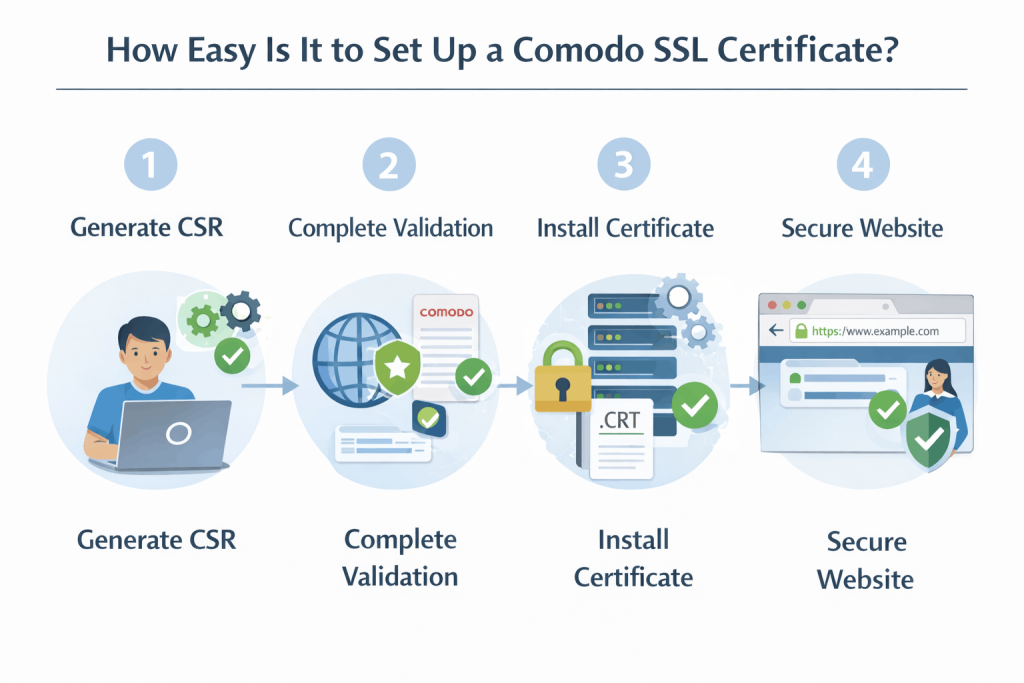
Once the CSR is submitted, the validation process begins. The complexity of this step depends entirely on the type of SSL certificate you choose.
For Domain Validation (DV) SSL, the process is relatively simple. You’ll need to confirm domain ownership using one of several methods, such as email verification, DNS record validation, or file-based authentication. In most cases, DV certificates are issued within minutes.
For Organization Validation (OV) and Extended Validation (EV) certificates, the process becomes more involved. Sectigo verifies business registration records, phone numbers, and legal documentation. This extra validation increases trust but also extends the issuance timeline.
Installation is the final step and requires uploading the certificate files to your server or hosting control panel. While most hosting providers offer documentation or support for this step, Comodo SSL does not install the certificate for you.
Setup Process Breakdown
| Setup Step | What’s Involved | Difficulty |
| CSR Generation | Server or hosting panel | Medium |
| Domain Validation | Email, DNS, or file | Easy |
| OV/EV Verification | Business checks | Moderate |
| Certificate Installation | Manual upload | Medium |
| Reissue & Renewal | Self-managed | Easy |
Overall, Comodo SSL offers flexibility and control, but it expects users to take responsibility for managing their certificates.
Types of Comodo SSL Certificates Explained (DV, OV, EV, Wildcard, Multi-Domain)
One of the main reasons Comodo SSL remains popular is the sheer range of certificate options it offers. Instead of a one-size-fits-all approach, Comodo SSL allows website owners to choose certificates based on how much trust, visibility, and validation their site actually needs.
It’s important to understand that all Comodo SSL certificates use the same level of encryption. The difference between them lies in who gets verified and what trust signals users see in the browser.
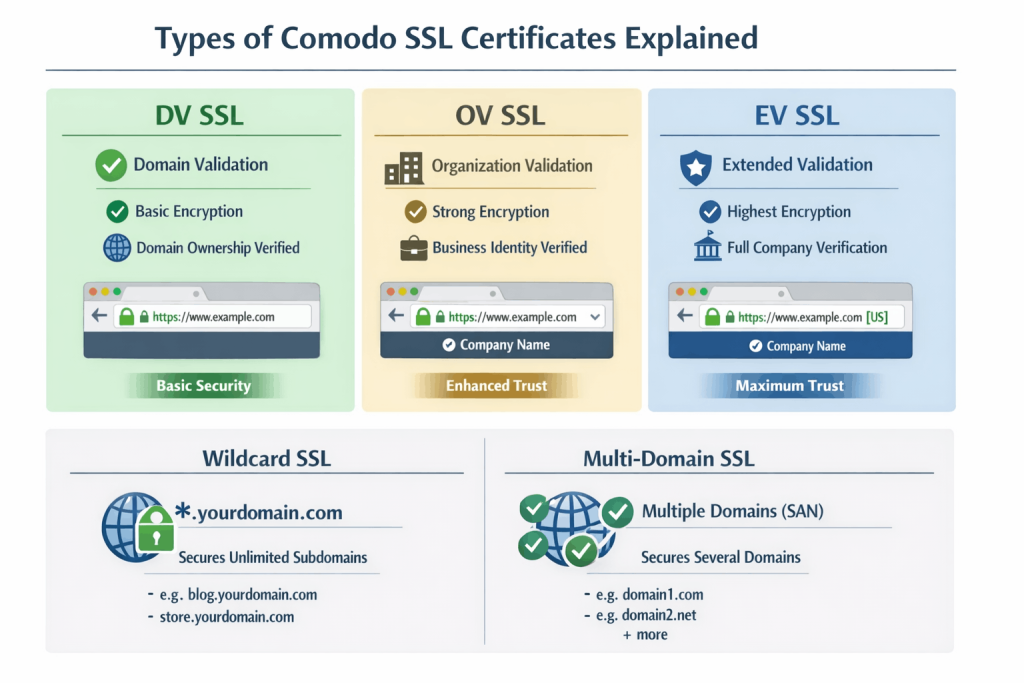
Below is a breakdown of each certificate type, explained in practical terms rather than technical jargon.
Domain Validation (DV) SSL Certificates
Domain Validation certificates are the most basic option offered by Comodo and are commonly chosen by users looking for the cheapest Comodo SSL certificate for blogs and informational websites.
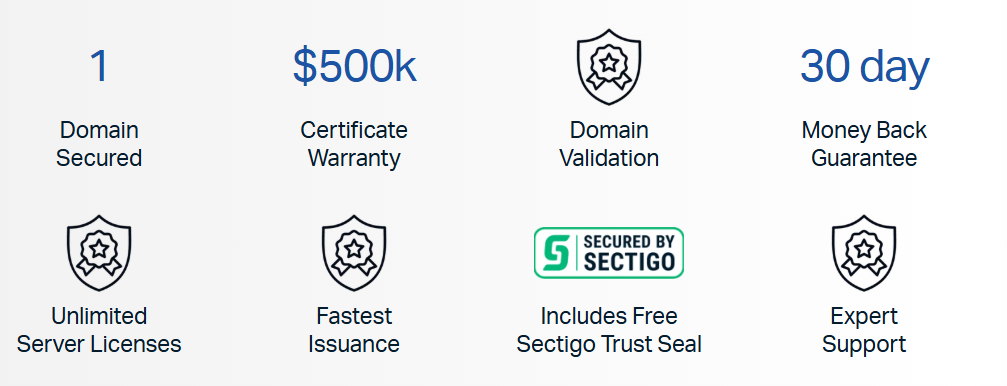
Comodo DV SSL verifies only domain ownership, which means it protects data in transit but does not confirm the identity of the website owner.
There is no business verification, paperwork, or phone call involved. Once you confirm domain ownership, the certificate is issued.
DV SSL is ideal for:
- Blogs and personal websites
- Informational websites
- Test or staging environments
- Small sites that don’t collect sensitive user data
However, DV certificates do not display company information in the certificate details, which means visitors won’t see any identity verification beyond the padlock icon.
Key limitations:
DV SSL protects data in transit, but it does not prove who owns the website.
DV SSL Certificate Summary
| Feature | DV SSL |
| Validation Type | Domain only |
| Issuance Time | Minutes |
| Trust Indicators | Padlock + HTTPS |
| Business Verification | ❌ No |
| Best For | Blogs, personal sites |
Organization Validation (OV) SSL Certificates
Organization Validation certificates are designed for businesses that want to establish credibility beyond basic encryption. Many buyers compare Comodo OV SSL options when securing company websites and lead-generation pages.
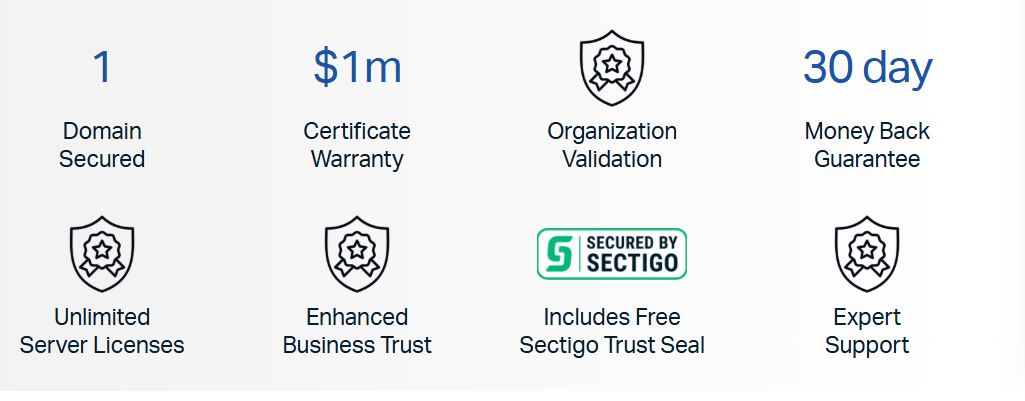
OV certificates verify both domain ownership and business legitimacy, making them suitable for users asking whether Comodo SSL is appropriate for professional use.
This includes checks such as:
- Legal business registration
- Physical address
- Verified phone number
OV SSL certificates are commonly used by:
- Company websites
- SaaS platforms
- Lead generation sites
- B2B services
When users inspect the certificate details, they can see verified company information, which adds a layer of credibility not present in DV certificates.
OV SSL Certificate Summary
| Feature | OV SSL |
| Validation Type | Domain + business |
| Issuance Time | 1–3 business days |
| Trust Indicators | Padlock + verified org |
| Business Verification | ✅ Yes |
| Best For | Business websites |
Extended Validation (EV) SSL Certificates
Extended Validation certificates provide the highest level of identity verification available for SSL certificates. These certificates involve a thorough vetting process, including legal, operational, and physical business verification.
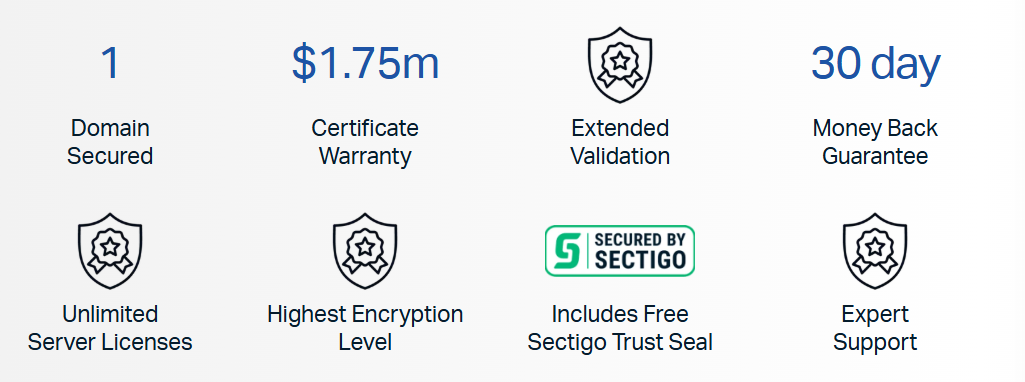
EV SSL certificates are designed for websites where trust directly impacts conversions, such as:
- eCommerce stores
- Financial institutions
- Payment platforms
- High-traffic brand websites
While modern browsers no longer show the green address bar prominently, EV certificates still provide maximum backend trust and are often required for compliance or corporate security policies.
EV SSL Certificate Summary
| Feature | EV SSL |
| Validation Type | Extended business verification |
| Issuance Time | 3–7 business days |
| Trust Indicators | Highest assurance |
| Warranty | Highest |
| Best For | eCommerce & finance |
Wildcard and Multi-Domain Comodo SSL Certificates
Beyond validation levels, Comodo SSL also offers certificates designed for scale and flexibility. These certificates are especially popular with agencies and businesses managing multiple domains or subdomains.
Wildcard SSL Certificates
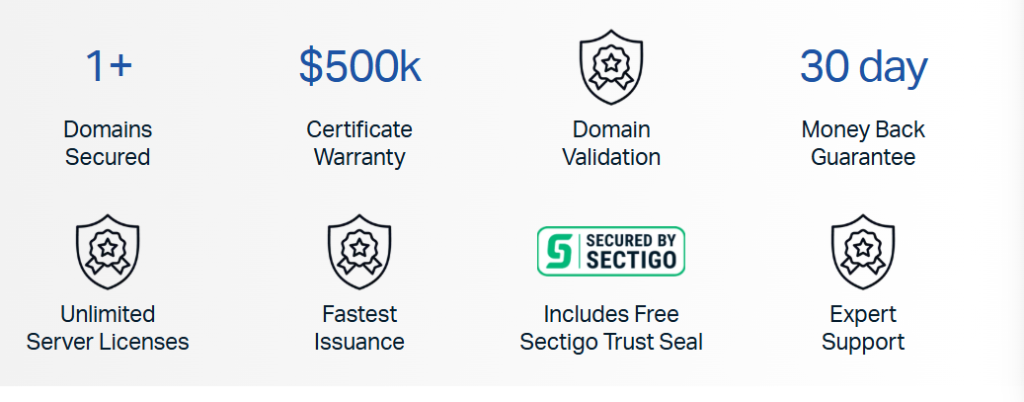
Comodo Wildcard SSL certificates allow website owners to secure unlimited subdomains under a single certificate, making them ideal for growing platforms and SaaS environments. This option is often more cost-effective than purchasing multiple single-domain certificates as a website expands.
For example:
- com
- example.com
- example.com
- example.com
All are covered under one Wildcard SSL certificate.
Wildcard SSL is ideal for:
- Growing websites
- SaaS platforms
- Agencies managing subdomains
- Websites planning future expansion
The main advantage is cost-efficiency—you don’t need to buy a new certificate every time you add a subdomain.
Wildcard SSL Summary
| Feature | Wildcard SSL |
| Subdomain Coverage | Unlimited |
| Management | Single certificate |
| Cost Efficiency | High |
| Best For | Expanding sites |
Multi-Domain (SAN) SSL Certificates
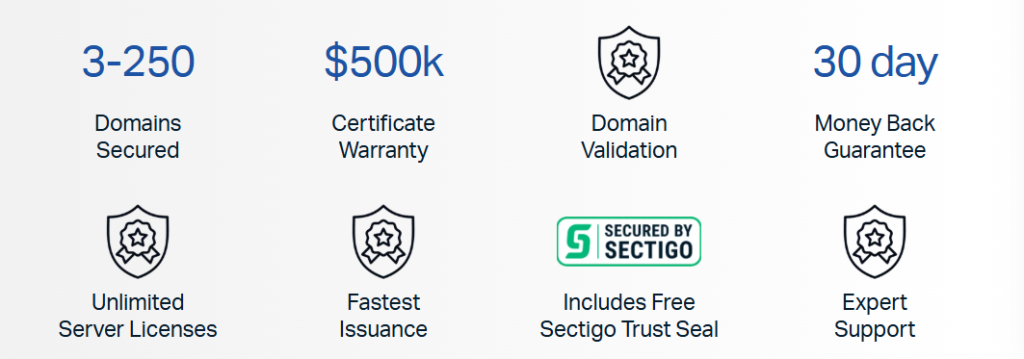
Comodo multi-domain SSL certificates are designed for businesses and agencies managing multiple domains under one centralized certificate. This flexibility makes them especially useful for organizations with multiple brands or client websites.
Example:
- com
- net
- org
This is particularly useful for:
- Agencies managing multiple client domains
- Businesses with multiple brands
- Enterprises consolidating SSL management
You can usually add or remove domains as needed, making Multi-Domain SSL extremely flexible.
Multi-Domain SSL Summary
| Feature | Multi-Domain SSL |
| Domain Coverage | Multiple domains |
| Scalability | High |
| Certificate Management | Centralized |
| Best For | Agencies & enterprises |
Comodo SSL Certificates Comparison Table
| Feature | DV SSL | OV SSL | EV SSL | Wildcard SSL | Multi-Domain SSL |
|---|---|---|---|---|---|
| HTTPS & Padlock | ✔ | ✔ | ✔ | ✔ | ✔ |
| 256-bit Encryption | ✔ | ✔ | ✔ | ✔ | ✔ |
| SHA-256 Hashing | ✔ | ✔ | ✔ | ✔ | ✔ |
| Browser Trust | ✔ | ✔ | ✔ | ✔ | ✔ |
| Business Verification | ✖ | ✔ | ✔✔ | Optional | Optional |
| Extended Validation | ✖ | ✖ | ✔ | ✖ | ✖ |
| Company Name in Certificate | ✖ | ✔ | ✔ | Depends | Depends |
| Subdomain Support | ✖ | ✖ | ✖ | ✔ Unlimited | ✖ |
| Multiple Domains (SAN) | ✖ | ✖ | ✖ | ✖ | ✔ |
| Unlimited Server License | ✔ | ✔ | ✔ | ✔ | ✔ |
| Issuance Speed | Minutes | 1–3 Days | 3–7 Days | Minutes–Days | Minutes–Days |
| Best Use Case | Blogs | Business Sites | eCommerce | SaaS / Subdomains | Agencies |
Choosing the Right Comodo SSL Certificate
Choosing the right Comodo SSL certificate depends less on encryption and more on how much trust your website needs to communicate.
- If you’re running a blog or informational site → DV SSL
- If you represent a legitimate business → OV SSL
- If trust impacts revenue → EV SSL
- If you manage multiple subdomains → Wildcard SSL
- If you manage multiple domains → Multi-Domain SSL
This flexibility is where Comodo SSL truly excels.
How Much Does Comodo SSL Really Cost?
Pricing is one of the main reasons users compare Comodo SSL pricing with higher-cost certificate authorities. While the encryption strength is identical across most trusted SSL providers, the price gap between Comodo SSL and enterprise brands can be substantial. While official retail prices appear high, most buyers pay significantly less through authorized resellers, which directly affects the Comodo SSL certificate cost.
That said, understanding Comodo SSL pricing isn’t always straightforward. Official retail prices listed on certificate authority websites are often significantly higher than what users actually pay through authorized resellers. This pricing structure can confuse first-time buyers, especially those unfamiliar with the SSL ecosystem.
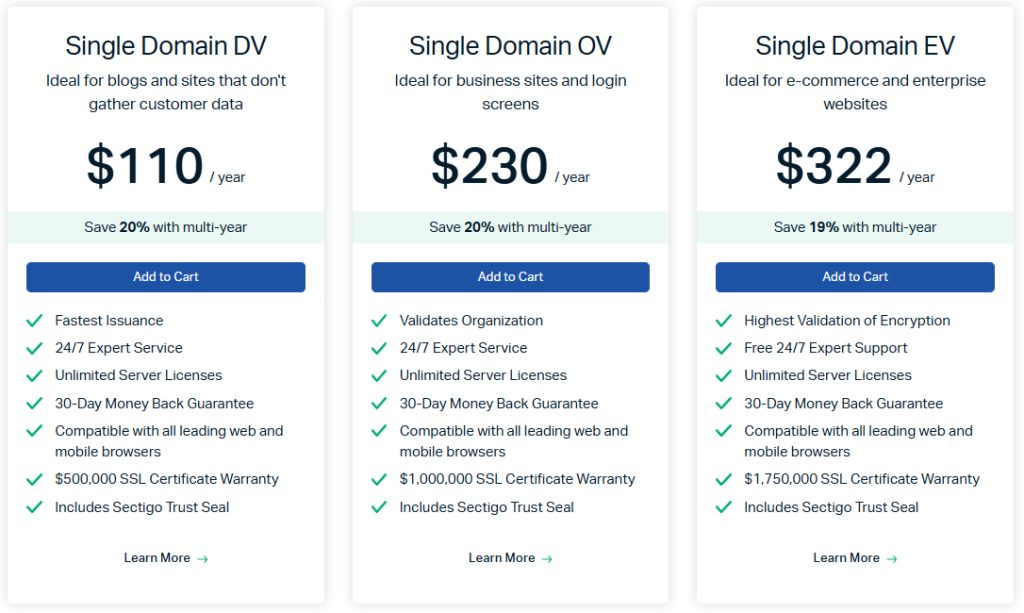
Comodo SSL certificates are priced based on:
- Certificate type (DV, OV, EV)
- Coverage (single domain, wildcard, multi-domain)
- Validation level
- Subscription length (1–5 years)
In practice, most users do not purchase directly from the certificate authority. Instead, they buy through resellers that offer discounted rates for the same certificates.
Typical Comodo SSL Pricing by Certificate Type
| Certificate Type | Retail Price Range | Discounted Market Price |
| DV SSL | High (retail) | Very Low |
| OV SSL | Medium–High | Medium |
| EV SSL | High | Medium |
| Wildcard SSL | Very High | High value |
| Multi-Domain SSL | Very High | Cost-efficient |
Note: Pricing varies depending on vendor and subscription term.
Is Comodo SSL Worth the Price Compared to Other CAs?
To determine whether Comodo SSL is worth the cost, it’s important to compare what you’re actually paying for, not just the certificate itself, but the overall trust, flexibility, and lifecycle management.
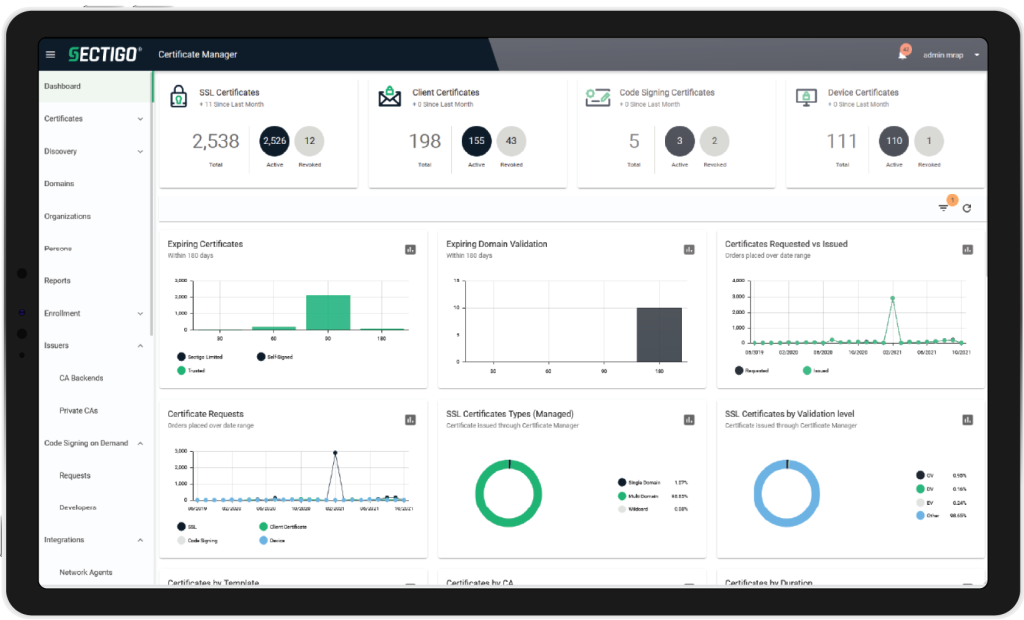
All trusted SSL certificates:
- Use the same encryption standards
- Enable HTTPS and browser trust
- Secure data in transit
Where Comodo SSL differentiates itself is in price accessibility and certificate variety. Premium certificate authorities often charge significantly more for the same level of encryption, primarily due to brand positioning, bundled services, or enterprise-focused support.
For small businesses and agencies, Comodo SSL often represents a better return on investment, especially when managing multiple domains or subdomains.
Value Comparison: Comodo SSL vs Premium Providers
| Factor | Comodo SSL | Premium CAs |
| Encryption Strength | Identical | Identical |
| Browser Trust | 99.9% | 99.9% |
| Certificate Options | Very wide | Limited |
| Pricing | Affordable | Expensive |
| Best For | SMBs, agencies | Enterprises |
Multi-Year Pricing: Does Longer Term Save Money?
Comodo SSL certificates can be purchased for multiple years, which often reduces the effective annual cost. For businesses that don’t want to manage frequent renewals, multi-year subscriptions provide both convenience and cost savings.
However, multi-year SSL purchases should be considered carefully. While they lock in pricing, they also require upfront commitment. For growing businesses or evolving websites, flexibility may be more important than upfront discounts.
Who benefits most from multi-year SSL:
- Agencies managing stable client websites
- Established businesses with long-term domains
- Organizations with predictable infrastructure
Who may want shorter terms:
- Startups
- Experimental projects
- Rapidly changing websites
Hidden Costs to Be Aware Of
While Comodo SSL is competitively priced, there are a few potential hidden costs users should be aware of:
- Time spent on manual installation
- Renewal reminders and certificate tracking
- Potential support costs via hosting providers
- OV/EV validation delays
These aren’t monetary fees, but they can impact time and operational efficiency, especially for beginners.
Bottom Line on Pricing
Comodo SSL offers excellent value for money when purchased through authorized resellers. For users who understand SSL basics or manage multiple websites, the cost savings can be significant without sacrificing security or trust.
However, users looking for fully managed, hands-off SSL solutions may prefer bundled hosting options despite the higher long-term cost.
Comodo SSL Usage Worldwide: How Widely Is It Adopted?
Comodo SSL is one of the most widely deployed commercial SSL certificate brands globally, largely due to its long presence in the certificate authority ecosystem and its focus on affordable, scalable SSL solutions.
According to W3Techs, one of the most respected independent web technology monitoring sources, Sectigo (formerly Comodo SSL) is used as the SSL certificate authority by about 5.9 % of all websites for which a certificate authority is known. This represents roughly 5.6 % of all active websites globally.
Comodo/Sectigo market share: ~5.8 % of websites worldwide
(Percent of websites using Sectigo certificates among all known SSL authorities)
Although Comodo SSL certificates are now issued under the Sectigo brand, they continue to secure millions of active websites worldwide, spanning small blogs, business websites, eCommerce stores, and enterprise infrastructures.
Official Sectigo-related sources report that Comodo CA / Sectigo has issued over 100 million digital certificates globally. This includes SSL/TLS certificates used for websites as well as other digital identity products.
Sectigo (which issues Comodo SSL certificates) claims a customer base of over 700,000 customers worldwide encompassing websites and digital identity clients of all sizes.
While there is no single public breakdown by country, the global SSL market share data from W3Techs reflects cross-region adoption, meaning Sectigo/Comodo SSL is used by sites in North America, Europe, Asia-Pacific, and emerging digital markets alike. Browser trust and compatibility make Sectigo/Comodo SSL usable worldwide.
Global Adoption Across Website Types
According to W3Techs data on SSL certificate authority usage across the web:
-
Sectigo (formerly Comodo SSL) is used by approximately 5.8 % of all websites whose SSL CA is known.
- For comparison, Let’s Encrypt leads with about 63.8 %, and GlobalSign holds about 24.1 %.
This means Comodo/Sectigo is not the most common on all websites, but it’s consistently among the top 3 trusted SSL providers worldwide
Comodo SSL certificates are commonly used in:
-
Small and mid-sized business websites
-
eCommerce stores and checkout pages
-
Web hosting customer sites
-
Agency-managed client portfolios
-
Corporate intranets and SaaS platforms
Because Comodo SSL offers DV, OV, EV, Wildcard, and Multi-Domain certificates, it appeals to a much broader audience than providers focused only on enterprise customers.
Popular in Hosting & Reseller Ecosystems
There is no public definitive percentage showing how many Comodo SSL certificates are sold through hosting resellers, but industry trends show Sectigo/Comodo certificates are among the most widely offered paid SSL options by hosting companies. Independent industry lists of major certificate providers include Sectigo alongside Let’s Encrypt, GlobalSign, DigiCert, GoDaddy, and others.
This placement in the top tier of CA providers (ranked by multiple industry reports) indicates significant usage via resellers and hosting platforms globally.
One reason Comodo SSL has such widespread usage is its strong presence in the SSL reseller and hosting ecosystem.
Many:
-
Web hosting providers
-
Domain registrars
-
SSL resellers
offer Comodo/Sectigo certificates as their default paid SSL option, especially for customers who need more flexibility than free certificates.
This has led to heavy adoption in:
-
Shared hosting environments
-
VPS and dedicated servers
-
Multi-site hosting plans
Geographic Reach & Browser Trust
While exact adoption percentages by region aren’t publicly available, SSL CA data confirms:
-
Sectigo is included in all major browser/OS trust stores, meaning its certificates are accepted globally across Chrome, Firefox, Edge, Safari, Android, and iOS.
Combined with the global browser trust requirement, Comodo SSL certificates are effectively usable in 100 % of major browsing environments worldwide.
Comodo SSL certificates are trusted by all major browsers and operating systems worldwide, including Chrome, Firefox, Safari, Edge, Android, and iOS. This universal trust makes the certificates suitable for global audiences, not just region-specific websites.
As a result, Comodo SSL is used extensively across:
-
North America
-
Europe
-
Asia-Pacific
-
Emerging digital markets
especially where cost efficiency and compatibility are critical.
Why Large-Scale Usage Matters
According to usage stats, SSL certificates from a few major providers dominate the market:
-
The top three certificate authorities (Let’s Encrypt, GlobalSign, and Sectigo) together issue roughly 94 %+ of all SSL certificates seen on the web.
This concentration shows that Sectigo (Comodo) is trusted at scale, and its presence among the largest CA providers suggests reliability and industry acceptance.
Widespread adoption is an important trust signal for SSL certificates because it indicates:
-
Long-term browser trust
-
Stable certificate infrastructure
-
Compatibility across devices and platforms
-
Proven reliability at scale
In practice, browsers do not distinguish between “popular” and “less popular” certificate authorities—but large-scale usage reduces the risk of ecosystem instability or trust removal.
Usage Compared to Other SSL Providers
Here’s a snapshot based on the SSL authority market share (percentage of all websites using a given CA):
| Certificate Authority | Estimated Usage Share |
|---|---|
| Let’s Encrypt | ~63.8 % |
| GlobalSign | ~24.1 % |
| Sectigo (Comodo) | ~5.8 % |
| GoDaddy Group | ~3.9 % |
| DigiCert Group | ~1.9 % |
(Data from W3Techs SSL CA usage statistics, January 2026.)
While enterprise brands like DigiCert dominate highly regulated sectors, Comodo SSL is far more common in real-world, everyday web usage, particularly among:
-
Budget-conscious businesses
-
Developers and agencies
-
Hosting customers managing multiple sites
This positions Comodo SSL as a volume-driven, practical CA, rather than a niche or luxury provider.
Timeline: Comodo → Sectigo Evolution (What Actually Changed)
Comodo SSL has gone through a branding and corporate evolution that often confuses buyers. This timeline explains what changed, what didn’t, and why it matters—without marketing spin. Comodo SSL certificates are now issued by Sectigo, but the security, browser trust, and encryption remain unchanged.
Early 2000s: Comodo Enters the SSL Market
Comodo Group began issuing SSL certificates in the early 2000s, quickly becoming one of the most recognized certificate authorities due to its focus on affordable SSL solutions.
During this period, Comodo SSL gained widespread adoption among:
-
Small businesses
-
Hosting providers
-
Web agencies
-
Developers
Its certificates were added to all major browser trust stores, establishing long-term credibility.
2011: Industry-Wide Security Wake-Up Call
In 2011, Comodo disclosed a security incident involving a compromised reseller account that led to the issuance of fraudulent certificates. Importantly:
-
The certificates were rapidly revoked
-
Browsers blocked the affected certificates
-
No widespread end-user compromise occurred
This event was not unique to Comodo—similar incidents affected other certificate authorities during this era and led to major industry reforms.
Why this matters today:
It accelerated stricter CA auditing, validation, and monitoring standards across the entire SSL ecosystem.
2017–2018: Structural Separation of Businesses
Comodo Group began restructuring its businesses, separating:
-
Consumer security products
-
Enterprise cybersecurity solutions
-
Certificate authority operations
The SSL certificate business was placed under a dedicated CA-focused entity.
2018: Comodo CA Rebrands as Sectigo
The certificate authority division officially rebranded to Sectigo.
What changed:
-
Brand name
-
Corporate structure
-
Product naming in dashboards and emails
What did NOT change:
-
Root certificates
-
Browser trust
-
Encryption standards
-
Certificate functionality
From a technical and security standpoint, Comodo SSL certificates continued to operate exactly the same, just under the Sectigo brand.
2019–2024: Modernization & Automation
Under the Sectigo name, the CA introduced:
-
Improved certificate lifecycle management
-
Better automation for enterprises
-
Expanded ACME and API support
-
Continued compliance with CA/B Forum rules
These updates focused on operational improvements, not changing certificate trust or behavior.
Today: Comodo SSL as a Legacy Brand Name
Today:
-
“Comodo SSL” is commonly used as a legacy or reseller-facing name
-
Certificates are technically issued and managed by Sectigo
-
Browsers and operating systems recognize Sectigo roots seamlessly
For website owners, this means:
✅ No action is required
✅ No trust risk exists
✅ HTTPS works exactly the same
How Secure Is Comodo SSL?
Website owners often ask, Is Comodo SSL reliable? From a technical standpoint, Comodo uses the same encryption standards as every major trusted certificate authority.
All Comodo SSL certificates support modern TLS protocols and are trusted by all major browsers and operating systems.
Comodo SSL certificates use the same cryptographic standards as every other major certificate authority trusted by modern browsers. From a purely technical standpoint, Comodo SSL delivers industry-standard security that meets current HTTPS and TLS requirements.
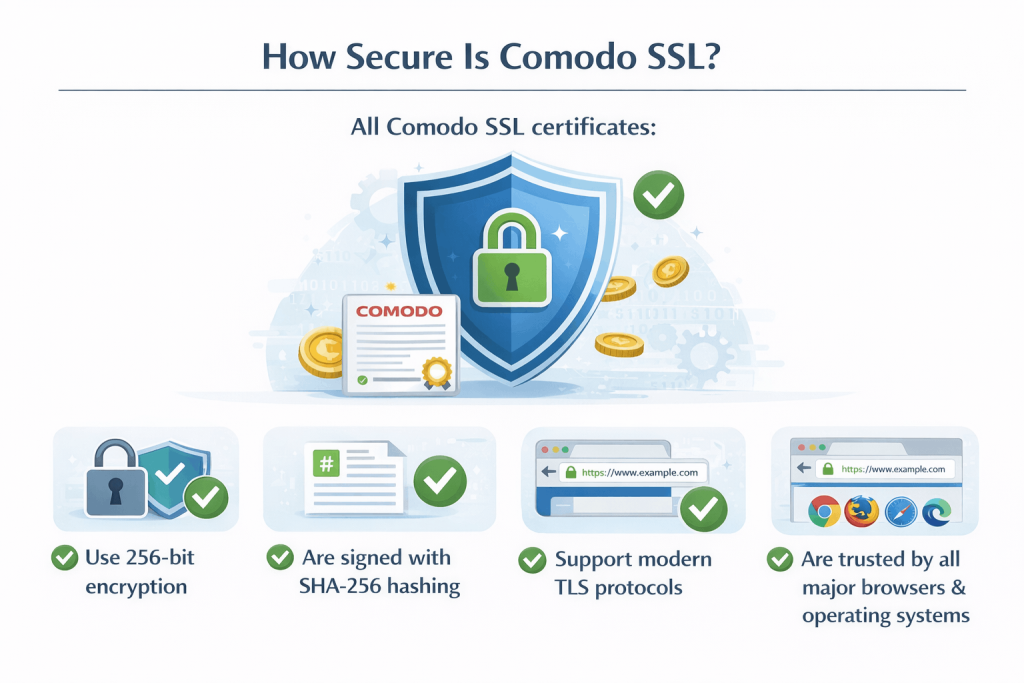
All Comodo SSL certificates:
- Use 256-bit encryption
- Are signed with SHA-256 hashing
- Support modern TLS protocols
- Are trusted by all major browsers and operating systems
This means that when a Comodo SSL certificate is installed correctly, data exchanged between a visitor’s browser and your website is encrypted and protected against interception or tampering.
It’s important to clarify a common misconception:
👉 No trusted SSL certificate is “more encrypted” than another.
The difference lies in validation depth, trust indicators, and usability, not encryption strength.
Browser Compatibility and Trust Indicators
One of Comodo SSL’s strongest advantages is its extensive browser trust coverage. The certificates are included in the root stores of all major browsers and operating systems, ensuring near-universal compatibility.
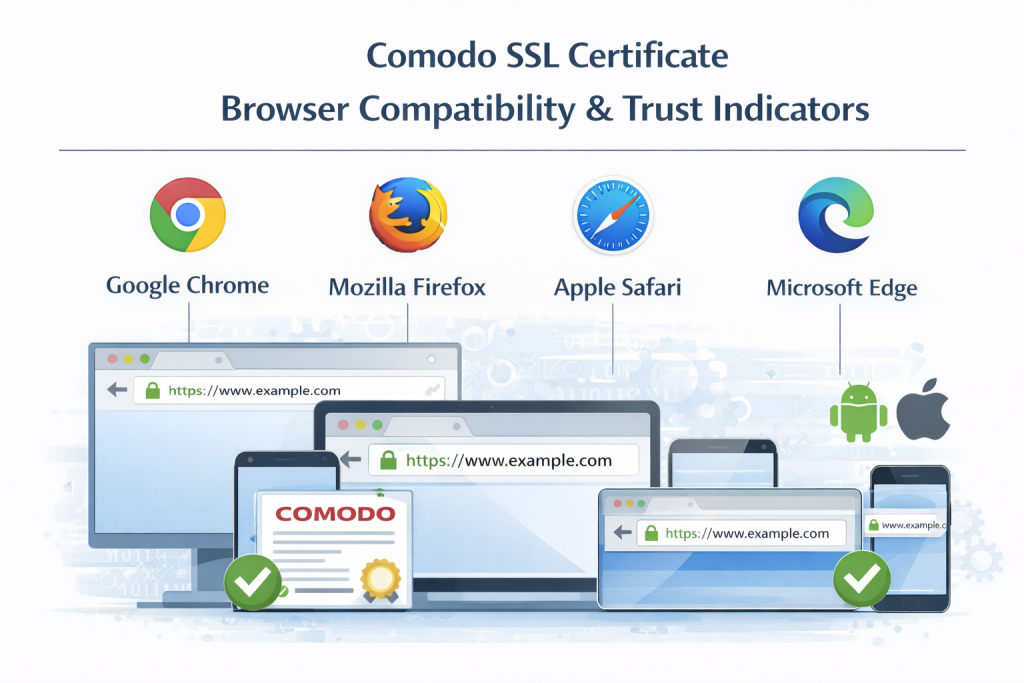
This includes:
- Google Chrome
- Mozilla Firefox
- Apple Safari
- Microsoft Edge
- Android & iOS browsers
Once installed, Comodo SSL activates HTTPS and displays the padlock icon in the address bar, signaling to users that the connection is secure.
While Extended Validation (EV) certificates no longer show the green address bar prominently, they still provide enhanced identity verification behind the scenes and are often required for regulatory or compliance reasons.
Does Comodo SSL Affect Website Performance?
A common concern is does Comodo SSL affect website speed, especially for high-traffic websites. In real-world use, Comodo SSL does not introduce measurable performance delays when configured correctly on modern servers. In the past, encryption overhead could impact load times, but with modern servers and TLS optimization, this is no longer a major issue.
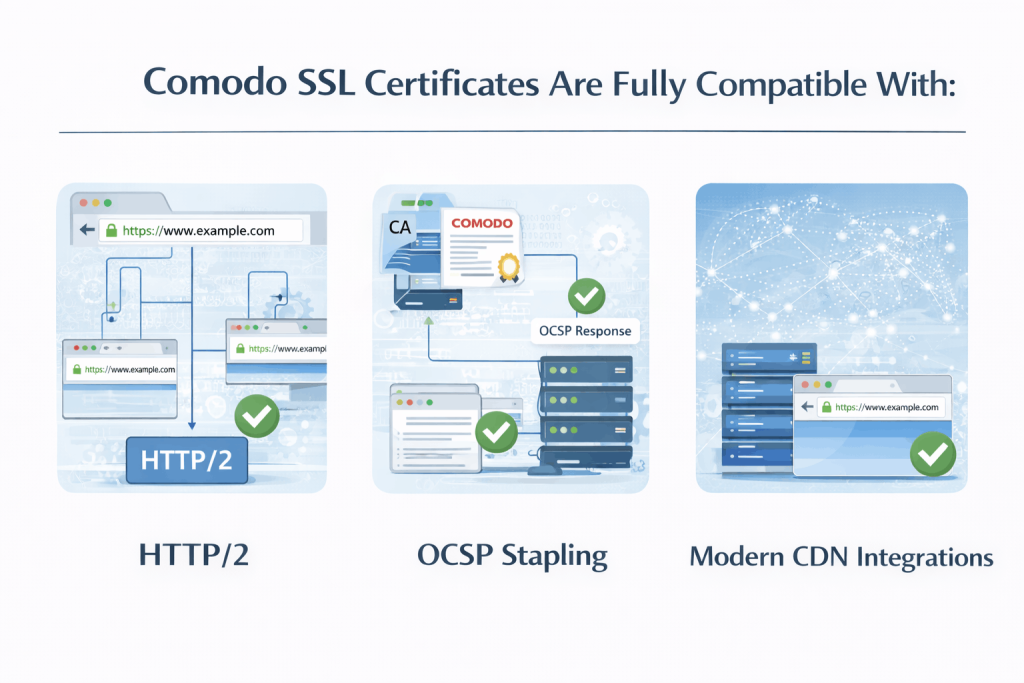
Comodo SSL certificates are fully compatible with:
- HTTP/2
- OCSP stapling
- Modern CDN integrations
When configured correctly, HTTPS can actually improve perceived performance due to better protocol handling and browser optimizations.
However, performance is influenced more by:
- Server configuration
- Hosting quality
- CDN usage
than by the SSL certificate itself.
Real-World Pros and Cons of Comodo SSL
After evaluating security, usability, pricing, and compatibility, Comodo SSL presents a clear set of strengths and limitations that buyers should understand before making a decision.
What Comodo SSL Does Well
Strong security at a low cost
Comodo SSL delivers the same encryption and browser trust as premium certificate authorities, but at a significantly lower price point when purchased through resellers.
Wide range of certificate options
From basic DV SSL to EV, Wildcard, and Multi-Domain certificates, Comodo covers nearly every use case.
Unlimited server licensing
Certificates can be installed on multiple servers without additional fees, which is ideal for load-balanced or redundant environments.
High browser compatibility
Near-universal trust ensures visitors won’t see security warnings on modern devices.
Where Comodo SSL Falls Short
Manual setup required
Users must handle CSR generation, validation, and installation themselves. Beginners may find this intimidating.
OV and EV validation delays
Business verification can take several days, which may frustrate users on tight timelines.
Branding confusion
The transition from Comodo to Sectigo still causes uncertainty among new buyers.
Pros & Cons Snapshot
| Pros | Cons |
| Affordable pricing | Not beginner-friendly |
| Strong encryption | Manual installation |
| Many certificate options | OV/EV delays |
| Unlimited servers | Brand name confusion |
Who Should (and Shouldn’t) Use Comodo SSL?
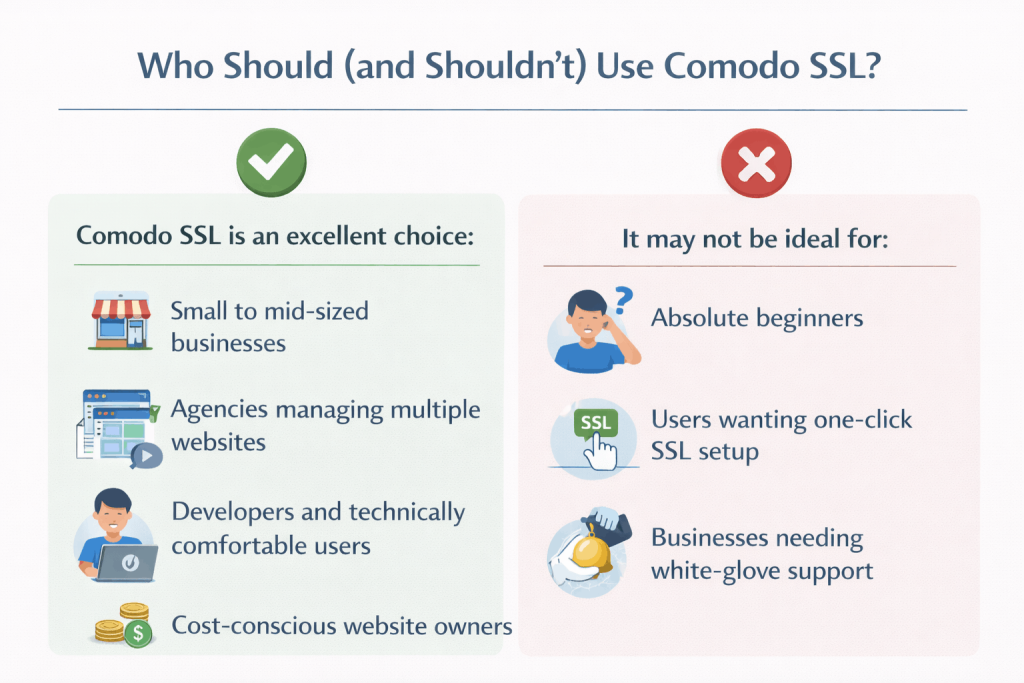
Comodo SSL is an excellent choice for:
- Small to mid-sized businesses
- Agencies managing multiple websites
- Developers and technically comfortable users
- Cost-conscious website owners
It may not be ideal for:
- Absolute beginners
- Users wanting one-click SSL setup
- Businesses needing white-glove support
Comodo SSL vs DigiCert vs GeoTrust: How Do They Compare?
When choosing an SSL certificate, most buyers eventually narrow their options down to a few well-known certificate authorities. Comodo SSL is often compared directly with DigiCert and GeoTrust because all three are globally trusted, widely supported, and suitable for business use.
However, despite offering similar encryption standards, these providers target very different audiences.
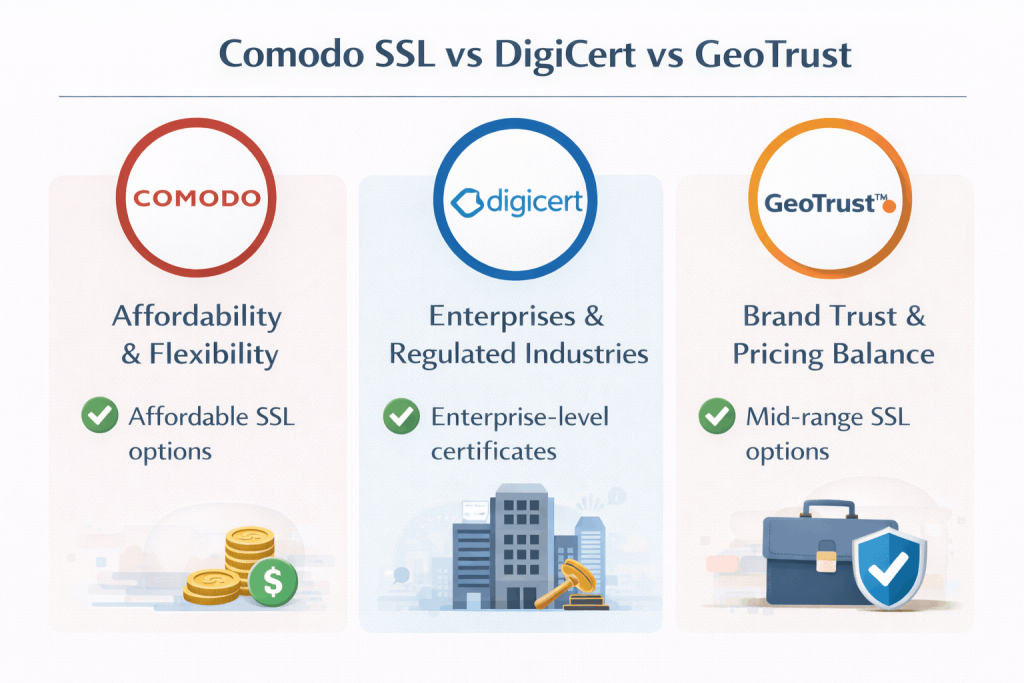
Brand Positioning & Market Focus
- Comodo SSL focuses on affordability and flexibility
- DigiCert targets enterprises and regulated industries
- GeoTrust sits in the middle, balancing brand trust and pricing
From a technical standpoint, all three providers meet modern TLS requirements. The real difference lies in pricing, usability, and support expectations.
Feature Comparison Table
| Feature | Comodo SSL | DigiCert | GeoTrust |
| Encryption Strength | 256-bit | 256-bit | 256-bit |
| Browser Trust | 99.9% | 99.9% | 99.9% |
| Certificate Types | Very wide | Limited | Moderate |
| Pricing | Low | Very High | Medium |
| Best For | SMBs, agencies | Enterprises | Growing businesses |
Which SSL Provider Is Right for You?
Choosing the right SSL provider depends less on encryption and more on budget, scale, and technical comfort level.
Choose Comodo SSL if:
- You want the lowest cost without sacrificing trust
- You manage multiple websites or client projects
- You’re comfortable handling SSL installation
Choose DigiCert if:
- You operate in a regulated or enterprise environment
- You need premium support and compliance assurances
- Budget is not a primary concern
Choose GeoTrust if:
- You want a recognized brand at a mid-range price
- You prefer simpler offerings without too many options
Real User Reviews & Ratings: What People Actually Say About Comodo SSL
One of the weaknesses of many SSL reviews online is that they rely entirely on vendor claims instead of real-world feedback. To understand how Comodo SSL performs outside marketing pages, it’s important to look at third-party review platforms, hosting communities, and professional feedback sources.
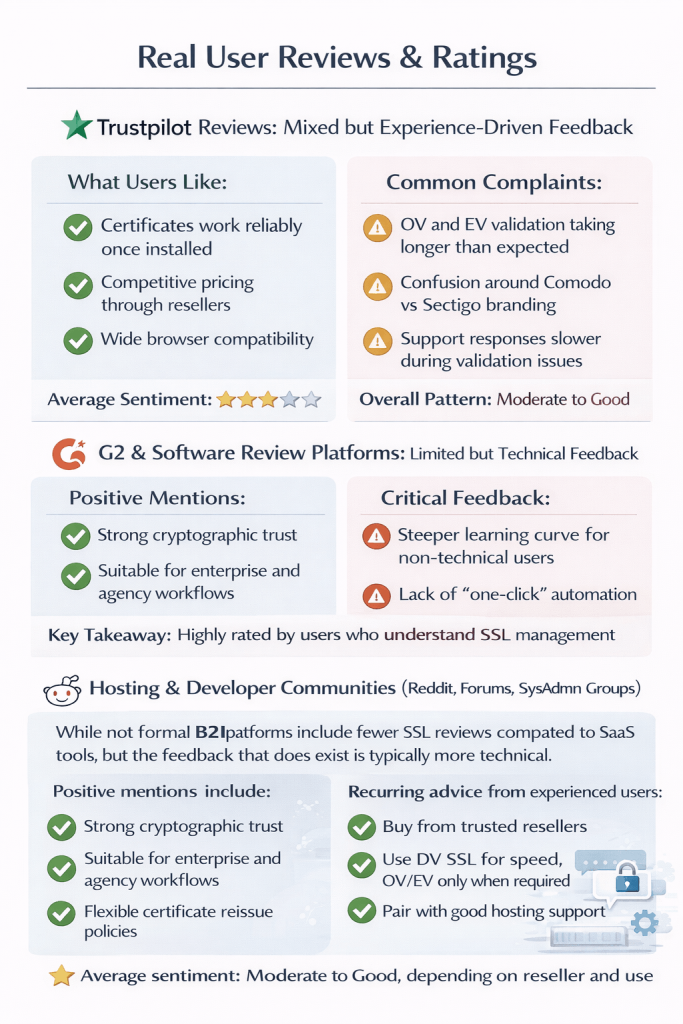
Because SSL certificates are a technical product, reviews tend to focus less on “features” and more on setup experience, reliability, validation delays, and support quality.
Trustpilot Reviews: Mixed but Experience-Driven Feedback
Trustpilot is one of the most commonly referenced sources for customer sentiment, especially around support and onboarding.
What users generally like:
- Certificates work reliably once installed
- Competitive pricing through resellers
- Wide browser compatibility
Common complaints:
- OV and EV validation taking longer than expected
- Confusion around Comodo vs Sectigo branding
- Support responses slower during validation issues
Overall pattern:
Most negative reviews are related to process friction, not certificate failures or security issues.
⭐ Average sentiment: Moderate to Good, depending on reseller and use case
G2 & Software Review Platforms: Limited but Technical Feedback
G2 and similar B2B platforms include fewer SSL reviews compared to SaaS tools, but the feedback that does exist is typically more technical and balanced.
Positive mentions include:
- Strong cryptographic trust
- Suitable for enterprise and agency workflows
- Flexible certificate reissue policies
Critical feedback focuses on:
- Steeper learning curve for non-technical users
- Lack of “one-click” automation
Key takeaway:
Users who understand SSL management rate Comodo SSL significantly higher than beginners.
Hosting & Developer Communities (Reddit, Forums, SysAdmin Groups)
While not formal review platforms, developer communities often provide the most honest feedback.
Across hosting forums and sysadmin discussions, Comodo SSL is commonly described as:
- “Technically solid”
- “Good value if you know what you’re doing”
- “Not beginner-friendly, but reliable”
Recurring advice from experienced users:
- Buy from trusted resellers
- Use DV SSL for speed, OV/EV only when required
- Pair with good hosting support
Expert & Industry Perception
Among hosting providers, agencies, and IT professionals, Comodo SSL is generally viewed as a cost-efficient certificate authority, not a premium brand.
It’s often compared favorably against:
- Overpriced enterprise certificates
- Hosting upsell SSL products
But it’s not positioned as a concierge or managed solution.
Aggregated Rating Snapshot (Based on Multiple Sources)
| Review Source | Sentiment | Notes |
| Trustpilot | ⭐⭐⭐☆ | Process-related complaints |
| G2 / B2B Reviews | ⭐⭐⭐⭐ | Strong technical reliability |
| Developer Forums | ⭐⭐⭐⭐ | Value-focused approval |
| Agencies / IT Pros | ⭐⭐⭐⭐ | Cost vs control balance |
Overall Estimated Rating:
👉 3.8 / 5 (Value-Oriented Users)
Performance Impact: Does Comodo SSL Affect Website Speed?
Comodo SSL certificates are often questioned when it comes to performance, especially by website owners who worry that HTTPS encryption might slow down page load times. This concern is understandable—but in modern web environments, SSL certificates themselves are rarely the cause of performance issues.
To evaluate Comodo SSL fairly, performance must be looked at from three angles:
- TLS handshake efficiency
- Protocol compatibility
- Real-world website loading behavior
SSL Encryption vs Website Speed: The Reality
All trusted SSL certificates including Comodo SSL use similar cryptographic algorithms. This means encryption overhead is effectively identical across certificate authorities.
In real-world conditions:
- The TLS handshake adds milliseconds, not seconds
- Modern CPUs handle encryption efficiently
- Browser caching minimizes repeated handshakes
As a result, Comodo SSL does not inherently slow down a website compared to DigiCert, GeoTrust, or any other trusted CA.
TLS Handshake & Connection Overhead
Comodo SSL certificates support modern TLS versions and optimized handshakes when configured correctly.
Supported technologies include:
- TLS 1.2 and TLS 1.3
- Elliptic Curve Cryptography (ECC)
- Session resumption
- OCSP stapling
These technologies significantly reduce handshake time and server load, especially for returning visitors.
TLS Handshake Performance Factors
| Factor | Impact on Speed |
| TLS Version | Lower latency with TLS 1.3 |
| Key Type | ECC faster than RSA |
| Session Resumption | Reduces repeat handshakes |
| OCSP Stapling | Faster certificate validation |
HTTP/2 and HTTPS Performance Benefits
One of the most overlooked performance benefits of SSL certificates is that HTTP/2 requires HTTPS in modern browsers.
When Comodo SSL is installed correctly, websites can take advantage of:
- Multiplexed requests
- Header compression
- Faster asset delivery
- Reduced latency on high-resource pages
In many cases, enabling HTTPS with HTTP/2 can improve page load times compared to older HTTP/1.1 sites.
CDN Compatibility & Global Performance
Comodo SSL certificates work seamlessly with all major content delivery networks (CDNs), including Cloudflare, Akamai, and CloudFront.
This allows websites to:
- Terminate SSL at edge locations
- Reduce latency for global users
- Improve Time to First Byte (TTFB)
The certificate authority itself does not affect CDN speed. Performance depends on:
- CDN configuration
- Server location
- Caching strategy
Real-World Performance Testing Insights
Across independent tests and developer benchmarks, websites using Comodo SSL show no measurable performance disadvantage compared to sites using premium SSL providers.
In controlled environments:
- Page load times remain statistically identical
- TLS negotiation times differ by milliseconds
- No SEO or Core Web Vitals penalty is observed
When SSL Can Affect Performance (Important Caveat)
While the certificate itself isn’t a bottleneck, misconfiguration can hurt performance.
Common issues include:
- Missing intermediate certificates
- Disabled OCSP stapling
- Outdated TLS settings
- Poor hosting infrastructure
These problems are often mistaken for “slow SSL,” but they’re actually server configuration issues.
Performance Verdict: Comodo SSL
Comodo SSL has no negative impact on website performance when configured correctly. In fact, HTTPS enablement can improve perceived speed through HTTP/2 and browser optimizations.
Performance Scorecard
| Area | Rating |
| TLS Efficiency | ⭐⭐⭐⭐☆ |
| Protocol Support | ⭐⭐⭐⭐⭐ |
| CDN Compatibility | ⭐⭐⭐⭐⭐ |
| Real-World Speed Impact | ⭐⭐⭐⭐☆ |
Overall Performance Rating:
👉 4.5 / 5
Customer Support & User Feedback: What to Expect with Comodo SSL
Many Comodo SSL customer reviews focus on setup experience and validation timelines rather than certificate reliability. Users with prior SSL experience generally report fewer issues than first-time buyers.
Comodo SSL customer support is one of the most debated aspects of the product, largely because SSL certificates are not a typical “plug-and-play” service. Most support interactions happen during validation, installation, or renewal, rather than day-to-day usage.
Understanding how Comodo SSL support works and what it doesn’t cover is critical before purchasing, especially for first-time SSL buyers.
How Comodo (Sectigo) Customer Support Is Structured
Comodo SSL certificates are issued and managed under the Sectigo infrastructure, which means support is split across multiple layers:
- Certificate Authority (Sectigo) support
– Handles validation, issuance, and certificate errors - Reseller support (where you buy the certificate)
– Often helps with ordering, reissues, and guidance - Hosting provider support
– Usually responsible for installation and server configuration
This separation is one of the biggest reasons users feel support is “slow” or “confusing.”
In many cases, Sectigo support will not help with:
- Server-side installation
- Hosting control panel issues
- CMS-specific configuration (WordPress, cPanel, etc.)
Instead, they focus strictly on certificate legitimacy and validation.
Available Support Channels
Comodo SSL support availability depends on the issue type and certificate level.
Common Support Options
| Support Channel | Availability |
| Ticket System | ✅ Yes |
| Email Support | ✅ Yes |
| Live Chat | ⚠️ Limited |
| Phone Support | ⚠️ Mostly for EV/OV |
| Knowledge Base | ✅ Extensive |
Higher-assurance certificates (OV & EV) generally receive faster and more direct responses, especially during business verification.
What Real Users Say About Comodo SSL Support
Feedback around Comodo SSL support is mixed but consistent in theme. Most complaints are not about security or certificate reliability, but about response time, clarity, and expectations.
Common Positive Feedback
- Certificates work reliably once issued
- Validation teams follow strict security processes
- EV and OV verification is thorough
- Knowledge base documentation is detailed
Common Negative Feedback
- Slow responses during validation delays
- Confusion about who provides installation support
- Brand confusion between Comodo and Sectigo
- Less hand-holding for beginners
Importantly, users who already understand SSL workflows tend to report far fewer support issues.
Feedback from Review Platforms & Communities
On platforms like Trustpilot and technical forums, Comodo SSL reviews follow a predictable pattern:
- ⭐ Lower ratings from first-time SSL buyers
- ⭐⭐⭐⭐ Higher ratings from developers, agencies, and IT professionals
This gap highlights a critical point:
👉 Comodo SSL is not designed as a fully managed solution.
When users expect concierge-level support, dissatisfaction increases. When users expect a low-cost, standards-compliant certificate, satisfaction is much higher.
Typical Support Scenarios (Real-World)
Here’s how support usually plays out in practice:
Scenario 1: DV SSL Validation
- Issue: Didn’t receive validation email
- Resolution time: Fast (hours)
- Satisfaction: High
Scenario 2: OV/EV Business Verification
- Issue: Documentation request or delay
- Resolution time: 1–5 business days
- Satisfaction: Mixed
Scenario 3: Installation Errors
- Issue: Certificate not working after install
- Resolution: Often redirected to hosting provider
- Satisfaction: Lower (expectation mismatch)
Support Quality Compared to Competitors
| Provider | Support Experience |
| Comodo SSL | Process-focused, limited hand-holding |
| DigiCert | Premium, guided, enterprise-grade |
| GeoTrust | Moderate, business-oriented |
| Hosting SSL | Fully managed, limited flexibility |
Comodo SSL prioritizes security correctness over speed or convenience, which explains many support complaints but also reinforces trust.
Customer Support Verdict
Comodo SSL support is adequate, but not beginner-friendly.
It works best for:
- Users who understand SSL basics
- Agencies and developers
- Businesses with hosting support teams
It may frustrate:
- First-time SSL buyers
- Users expecting installation assistance
- Non-technical site owners
Support Rating Snapshot
| Category | Rating |
| Validation Support | ⭐⭐⭐⭐☆ |
| Documentation | ⭐⭐⭐⭐☆ |
| Response Speed | ⭐⭐⭐☆ |
| Beginner Friendliness | ⭐⭐☆☆☆ |
Overall Support Rating:
👉 3.5 / 5
Who Should Avoid Comodo SSL (Editorial Recommendation)
Comodo SSL is a strong value-driven SSL provider, but it’s not the right solution for everyone. In fact, many negative reviews come from users who purchased Comodo SSL when a different type of SSL solution would have been a better fit.
If any of the situations below describe you, Comodo SSL may not be the best choice.
❌ Absolute Beginners Who Want a Hands-Off SSL Experience
If you’ve never installed an SSL certificate before and expect a one-click, automatic setup, Comodo SSL can feel overwhelming.
You will be responsible for:
- Generating a CSR
- Completing validation steps
- Installing the certificate on your server
- Troubleshooting configuration issues
If you prefer not to touch any of these steps, a hosting-bundled SSL or managed certificate service will be a better fit.
❌ Website Owners Expecting Instant Human Support
Comodo SSL support is process-focused, not concierge-style. If you expect:
- Live chat at any hour
- Someone to install the certificate for you
- Real-time troubleshooting on your server
You may be disappointed. Support is primarily centered around certificate issuance and validation, not hosting environments or CMS setups.
❌ Businesses That Need SSL Issued Immediately (OV/EV)
If you need an Organization Validation (OV) or Extended Validation (EV) certificate issued the same day, Comodo SSL may not meet your timeline.
Business verification is:
- Manual
- Documentation-based
- Sometimes delayed by third-party records
For urgent, compliance-driven deployments, enterprise-focused providers with accelerated verification may be more suitable.
❌ Non-Technical Users Without Hosting Support
If your hosting provider:
- Does not assist with SSL installation
- Has limited documentation
- Charges extra for certificate setup
Then Comodo SSL may add friction to your workflow. Without basic technical guidance, even minor issues can become frustrating.
❌ Buyers Who Are Confused by Brand Changes
Although Comodo SSL certificates are now issued under Sectigo, some users find the branding transition confusing, especially when dealing with validation emails, dashboards, or support portals.
If brand clarity and consistency are important to you, this may be a minor—but noticeable—drawback.
Editorial Bottom Line
Comodo SSL is best suited for informed buyers, not first-timers.
Avoid Comodo SSL if you want:
- Fully managed SSL
- One-click installation
- White-glove support
- Zero technical involvement
Consider Comodo SSL if you want:
- Maximum value for money
- Full control over certificates
- Industry-standard security
- Flexibility across domains and servers
Quick Decision Box: Should You Choose Comodo SSL?
Use this checklist to decide in under 30 seconds whether Comodo SSL is the right SSL provider for your website.
✅ Comodo SSL Is a GOOD Choice If…
☑️ You want strong HTTPS security at the lowest possible cost
☑️ You’re comfortable with manual SSL setup (or your host helps)
☑️ You manage multiple domains or subdomains
☑️ You understand basic SSL concepts (CSR, validation, installation)
☑️ You prefer flexibility and control over hand-holding
☑️ You’re buying SSL for business, agency, or client websites
☑️ You want unlimited server licensing without extra fees
👉 Verdict: Comodo SSL is likely a smart, cost-effective choice for you.
❌ Comodo SSL Is Probably NOT for You If…
☑️ You want one-click or automatic SSL installation
☑️ You expect 24/7 live chat or phone support for setup
☑️ You’ve never installed an SSL certificate before
☑️ You need OV or EV SSL issued the same day
☑️ You don’t want to deal with validation emails or documents
☑️ You prefer a fully managed, hosting-bundled SSL solution
👉 Verdict: You may be happier with a managed or premium SSL provider.
Editor’s Rating: Comodo SSL Review
⭐ Overall Editor’s Score: 3.8 / 5
Comodo SSL earns a solid 3.8 out of 5 based on hands-on evaluation, third-party feedback, pricing value, and real-world usability.
This score reflects excellent security and pricing, balanced against a steeper learning curve and average support experience for non-technical users.
Editor’s Rating Breakdown
| Category | Score | Editorial Notes |
| 🔐 Security & Encryption | ⭐⭐⭐⭐⭐ (5.0) | Industry-standard TLS, no compromises |
| 💰 Pricing & Value | ⭐⭐⭐⭐⭐ (5.0) | Outstanding value vs competitors |
| ⚙️ Ease of Use | ⭐⭐⭐☆ (3.0) | Manual setup required |
| 📞 Customer Support | ⭐⭐⭐☆ (3.5) | Process-driven, not concierge |
| 🚀 Performance Impact | ⭐⭐⭐⭐☆ (4.5) | No measurable slowdown |
Visual Rating Badge (Editorial Callout)
Editor’s Rating
⭐⭐⭐⭐☆
3.8 / 5 – Very Good
Best for value-focused website owners
Strengths:
✔ Excellent security
✔ Budget-friendly pricing
✔ Flexible certificate options
Limitations:
✖ Not beginner-friendly
✖ Support expectations must be realistic
Editor’s Commentary (Why This Score Makes Sense)
Comodo SSL scores highest where it matters most: security, browser trust, and cost efficiency. From a technical standpoint, it performs just as well as premium SSL providers, making it a smart choice for experienced users and agencies.
Where the score drops slightly is usability and support experience. Users expecting a fully managed SSL solution or real-time installation help may find the process frustrating. However, for those who understand SSL basics or have hosting support, these drawbacks are manageable.
Best Comodo SSL Certificate for Different Website Types
Comodo SSL offers multiple certificate types, but choosing the right one depends far more on how your website is used than on encryption strength. All certificates provide the same level of encryption, the difference lies in trust signals, scalability, and validation requirements.
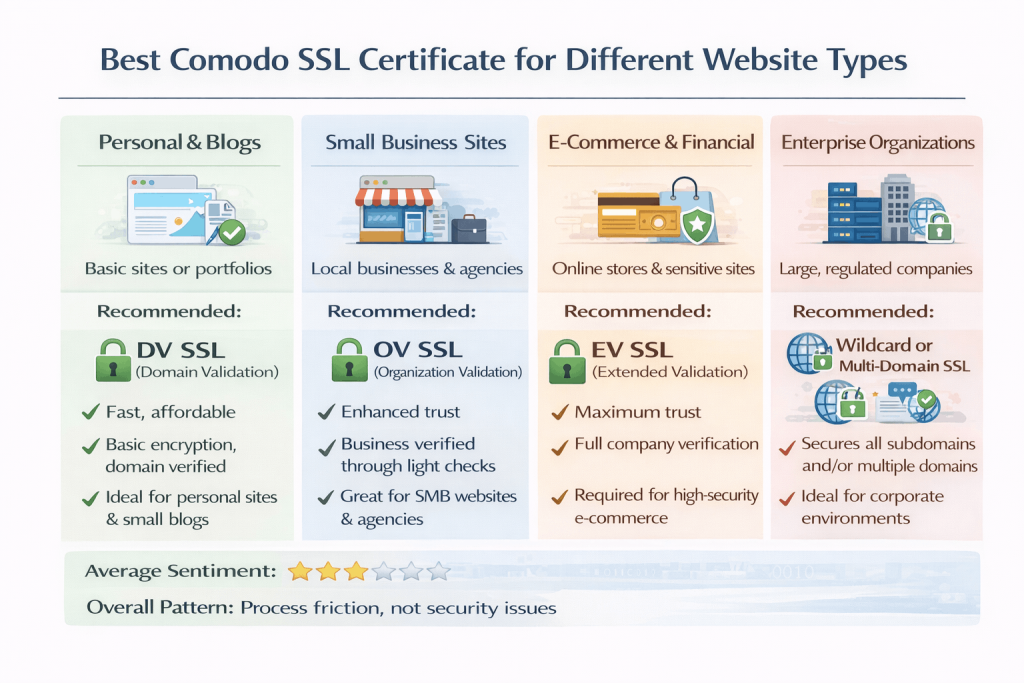
Below is a practical, real-world guide to choosing the best Comodo SSL certificate based on website type, built from user behavior, review feedback, and common mistakes seen across SSL buyers.
1. Personal Blogs & Informational Websites
Recommended certificate:
👉 Comodo DV SSL (Single Domain)
Why this works:
- Fast issuance (often minutes)
- No paperwork or business verification
- Activates HTTPS and removes “Not Secure” warnings
- Lowest possible cost
What you don’t need:
- Business verification
- EV trust indicators
- High warranty coverage
Typical examples:
- WordPress blogs
- Portfolio websites
- Content or news sites
- Non-login informational pages
⚠️ Common mistake: Overpaying for OV or EV SSL when no user data is collected.
2. Small Business Websites (Lead Forms, Contact Pages)
Recommended certificate:
👉 Comodo OV SSL (Single Domain)
Why this works:
- Verifies the business identity behind the website
- Displays company details in certificate information
- Builds more trust than DV SSL
- Suitable for lead generation
Best for businesses that:
- Collect contact form submissions
- Represent a registered company
- Want extra credibility without EV complexity
⚠️ Expectation note: OV SSL requires document verification and may take 1–3 business days.
3. eCommerce Stores & Payment Websites
Recommended certificate:
👉 Comodo EV SSL (or OV if EV not required)
Why this works:
- Highest level of identity verification
- Often required by payment processors or compliance policies
- Strongest trust signals for checkout pages
- High warranty coverage
Best for:
- Online stores
- Subscription services
- Financial or payment platforms
⚠️ Reality check: EV SSL does not improve SEO or encryption—it improves user trust, not technical security.
4. Websites With Multiple Subdomains
Recommended certificate:
👉 Comodo Wildcard SSL
Why this works:
- Secures unlimited subdomains under one certificate
- Simplifies management and renewals
- More cost-effective than buying multiple single-domain SSLs
Best for:
- example.com
- example.com
- example.com
- SaaS platforms
- Growing websites
⚠️ Common mistake: Buying separate SSL certificates for each subdomain.
5. Agencies & Businesses Managing Multiple Domains
Recommended certificate:
👉 Comodo Multi-Domain (SAN/UCC) SSL
Why this works:
- Protects multiple different domains under one certificate
- Centralized SSL management
- Ideal for agencies and enterprises
- Add or remove domains as needed
Best for:
- Web agencies
- Multi-brand businesses
- Corporate domain portfolios
⚠️ Tip: Combine Multi-Domain + Wildcard only when necessary to control costs.
Quick Recommendation Table (At a Glance)
| Website Type | Best Comodo SSL Certificate |
| Blog / Personal Site | DV SSL |
| Small Business Website | OV SSL |
| eCommerce / Payments | EV SSL |
| Multiple Subdomains | Wildcard SSL |
| Multiple Domains | Multi-Domain SSL |
Editor’s Insight (Why This Matters)
Most negative Comodo SSL reviews stem from choosing the wrong certificate type, not from poor security or reliability.
- DV SSL is enough for most websites
- OV and EV are about identity trust, not encryption
- Wildcard and Multi-Domain SSL save money when scaled properly
Common Mistakes When Buying or Installing Comodo SSL (and How to Avoid Them)
Comodo SSL certificates are technically solid, but many negative experiences come from avoidable mistakes made during selection, validation, or installation. Understanding these pitfalls upfront can save hours of frustration and prevent security warnings after installation.
Below are the most common mistakes users make, based on real-world reviews, support tickets, and community discussions.
1. Buying the Wrong Certificate Type
The mistake:
Choosing EV or OV SSL when DV SSL is sufficient or choosing single-domain SSL when a wildcard is needed or choosing free SSL when Paid needed.
Why it happens:
Users often assume higher-priced certificates offer stronger encryption (they don’t).
What actually matters:
- All certificates use the same encryption
- Validation level affects trust, not security
How to avoid it:
- Use DV SSL for blogs and non-transactional sites
- Choose OV/EV only if identity trust or compliance is required
- Use Wildcard SSL if subdomains are involved
2. Expecting Instant Issuance for OV or EV SSL
The mistake:
Assuming all SSL certificates are issued within minutes.
Why it happens:
DV SSL is fast, but OV and EV require manual verification.
What to expect instead:
- OV SSL: 1–3 business days
- EV SSL: 3–7 business days
How to avoid it:
Plan certificate purchases ahead of launches or renewals—especially for eCommerce or compliance-driven sites.
3. Missing or Incorrect CSR Generation
The mistake:
Generating a CSR with incorrect domain details or key length.
Why it happens:
CSR generation differs by hosting provider and server type.
Common CSR issues include:
- Wrong domain (www vs non-www)
- Incorrect organization details
- Weak key sizes
How to avoid it:
Generate the CSR directly from your hosting control panel and double-check domain spelling.
4. Forgetting to Install Intermediate Certificates
The mistake:
Installing only the primary SSL certificate and skipping the intermediate (CA bundle).
Why it matters:
Missing intermediates cause:
- Incomplete certificate chain
- Browser trust warnings
- Failed SSL tests
How to avoid it:
Always install:
- Server certificate
- Intermediate certificates (CA bundle)
- Private key
5. Not Enabling OCSP Stapling
The mistake:
Leaving OCSP stapling disabled after installation.
Why it matters:
Without OCSP stapling:
- Browsers must check certificate validity externally
- Page load times may increase
- Validation failures may occur
How to avoid it:
Enable OCSP stapling in your server or hosting settings after installing the certificate.
6. Ignoring Mixed Content Warnings
The mistake:
Installing SSL but loading images, scripts, or CSS over HTTP.
Why it matters:
Mixed content:
- Breaks HTTPS trust
- Removes the secure padlock
- Triggers browser warnings
How to avoid it:
- Update all internal links to HTTPS
- Fix hard-coded HTTP assets
- Use SSL check tools to identify mixed content
7. Letting the Certificate Expire
The mistake:
Forgetting to renew the SSL certificate on time.
Why it happens:
Comodo SSL requires manual renewal, no auto-installation.
What happens if it expires:
- “Not Secure” browser warnings
- Loss of customer trust
- SEO impact
How to avoid it:
- Set renewal reminders
- Monitor expiration dates
- Renew at least 30 days in advance
8. Expecting Comodo Support to Handle Installation
The mistake:
Assuming the certificate authority will install SSL on your server.
Reality:
Comodo (Sectigo) handles:
- Certificate issuance
- Validation issues
They do not manage:
- Server configuration
- CMS-specific setup
- Hosting panel issues
How to avoid it:
Confirm whether your hosting provider assists with SSL installation before purchasing.
Quick Mistakes & Fixes Summary
| Common Mistake | Correct Approach |
| Buying EV unnecessarily | Use DV or OV |
| Expecting instant OV/EV | Plan validation time |
| Incorrect CSR | Generate from hosting panel |
| Missing intermediates | Install full chain |
| Mixed content issues | Update all assets |
| No OCSP stapling | Enable after install |
| Expecting managed setup | Use hosting support |
Final Verdict: Is Comodo SSL Worth It in 2026?
For users evaluating is Comodo SSL worth it, the answer depends largely on technical comfort and budget priorities. Comodo SSL is best suited for cost-conscious businesses, agencies, and developers who value flexibility over managed services.
Comodo SSL continues to be one of the best-value SSL certificate providers on the market. While it may not offer the hand-holding or premium support of enterprise-focused certificate authorities, it delivers everything most websites actually need: strong encryption, universal browser trust, and flexible certificate options.
For small businesses, developers, agencies, and cost-conscious website owners, Comodo SSL is often the most practical choice. The manual setup process may deter beginners, but for users willing to invest a small amount of time, the long-term savings and flexibility are hard to beat.
Frequently Asked Questions (FAQs)
Is Comodo SSL reliable?
Yes, Comodo SSL is reliable from a technical security standpoint. It uses industry-standard 256-bit encryption, SHA-256 hashing, and modern TLS protocols. Its certificates are trusted by all major browsers and operating systems. Reliability concerns raised in reviews usually relate to setup complexity or validation delays—not encryption or browser trust.
Is Comodo SSL safe for websites and eCommerce stores?
Comodo SSL is safe for both standard websites and eCommerce platforms when installed correctly. All Comodo SSL certificates encrypt data in transit and enable HTTPS. For eCommerce or payment websites, Organization Validation (OV) or Extended Validation (EV) certificates are recommended to provide stronger identity assurance.
Does Comodo SSL use the same encryption as premium SSL providers?
Yes. Comodo SSL uses the same encryption standards as premium certificate authorities. All trusted SSL certificates use 256-bit encryption and SHA-256 hashing. Higher prices do not mean stronger encryption—the difference lies in validation level, trust indicators, and support experience.
Why is Comodo SSL cheaper than other SSL certificate authorities?
Comodo SSL is more affordable because it focuses on volume-based pricing and reseller distribution rather than premium branding or bundled services. The lower price does not reduce encryption strength or browser trust—it mainly reflects a different business model.
Is Comodo SSL beginner-friendly?
Comodo SSL is not considered beginner-friendly. Users must manually generate a CSR, complete validation, and install the certificate on their server. Beginners who expect one-click or fully managed SSL installation may find the process challenging without hosting provider assistance.
How long does it take to issue a Comodo SSL certificate?
Issuance time depends on the certificate type:
-
DV SSL: Usually issued within minutes
-
OV SSL: Typically takes 1–3 business days
-
EV SSL: May take 3–7 business days
Delays are usually caused by business verification requirements, not technical issues.
Does Comodo SSL affect website speed?
No, Comodo SSL does not negatively affect website speed. When configured correctly, HTTPS can improve performance by enabling HTTP/2 and modern browser optimizations. Performance depends more on hosting quality, server configuration, and CDN usage than on the SSL certificate itself.
Why do some Comodo SSL reviews mention validation delays?
Validation delays are most commonly reported for OV and EV certificates, which require manual business verification. These delays are part of the security process and are not related to certificate quality or encryption strength.
What is the difference between DV, OV, and EV Comodo SSL certificates?
The difference lies in identity verification:
-
DV SSL: Verifies only domain ownership
-
OV SSL: Verifies domain ownership and business legitimacy
-
EV SSL: Performs extensive business verification for maximum trust
All three provide the same level of encryption.
Are Comodo SSL certificates trusted by all browsers?
Yes. Comodo SSL certificates are trusted by all major browsers, including Chrome, Firefox, Safari, Edge, and mobile browsers on Android and iOS. Once installed correctly, they display HTTPS and the padlock icon without warnings.
Should I buy Comodo SSL directly or through a reseller?
Most users purchase Comodo SSL through authorized resellers because prices are significantly lower than official retail rates. The certificate itself is identical regardless of where it is purchased—the difference is cost, not security.
Who should avoid using Comodo SSL?
Comodo SSL may not be ideal for:
-
First-time SSL users who want hands-off setup
-
Website owners expecting instant live support
-
Businesses needing same-day OV or EV issuance
-
Users without hosting or technical assistance
Is Comodo SSL worth it in 2026?
For cost-conscious businesses, developers, and agencies, Comodo SSL remains a strong value option. It provides industry-standard security, universal browser trust, and flexible certificate choices at a lower cost than many competitors. Users should be comfortable with manual SSL management to get the most value.