Last updated: Oct 31, 2025
Online security is no longer optional. As cyber attacks evolve and data privacy becomes a priority for both personal and enterprise users, the methods of securing web traffic must also advance. That’s where ECC SSL certificates enter the picture.
With traditional RSA-based SSL certificates still in wide use, many website owners, server admins, and developers wonder whether ECC is worth switching to — especially as TLS 1.3 becomes more widely adopted and performance matters more than ever.
In this guide, you’ll learn everything you need to know about Elliptic Curve Cryptography (ECC) SSL certificates in 2026: what they are, how they work, how to get one, and how they compare to RSA SSL certificates.
Whether you’re migrating a legacy RSA-powered server to ECC, configuring HTTPS for the first time, or simply curious about faster SSL handshakes — this guide was written with both technical and non-technical readers in mind.
What is an ECC SSL Certificate?
An ECC SSL certificate, short for Elliptic Curve Cryptography SSL certificate, is a type of HTTPS certificate that uses a more modern form of public-key cryptography based on elliptic curve math instead of the large integer factorization used in RSA certificates.
In simple terms, ECC SSL certificates allow secure communication between a client (such as a web browser) and a server (like your website) over HTTPS — just like traditional SSL certificates — but they do it using keys that are smaller, faster, and just as secure (or more) than larger RSA keys.
For example, a 256-bit ECC key provides the same level of encryption strength as a 3072-bit RSA key, but requires significantly fewer computing resources to generate, validate, and use during each HTTPS connection.
This makes ECC SSL ideal for:
- High-traffic websites using modern TLS (1.2/1.3)
- Mobile-friendly or low-power devices
- Cloud and CDN-based deployments
- IoT services or microservice architecture
- Real-time platforms like financial dashboards and APIs
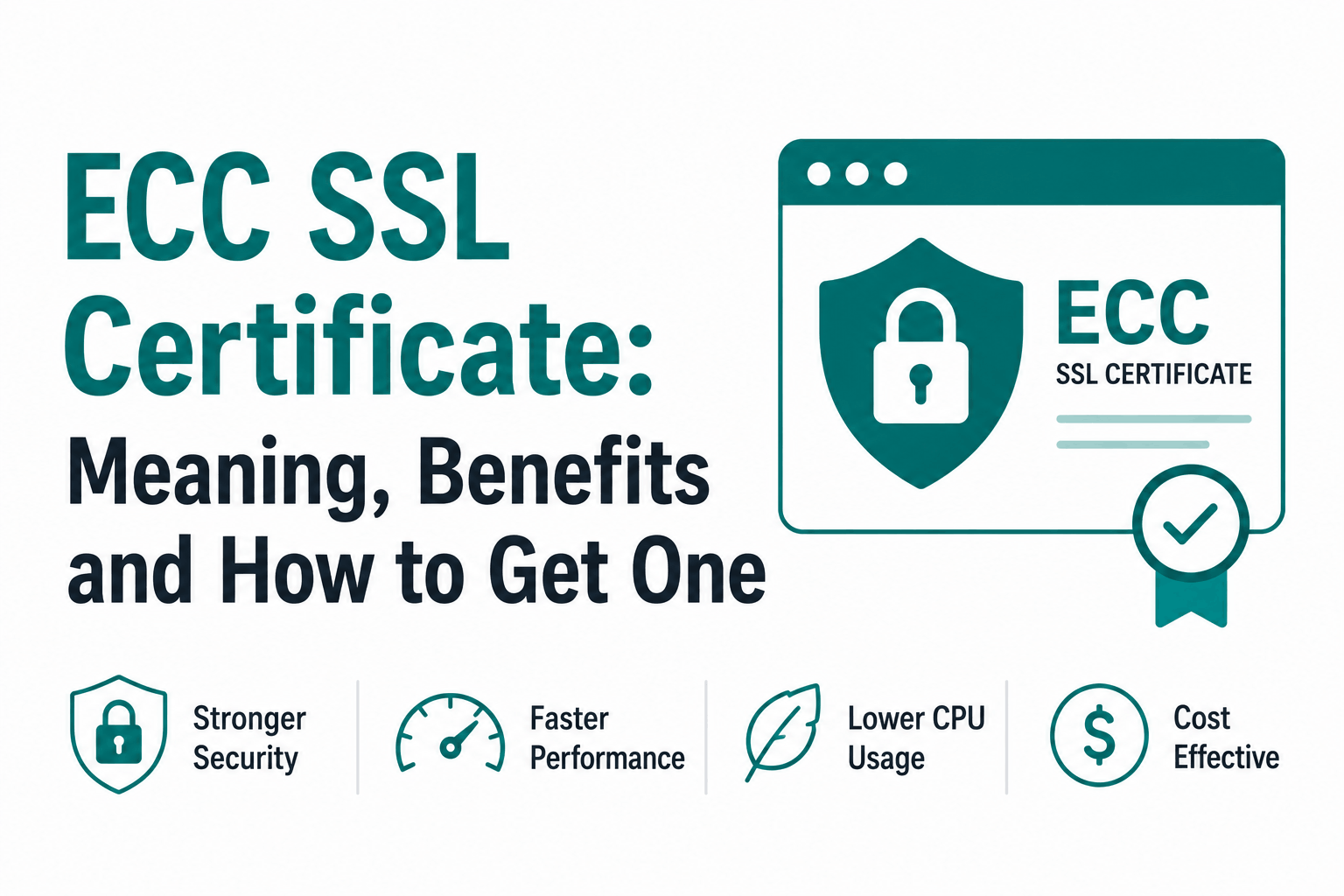
An ECC SSL certificate is a type of SSL that uses Elliptic Curve Cryptography instead of RSA to provide secure HTTPS encryption with smaller key sizes and faster performance, without compromising on security.
How Does ECC SSL Work?
To understand how ECC SSL works, it helps to break SSL down into two main phases: the asymmetric key exchange and the symmetric data encryption.
With ECC, the asymmetric key exchange — the part responsible for verifying the identity of the server and establishing a shared secret — is based on computations over a special kind of elliptic curve function defined mathematically over finite fields.
The key takeaway is this: ECC SSL certificates use the Elliptic Curve Digital Signature Algorithm (ECDSA) instead of RSA for the TLS handshake phase. While both RSA and ECC provide secure ways to exchange keys and validate identity, ECC does it using keys that are significantly smaller in size.
That means:
- Faster handshakes
- Lower CPU load
- Better performance under load
- Lower latency for end users
When ECC is paired with modern TLS (especially TLS 1.3), the result is the fastest, leanest, and most secure HTTPS stack currently available to websites, web apps, and servers.
ECC vs. RSA SSL Certificates (2026 Comparison Guide)
If you’re migrating from an RSA certificate or trying to decide between RSA and ECC SSL, you should understand how they compare across performance, compatibility, and security.
While both offer secure HTTPS, ECC is often the better choice—unless you’re forced to maintain backward compatibility with very old systems (e.g., IE8 on Windows XP).
Key Size and Security Strength
- ECC 256-bit key ≈ RSA 3072-bit key
- ECC 384-bit key ≈ RSA 7680-bit key
In 2026 and beyond, using RSA 2048-bit keys is still secure — but ECC simply provides more security per bit and is already more resistant to brute-force attacks, including potential quantum threats.
Performance and TLS Handshake Speed
The smaller the key, the faster it is to verify. ECC reduces CPU usage for both the server and the browser, especially noticeable under thousands of HTTPS requests per minute.
This makes a big performance difference for:
- eCommerce websites with active traffic
- Real-time dashboards and SaaS applications
- Web apps that use HTTP/2 or HTTP/3 (QUIC)
Compatibility and Browser Support
RSA is still more compatible with older devices. But ECC is fully supported by:
- Chrome, Firefox, Safari, Edge
- Android 7+, iOS 11+
- Windows 10+, macOS, Linux distros
- Cloudflare, AWS ACM, Azure, cPanel, NGINX, Apache
Only legacy browsers and old Java-based systems may require RSA.
Why Use ECC SSL? Benefits You Can’t Ignore
Switching to ECC SSL certificates isn’t only about protecting data — it’s about creating a faster, lighter, and more scalable web experience.
Here are the top advantages of ECC SSL:
1. Faster SSL Handshakes
During an HTTPS connection, the browser and server perform an algorithm to establish an encrypted session. With ECC, this process is faster and uses fewer resources. On busy sites, this can reduce TTFB (Time to First Byte) by several milliseconds.
2. Resource Savings for Servers
If you’re running a busy NGINX or Apache server, ECC can reduce CPU usage by 40–60% compared to RSA. That means better performance without upgrading hardware.
3. Ideal for Mobile and IoT
ECC was designed to work efficiently even in low-power computing environments. If your users include mobile devices, smart TVs, or IoT hardware, ECC improves battery life and response time.
4. Stronger Future Proofing
RSA has already doubled in recommended key size from 1024 to 2048 bits, and new minimums of 3072 bits are on the horizon. ECC offers plenty of resistance with smaller keys.
5. TLS 1.3-Optimized
If you’re rolling out TLS 1.3, ECC is practically the preferred algorithm, especially for key exchange using ECDHE-ECDSA.
ECC SSL Compatibility Across Browsers and Platforms
Here’s where ECC shines: it’s fully compatible with all modern web browsers and platforms.
| Platform | ECC SSL Supported? | Notes |
|---|---|---|
| Google Chrome | ✅ | Full support for ECDSA certificates |
| Mozilla Firefox | ✅ | TLS 1.2+ required for full cipher support |
| Safari (Mac + iOS) | ✅ | ECC fully supported in recent releases |
| Microsoft Edge | ✅ | Supports ECC since Chromium integration |
| Android Devices | ✅ | Android 7.0+ required for maximum ECC compatibility |
| Cloudflare | ✅ | Edge certs include both RSA + ECC for compatibility |
| AWS ACM | ✅ | ECC certs supported on ALB, CloudFront |
| cPanel / WHM | ✅ | Supports ECC via AutoSSL and manual installs |
⚠️ Still need RSA fallback?
If you’re hosting apps that may need to serve Windows XP, Android 4.x, or IE 8, keep an RSA certificate on your server too or use a hybrid deployment (supported by NGINX and Cloudflare).
How to Generate an ECC SSL Certificate (Step-by-Step)
1. Generate ECC Private Key with OpenSSL
We’ll start with the prime256v1 curve (broadly compatible):
openssl ecparam -name prime256v1 -genkey -noout -out ecc.key
2. Create Certificate Signing Request (CSR)
openssl req -new -key ecc.key -out ecc.csr
OpenSSL will ask for information like domain name, organization, etc.
3. Submit CSR to Certificate Authority (CA)
You can now submit the .csr file to:
- Let’s Encrypt
- DigiCert
- Sectigo
- Namecheap
- GlobalSign
4. Deploy ECC SSL Certificate
Once issued, you’ll receive certificates in .crt, .pem, or .cer format, along with an intermediate or chain file.
Installing ECC SSL on Different Servers
On NGINX
ssl_certificate      /etc/ssl/certs/ecc_fullchain.pem;
ssl_certificate_key  /etc/ssl/private/ecc.key;
ssl_protocols        TLSv1.2 TLSv1.3;
ssl_ciphers          ECDHE-ECDSA-AES256-GCM-SHA384:...
On Apache
In your SSL-enabled .conf file:
SSLCertificateFile      /etc/ssl/certs/ecc.crt
SSLCertificateKeyFile   /etc/ssl/private/ecc.key
SSLCertificateChainFile /etc/ssl/certs/chain.crt
On Cloudflare
- Log in → SSL/TLS Settings
- Choose “Full (Strict)” mode
- Cloudflare automatically provides both RSA and ECC edge certificates
ECC SSL Certificate Providers (Free + Paid Options)
| Provider | ECC Support | Free? | Wildcard Option? |
|---|---|---|---|
| Let’s Encrypt | ✅ | Yes | Wildcard via DNS ACME |
| DigiCert | ✅ | No | Available |
| Namecheap | ✅ | No | Available |
| Sectigo | ✅ | No | Available |
| Cloudflare SSL | ✅ | Yes (shared certs) | No |
| GlobalSign | ✅ | No | Available |
If you’re looking for a free ECC SSL certificate, Let’s Encrypt is your best choice — and it supports full ECDSA issuance via ACME clients like Certbot.
ECC SSL and TLS 1.3: The Perfect Match
ECC SSL certificates pair extremely well with TLS 1.3, which simplifies the handshake process and removes insecure cipher suites.
If you’re configuring NGINX or Apache for TLS 1.3 + ECC, make sure you’re using:
- Key exchange:
ECDHE - Signature:
ECDSA - Ciphers:
TLS_AES_256_GCM_SHA384,TLS_CHACHA20_POLY1305_SHA256
Frequently Asked Questions (FAQ)
What curve should I use for ECC SSL certificates?
The most common is prime256v1 (also known as secp256r1). For stronger security, use secp384r1.
Does Let’s Encrypt support ECC SSL certificates?
Yes — fully supported via ECDSA key pairs.
Can I convert my RSA certificate to ECC?
Not directly. You must create a new ECC key + CSR and reissue with your CA.
Is ECC more secure than RSA?
Yes. ECC offers equivalent security strength with smaller keys, reducing attack vectors and resource needs.
Conclusion
ECC SSL certificates are not just a replacement for RSA—they’re the future of cryptographically secure communication on the web.
They improve performance, reduce CPU load, and offer robust encryption strength with less overhead. If you’re operating a modern web server, especially on TLS 1.3, now is the time to switch to ECC or deploy hybrid RSA+ECC fallback.
From free options like Let’s Encrypt to enterprise-grade providers like DigiCert and GlobalSign — ECC SSL is easier to obtain, deploy, and automate than ever.
So whether you manage a WordPress blog, a large multi-region API, or an IoT-powered platform, ECC SSL is built for 2026 and beyond.