Last updated: Nov 1, 2025
At the most basic level, code signing is the process of applying a digital signature to software—such as executables, drivers, installers, or scripting libraries—to verify two core things: the identity of the publisher and the integrity of the code. When developers sign their software with a code signing certificate, operating systems, browsers, and antivirus engines can confirm that the software was created by a known party and that it hasn’t been altered since it was signed.
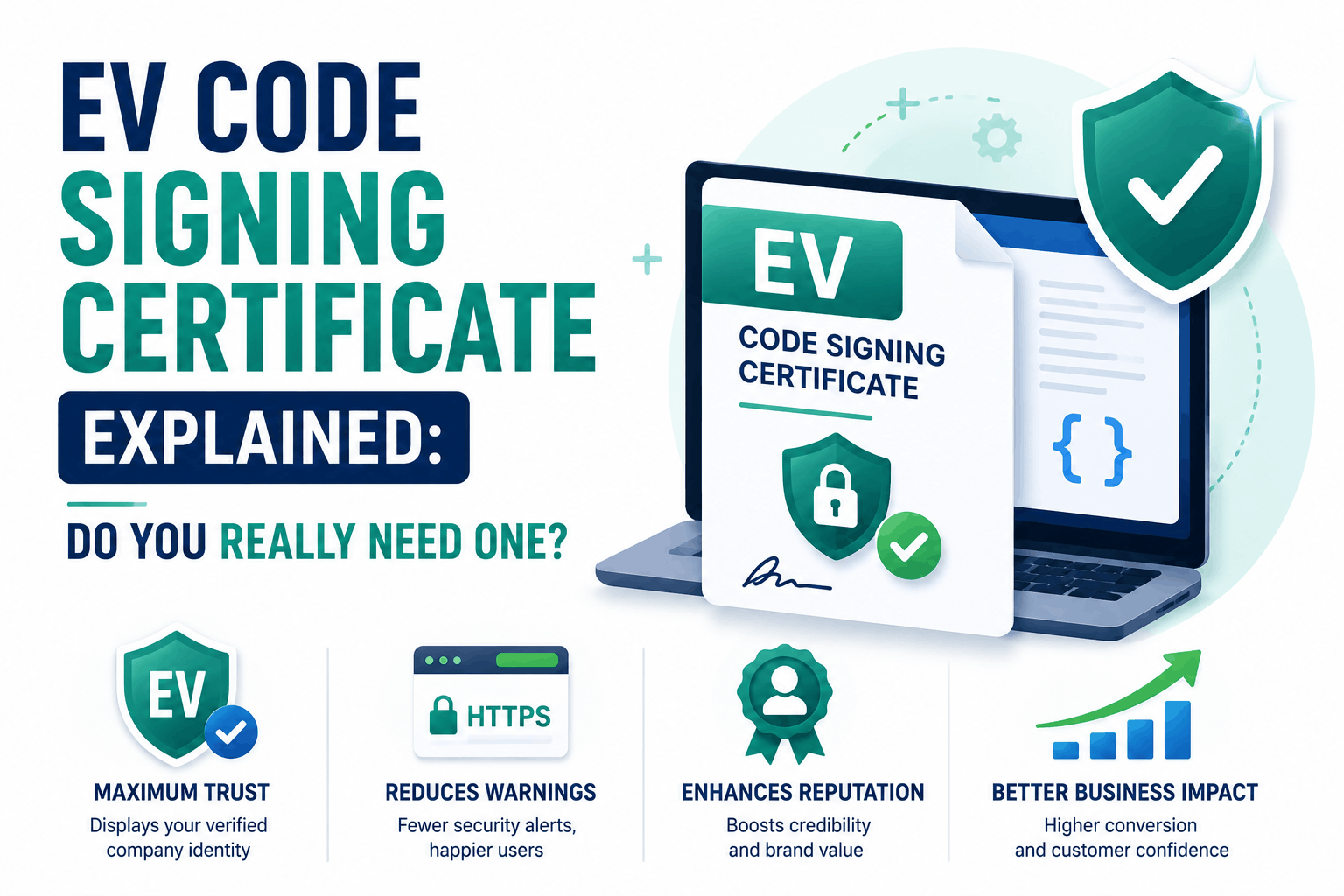
An EV Code Signing Certificate, which stands for Extended Validation Code Signing Certificate, is the highest-trust type of code signing certificate available today. Unlike standard (OV) code signing certificates, EV certificates undergo a much more rigorous validation process before they are issued. This includes extensive verification of the publisher’s legal identity, operational existence, and authorization of the requestor, ensuring the certificate can only be obtained by legitimate businesses or verified software publishers.
What makes EV code signing particularly distinct today is not just the identity verification—but the enforcement of hardware-based private key storage. According to the Code Signing Baseline Requirements (as updated in 2023–2024), all EV code signing certificates must store the signing key on a Hardware Security Module (HSM) or a FIPS 140-2 Level 2-compliant token. This means the private key used for signing cannot be exported, copied, or stolen through normal system compromise or malware. The security implication is significant: an attacker cannot use a stolen EV code signing key to sign malware without having the physical hardware or authorized cloud signing access.
When an application, driver, or executable is signed with an EV code signing certificate, operating systems like Microsoft Windows and code reputation engines such as Windows Defender SmartScreen are able to verify not only that the code was signed—but that it was signed by a cryptographically protected, identity-validated publisher. This is why EV code signing is closely associated with reducing or bypassing SmartScreen warnings, such as:
“The publisher of this app could not be verified.”
“Windows protected your PC.”
Another important property of EV-signed binaries is that they can be timestamped using a trusted timestamp server. Timestamping allows the signed software to remain valid even after the certificate expires. As long as the software was signed and timestamped while the certificate was valid, the digital signature remains trusted indefinitely—preserving long-term distribution integrity.
In short, EV code signing is a combination of:
-
Strong identity validation (first layer of trust)
-
Hardware-protected cryptographic signing keys (second layer of trust)
-
Digital signature and timestamping (third layer of trust)
-
OS-level trust and reputation (fourth layer of trust)
Taken together, EV code signing is used by organizations that must distribute software safely at scale—especially where reputation and compliance are critical. It is the de-facto standard for enterprise-grade, commercial, or widely distributed applications, where both user confidence and platform trust directly affect adoption.
How EV Code Signing Works (Step-by-Step)
EV Code Signing works by combining identity verification, hardware-enforced key control, and digital signatures to ensure that software can be authenticated by operating systems and security tools before it is installed or executed. The following is a complete, chronological overview of how EV code signing works—from certificate request to user installation.
Step 1: Certificate Enrollment and Identity Validation
The process begins when a software publisher (company or verified individual) requests an EV Code Signing Certificate from a trusted Certificate Authority (CA) such as DigiCert, Sectigo, GlobalSign, or SSL.com.
Unlike regular (OV) code signing certificates, EV certificates undergo extensive validation. The CA must verify:
-
Legal existence of the organization (business registry proof)
-
Physical address and phone verification
-
Operational status (not shell or inactive entity)
-
That the requester is authorized to obtain the certificate on behalf of the organization
This validation is governed by the CA/Browser Forum’s EV Guidelines for Code Signing, which include both certificate rules and identity audit procedures. Due to this rigor, issuance typically takes several business days instead of hours.
Step 2: Private Key Generation in Hardware (Token or HSM)
Once the CA approves the request, the next critical step is the generation and storage of the cryptographic private key.
Under the updated Code Signing Baseline Requirements (effective 2023–2024), the private key for EV code signing must be generated and stored in a FIPS 140-2 Level 2 (or equivalent) hardware device. There are two accepted forms:
-
USB-based hardware tokens shipped by the CA (e.g., SafeNet tokens)
-
Cloud-based Hardware Security Modules (HSMs) or signing services (e.g., AWS CloudHSM, Azure Key Vault, or CA-hosted signing platforms)
This means the key cannot be exported, backed up as a file, or stored on a local computer. Even if malware compromises a development machine, the attacker cannot sign malicious code without physically accessing the token or authorized HSM API.
Step 3: Code Signing Using an Authenticated Signing Tool
When signing a software package—such as a .exe, .dll, .msi, .sys, or script—the developer uses a trusted signing tool such as:
-
Microsoft SignTool (Windows)
-
osslsigncode(cross-platform alternative) -
jarsigner(for Java archives) -
codesign(macOS-specific tool)
Example Windows signing command using SignTool:
The signing tool interacts with the hardware token or HSM to access the private key at signing time. The result is a digitally signed file that contains:
-
Signature block (cryptographic binding to publisher’s certificate)
-
Certificate chain (publisher → intermediate CA → trusted root)
-
Optional RFC 3161 timestamp
Step 4: Timestamping for Long-Term Trust
Timestamping plays an important role in ensuring the signature remains valid even after the certificate expires. Without timestamping, a signed application becomes invalid at the moment the certificate expires—even if the software hasn’t been modified.
With timestamping, the timestamp server certifies that the signing took place during the certificate’s valid period. Security tools and OS trust models treat this as still valid indefinitely, as long as the binary has not been tampered with.
Step 5: Verification by Operating Systems and Security Tools
When a user downloads or installs EV-signed software, systems like Windows perform several verification checks:
-
Was the binary signed with a valid certificate?
-
Was the certificate trusted (EV identity, active, non-revoked)?
-
Is the certificate chain traceable to a root authority in the OS trust store?
-
Was a timestamp applied?
-
Has the file been changed since the signature was applied?
If all checks pass, the user sees the verified publisher name during installation, and no SmartScreen or “Unknown Publisher” warning appears.
The signature also protects integrity. If even one byte of the binary is altered post-signing, the signature becomes invalid, and the system warns the user that the file may be corrupted or malicious.
Quick Checklist: What You Need to Sign with EV Code Signing
-
EV Code Signing Certificate from trusted CA
-
Hardware token or access to HSM/cloud signing
-
Signing tool (SignTool, jarsigner, etc.)
-
Timestamp server URL from trusted TSA provider
-
Administrative permissions on signing machine or CI pipeline
-
Secure signing policy (role-based access, logging, limited key holders)
This full process—from identity validation to runtime verification—is what makes EV code signing fundamentally more secure than standard (OV) code signing. It doesn’t just certify the code; it certifies the developer, the hardware the key lives in, and the authenticity of every distributed binary.
Benefits of EV Code Signing (With SmartScreen Reality Check)
EV Code Signing Certificates deliver a wide range of security, trust, and distribution advantages that standard (OV) code signing certificates do not. These benefits are rooted not only in stronger identity verification, but also in hardware-enforced security and elevated trust at the operating system and reputation system level. While some vendors oversimplify the benefits—especially around SmartScreen reputation—it’s important to distinguish between expected operational benefits and guaranteed outcomes. This section explains both clearly.
1. Strongest Publisher Identity Verification
EV certificates follow the highest level of identity vetting defined by the CA/Browser Forum. Before issuing an EV Code Signing Certificate, the Certificate Authority verifies:
-
Legal registration status of the organization
-
Full operational existence (not a shell entity)
-
Verified physical address and phone number
-
That the requestor is an authorized officer or employee
These steps matter because many software supply chain attacks rely on impersonation. EV verification dramatically lowers the risk that a malicious actor can obtain a certificate in the name of a real company—or sign malware under a forged identity. This is significantly stronger than the validation steps used for standard (OV) code signing.
2. Hardware-Protected Private Keys (High-Assurance Security)
Unlike regular code signing certificates, EV certificates require the private key to be stored in hardware—either on a physical USB token or cloud-based HSM (Hardware Security Module). The key cannot be exported, duplicated, or stored as a file on a developer’s laptop or CI server.
This directly addresses one of the most common and damaging attack vectors in recent years: stolen signing keys. Attackers who compromise build systems or development endpoints are unable to retrieve EV signing keys without access to the secure device or signing service. This mitigates the risk of malware being signed under a legitimate name, which otherwise bypasses many security detections.
3. Increased Trust and Reduced Install Friction
One of the biggest practical benefits of EV Code Signing Certificates is the difference in user experience during installation. When installing software signed with an EV certificate, users see the verified publisher name in the security dialog box instead of generic or alarming labels such as “Unknown Publisher.”
This is especially important when distributing downloadable software such as:
-
Executable installers (.exe, .msi)
-
Desktop applications
-
System utilities
-
Command-line tools
-
Drivers and hardware-related software
Users are less likely to abandon installation or report the software as unsafe, resulting in better software adoption and fewer support issues.
4. SmartScreen Reputation Advantage – But Not a Guaranteed Bypass
A frequent claim in sales materials is that EV Code Signing Certificates “instantly bypass Microsoft SmartScreen filter warnings.” In reality, the truth is more nuanced.
SmartScreen is a reputation-based system, not a simple certificate check. However, EV certificates are explicitly recognized by SmartScreen as high-trust credentials. In practice, this often results in immediate reputation or dramatically faster trust accumulation compared to standard code signing certificates. Many developers find that newly signed applications pass SmartScreen checks without “Windows protected your PC” warnings.
However, SmartScreen is not mathematically guaranteed to bypass warnings solely because the binary was signed with an EV certificate. Reputation also considers factors like:
-
Code signing history of the publisher
-
File distribution volume and download ecosystem
-
User feedback (positive/negative)
-
Threat intelligence and malware reports
In summary:
-
EV code signing strongly increases the likelihood of SmartScreen pass
-
But SmartScreen results are not guaranteed in every case or for every file
By stating this clearly, we set proper expectations and avoid misleading claims, while still conveying why EV remains the most reliable option for high-trust software distribution.
5. Supports Microsoft Driver Signing Requirements
Microsoft’s current policy requires EV Code Signing Certificates for software publishers who sign kernel-mode drivers on Windows 10, Windows 11, and Server editions. The EV certificate is used not for final distribution, but to authenticate the publisher with Microsoft’s Hardware Dev Center before submitting the driver package for attestation signing.
Without an EV certificate, a developer cannot onboard into the Microsoft driver signing portal. This requirement alone makes EV code signing mandatory for hardware and driver developers.
6. Lower False Positives from Antivirus Engines
Unsigned or self-signed applications are far more likely to be flagged as suspicious or quarantined by antivirus engines and endpoint management tools. Even OV-signed applications are sometimes flagged when their publisher reputation is low.
EV-signed applications, by contrast, inherit a significantly cleaner baseline in antivirus and threat intelligence systems—because EV validation proves the software was produced by a verified, traceable entity. This reduces support tickets, customer complaints, and deployment failures in managed enterprise environments.
7. Long-Term Signature Validity Through Timestamping
With proper timestamping, an EV code signature remains valid indefinitely—even after the certificate expires. This is critical for organizations that distribute software over long periods or maintain archived versions for compliance reasons.
If timestamping is omitted, the signature becomes untrusted on the day the certificate expires—a major risk for unattended installers and long-life downloads.
EV Code Signing offers both security advantages (like hardware key protection and supply-chain integrity) and distribution advantages (like better install experience, SmartScreen trust, and reduced AV false positives). The combination of both is why EV certificates are now widely used not just by large software vendors, but also by smaller ISVs, SaaS vendors, cybersecurity tools, and enterprise internal software publishers.
EV vs OV Code Signing: Which Should You Choose?
Choosing between an EV (Extended Validation) Code Signing Certificate and an OV (Organization Validation) Code Signing Certificate depends on your software distribution model, security requirements, platform expectations, and user trust goals. While both certificate types allow you to digitally sign applications and assure code integrity, the level of identity validation, key protection, platform reputation, and deployment outcomes differ in important ways.
What OV Code Signing Provides
An OV Code Signing Certificate verifies the identity of the publisher at the organization level and enables developers to sign software so that operating systems and users can confirm its origin. When a user installs an OV-signed application, operating systems like Windows can confirm that the binary is intact and that the installer was published by the named entity (e.g., “Acme Software, Inc.”) rather than “Unknown Publisher.”
However, OV code signing has key limitations:
-
The private key may be stored on the file system, making it vulnerable to theft if not carefully managed.
-
Windows SmartScreen reputation is not automatically established for OV-signed applications; reputation must be earned gradually over time through user downloads and telemetry.
-
OV does not satisfy newer Microsoft requirements for Windows kernel-mode driver signing on Windows 10 and 11.
-
The certificate lifecycle and compliance requirements are not as strict as with EV.
For many internal, low-risk, or low-distribution applications, OV code signing can be sufficient, especially if SmartScreen warnings and enterprise trust workflows are not a concern.
What EV Code Signing Adds on Top of OV
An EV Code Signing Certificate includes everything OV does—but with significantly stronger assurance and mandatory technical controls. In addition to identity verification, EV requires:
-
Hardware-based private key storage (USB token or HSM)
-
Extended organizational identity screening during issuance
-
Greater trust from reputation services (especially Microsoft SmartScreen)
-
Eligibility for Windows driver signing certification workflows
-
More secure distribution process, reducing supply chain attack surface
In environments where software reputation, trust, and compliance are critical—especially for widely distributed installers, consumer apps, commercial software, or Windows drivers—EV code signing is not just a higher-security option but often a practical or compliance requirement.
EV vs OV Code Signing Summary Table
| Feature | OV Code Signing Certificate | EV Code Signing Certificate |
|---|---|---|
| Identity Validation | Standard organization verification | Extended Validation (legal, operational, and identity checks) |
| Private Key Storage | File-based storage allowed | Hardware token or HSM required |
| SmartScreen Reputation | Not automatic; builds over time | Strong boost; often instant or accelerated |
| Windows Driver Signing | Not accepted for kernel-mode drivers | Required for Dev Center onboarding and driver submission |
| Protection Against Stolen Keys | Not enforced; local key theft more likely | Hardware-backed, FIPS-level secure |
| Issuance Time | 1–3 days typically | 3–10 days typically (depending on documentation) |
| Use Case Fit | Internal tooling, limited distribution, low-risk apps | Public apps, commercial software, high trust, security compliance |
| Cost | Lower | Higher due to validation and hardware |
Choosing the Right Certificate
You should choose EV Code Signing if:
-
Your software is distributed to the public via download or installer
-
You want to avoid “Unknown Publisher” or SmartScreen warnings
-
You have a brand reputation to protect or products with long lifecycles
-
You develop Windows kernel-mode drivers
-
You need to meet enterprise or regulated software delivery requirements
-
You want hardware-based private key protection against signing key theft
You should choose OV Code Signing if:
-
Your app is deployed internally or to a trusted user base
-
SmartScreen reputation and user prompts do not affect adoption
-
Your dev team can protect a local private key without hardware
-
You’re working with scripts, test binaries, or low-distribution tools
In many organizations, both certificates may be used for different purposes. For example, EV may be used to sign full installer packages or drivers, while OV may be used to sign internal debugging utilities or non-sensitive components.
Do I Need EV Code Signing for Windows Drivers?
If you are developing a driver or kernel-mode software that will be used on Microsoft Windows, the answer in many cases is: yes, you do need an EV Code Signing Certificate. Microsoft’s current driver signing policy has placed EV certificates at the centre of its validation workflow, especially for kernel-mode drivers distributed to Windows 10, Windows 11, and Windows Server platforms. Understanding how this works is critical for any software publisher working with drivers.
Why EV is Required for Driver Signing
Microsoft requires that any company who wants to submit a kernel-mode driver to the Hardware Dev Center (and thereby have it signed by Microsoft) must first authenticate the identity of the publisher. That authentication is conducted using an EV Code Signing Certificate issued to a verified organization. In other words, the EV certificate is used to onboard your organization into Microsoft’s trusted publisher ecosystem.
Without an EV code signing certificate, you cannot complete the Dev Center enrollment phase and you cannot obtain the catalogs or cross-certificates needed for driver distribution.
Kernel-Mode Signing Workflow (Simplified)
Here is a high-level workflow of how driver signing works when EV is involved:
-
Purchase an EV Code Signing Certificate and complete the identity verification (legal entity, physical address, etc).
-
Use the EV certificate to authenticate your organization inside Microsoft Partner Center/Hardware Dev Center.
-
Build your driver package and sign it locally with your EV certificate (optional depending on workflow).
-
Submit your driver package to Microsoft for attestation signing or HLK (Hardware Lab Kit) validation. Microsoft applies its signature and issues a signed catalog file (.cat) or driver package.
-
Distribute your signed driver through Windows Update, OEM channels, or directly. Because the driver is signed (via Microsoft’s trusted system) and the publisher identity is verified, Windows will install without the “Unknown Publisher” or “Unsigned Driver” warnings.
When EV Might Not Be Needed
If you are writing a user-mode driver or a signed driver that is intended only for internal enterprise deployment (using Group Policy or enterprise trust), the requirement for EV may be relaxed depending on your distribution context. For example, if the driver’s installer is published internally and trust is handled via an internal certificate authority, you may choose an OV code signing certificate or enterprise-trusted certificate chain instead.
However, for publicly distributed drivers—especially those published via Windows Update or as part of third-party OEM components—EV remains the widely accepted standard and often the policy expectation.
What This Means for Your Project
If you are developing a driver with the following characteristics, you should prepare for EV code signing:
-
Intended for Windows 10/11 or Windows Server in kernel mode
-
Distributed publicly (internet download, OEM bundle, retail packaging)
-
Intended to update via Windows Update or be listed in Device Manager without warnings
-
Required to pass Microsoft’s attestation signing process
By contrast, if your software is a simple user-mode application or a device driver distributed only inside a closed enterprise, you may evaluate whether OV code signing meets your needs—but you must still assess the security, trust, and reputation ramifications.
Hardware Tokens, HSMs, and Cloud Signing Services
A defining requirement of EV Code Signing Certificates is that the private key used for signing must be stored and used inside a hardware-backed cryptographic module. This rule is enforced by the CA/Browser Forum’s Code Signing Baseline Requirements, which mandate that EV code signing keys be generated and protected in a device certified to FIPS 140-2 Level 2 or higher, or an equivalent Common Criteria assurance level. This shift has major implications for how signing workflows are designed, especially in modern CI/CD pipelines and distributed development teams.
Why Hardware Key Storage Is Required
The primary reason behind this requirement is to prevent one of the most damaging forms of cyberattack: the theft of software signing keys. Stolen signing certificates have been used in high-profile supply chain attacks to sign malware that appears legitimate and trusted by operating systems—effectively bypassing core security controls. By enforcing hardware-based private key protection, EV code signing greatly reduces this attack surface.
Private keys stored in a hardware security module (HSM) or a purpose-built USB token cannot be exported, copied, or injected into memory like file-based keys (e.g., .pfx, .pem) used in regular code signing. Even if an attacker compromises a developer workstation or build agent, they cannot extract the signing key without physical access to the cryptographic device.
The Three Main Key Storage Models
There are now three common ways organizations use EV code signing securely in production, depending on their size, workflow, and deployment model.
1. USB Hardware Token
-
The CA issues a physical USB token (e.g., SafeNet eToken) that contains the private key and certificate.
-
Developers plug in the token when signing software locally using
signtool,jarsigner, or GUI-based tools. -
Works in small, manual signing workflows or single-machine signing setups.
-
Not ideal for automated CI/CD pipelines unless you implement USB forwarding, VM passthrough, or air-gapped signing stations.
2. On-Premises or Cloud HSM
-
Instead of a USB device, the EV certificate is installed on a network-accessible HSM (Hardware Security Module), such as Thales or AWS CloudHSM.
-
The signing operation is performed remotely using authenticated API calls.
-
This is the preferred model for enterprises doing centralized signing, auditing, and delegation of signing rights.
-
Often integrated with role-based access and tamper-evident controls.
3. Managed Code Signing Services
-
Some CAs and security vendors now offer hosted signing platforms, where the private key is held inside a compliant HSM and accessed through secure signing APIs.
-
There is no token to manage, and the key remains inside a controlled environment.
-
Ideal for cloud-native builds, DevOps pipelines, and remote teams.
-
Examples include DigiCert KeyLocker, Sectigo Signing Service, and Azure Key Vault signing.
This third option has grown rapidly in popularity because it satisfies both compliance requirements (FIPS-level key protection) and DevOps workflow needs (API-based, automated, credential-gated signing).
Which Option Should You Choose?
| Requirement | Best Fit Option |
|---|---|
| Small team, occasional manual signing | USB token |
| Enterprise security, SOC 2/ISO compliance | On-prem HSM |
| Automated signing in cloud CI/CD | Managed signing service or cloud HSM |
| Driver signing with Windows Dev Center integration | Any, as long as EV and hardware rules are satisfied |
Implementation Considerations for CI/CD
If you are signing binaries inside a CI/CD pipeline (Azure DevOps, GitHub Actions, Jenkins, etc.), storing a private key in the build environment is no longer an option for EV certificates. Instead, signing jobs should:
-
Authenticate to an HSM or signing API using securely stored credentials
-
Execute a signing workflow in the final stage of the build
-
Store no persistent signing key material in the CI environment
-
Log signing audit data (signature hash, build ID, operator identity, timestamp)
These patterns are now becoming mainstream as part of software supply chain security practices, especially in environments adopting SLSA, SIGSTORE, or SBOM-enforced delivery models.
Implementation Guide: Signing in CI/CD
Code signing used to be something done manually on a developer’s workstation, perhaps once before a public software release. But with frequent deployments, distributed teams, zero trust security models, and modern supply chain standards, organizations now need the ability to sign software securely inside a continuous integration / continuous delivery pipeline—without exposing private keys or weakening trust.
EV Code Signing introduces new constraints that impact CI/CD design. Since private keys must be stored in hardware (either a physical token or an HSM), signing workflows must be adapted to use secure, authenticated key access instead of static .pfx files or local certificate stores.
Below is a practical framework for implementing EV code signing inside automated build systems.
Step 1: Choose a Hardware-Backed Key Storage Model
Before integrating signing into CI/CD, choose how your EV certificate will be stored and accessed:
-
Hardware Token (USB-based): Requires physical access or USB forwarding to a build host. Suitable for isolated build servers, not for cloud-based CI.
-
Cloud or On-Prem HSM (e.g., AWS CloudHSM, Azure Key Vault, Thales HSM): Keys are stored in a secure module and accessed via authenticated API calls.
-
Managed Signing Service (e.g., DigiCert KeyLocker, Sectigo Signing Service): Key never leaves CA-controlled environment; signing is done through secure endpoints.
For cloud-based pipelines (GitHub Actions, GitLab CI, Azure DevOps), the HSM or signing service model is strongly recommended.
Step 2: Configure Your Signing Toolchain
EV code signing works with standard signing utilities that support external key environments. Common signing tools include:
-
signtool.exe– Microsoft’s built-in signing tool (for.exe,.dll,.sys, etc.) -
jarsigner– Java archives (.jar) -
osslsigncode– Cross-platform CLI for Authenticode and PE signing -
codesign– macOS signing for.app,.dmg,.pkg
Here’s an example using signtool with timestamping and automatic certificate selection:
If you’re using a remote signing service or HSM, your tool will authenticate using:
-
Token identity or access keys
-
TLS client certificates
-
Role-based service accounts
-
IP allow-listing or VPN restrictions
Step 3: Add Secure Signing to the CI/CD Pipeline
Signing should happen after the build and test stages, and before packaging or artifact publishing.
Typical CI/CD stages:
-
Build – Compile and assemble software artifacts
-
Test – Unit, integration, and security validation
-
Sign – Call the signing tool, using hardware-backed EV key
-
Timestamp – Add RFC 3161 timestamp metadata
-
Package – Wrap installer, container, or driver
-
Publish – Deploy to distribution channel
In YAML (hypothetical example for Azure Pipelines):
In GitHub Actions using a signing API:
These examples illustrate the difference: the signing tool interacts with the remote key, not with a local .pfx or certificate file.
Step 4: Audit and Log Signatures
In regulated environments, signing activity itself must be logged so you can attest:
-
Who triggered the signing job
-
Which version or artifact was signed
-
Which key or certificate was used
-
The hash or digest of the signed binary
-
The timestamp server used
Use secure log forwarding or SIEM integration to retain this data. Many managed signing services provide audit logs and signing session metadata by default.
Step 5: Validate and Verify the Signature
Always verify the signature after the signing step. For example, use signtool verify /pa file.exe or equivalent checks in your pipeline. A verification step catches issues such as:
-
Certificate chain errors
-
Missing or invalid timestamp
-
Incorrect usage (e.g., EV certificate used for nonsensical binary types)
-
Policy misalignment (e.g., wrong certificate used)
Best Practices for CI/CD-Ready EV Code Signing
-
Never store signing keys in environment variables or files
-
Require two-person approval or role-based access to initiate signing
-
Use separate certificates for production and staging artifacts
-
Store private keys in dedicated HSMs—not in developer laptops
-
Always timestamp signed binaries for post-expiry trust
-
Rotate signing access credentials regularly
-
Monitor and alert on unexpected signing activity
These patterns are now considered baseline practice in modern software supply chain security and align with frameworks like SLSA, NIST SSDF, and upcoming software signing regulations.
Cost, Issuance, and Validation Requirements
When deciding whether to purchase an EV Code Signing Certificate, it’s important to understand not only the technical requirements but also the logistical and financial elements involved. Compared to standard (OV) code signing certificates, EV certificates require additional validation steps, hardware security controls, and identity verification. These increase the level of trust but also add cost and operational overhead.
Below is a breakdown of pricing expectations, typical issuance timelines, and what documents are required to pass Extended Validation (EV) checks successfully.
How Much Does an EV Code Signing Certificate Cost?
The cost of an EV Code Signing Certificate typically ranges from $300 to $700 per year, depending on:
-
The issuing Certificate Authority (CA)
-
Subscription length (multi-year purchases may include discounts)
-
Whether the certificate includes a physical hardware token
-
Whether you are using a cloud-based signing service (billed separately)
Here is a common price range as of 2024:
| Provider | 1-Year EV Code Signing Price (Approx.) |
|---|---|
| DigiCert | $499–$599/year |
| Sectigo | $449–$599/year |
| GlobalSign | ~$649/year |
| SSL.com | ~$349–$449/year |
| Comodo | ~$400–$550/year |
Additional costs may apply if:
-
A USB token needs to be shipped internationally
-
A signing HSM service is used (e.g., $20–$80 per month)
-
You bundle timestamp or document signing tools
Most vendors allow 1-, 2-, or 3-year purchase terms, though the certificate itself must be renewed and reissued every 1–3 years per CA/B Forum policies.
How Long Does EV Certificate Issuance Take?
EV Code Signing Certificates are not issued instantly. Because they require full verification of the publisher’s identity, issuance can take anywhere between:
-
3–5 business days (fast track)
-
7–14 business days (standard timeline)
Factors that impact issuance time:
| Factor | Impact on Timeline |
|---|---|
| Business legitimacy records are up to date | Faster processing |
| Public directory validation matches (DUNS, state registry) | Faster processing |
| Legal name mismatch or recent company changes | Slower processing |
| Missing phone verification or domain verification delays | Slower processing |
| Certificate requestor authorization cannot be confirmed | Slower processing |
If your organization’s legal or registration information is incomplete, outdated, or difficult to verify, the process can take significantly longer.
What Documents Are Required for EV Validation?
To pass Extended Validation, Certificate Authorities must verify several attributes about your company or organization, including:
-
Legal Existence – Verified via government or public business registry.
-
Operational Status – Company must not be dissolved or inactive.
-
Physical Address – Verified via trusted third-party databases or official filings.
-
Telephone Number – Must match validated business identity or directory listing.
-
Certificate Requestor Authorization – CA must verify that the person requesting the certificate is authorized by the organization (e.g., through HR or legal confirmation).
Acceptable documentation includes:
-
Government business registration certificate
-
Articles of incorporation
-
Active DUNS listing (with accurate info)
-
Utility bills or bank statements for physical address verification (in some cases)
-
Signed subscriber agreement or authorization form
For sole proprietors or individuals, supporting documents may include government-issued ID and proof of business activity.
Why EV Validation Sometimes Fails
Common reasons why EV certificate issuance stalls or fails:
-
The organization was recently renamed, merged, or restructured
-
The business address doesn’t match public records or was recently updated
-
The CA cannot reach a public directory listing to validate the phone number
-
The certificate requester is not clearly tied to the organization
-
Missing or incomplete validation authorization form
-
The company has no visible online presence or public record
To avoid delays, you should confirm your business information is correct and up to date in sources like DUNS, government registries, or tax/licensing bodies before applying.
Final Issuance and Hardware Delivery
Once validation is complete, the CA issues the EV Code Signing Certificate and:
-
Ships your hardware USB token (if applicable)
-
Delivers credentials for HSM/cloud signing access
-
Provides installation and API instructions for signing tools
Only after you receive the hardware token or complete signing service enrollment can you begin signing binaries.
Bottom Line: When EV Code Signing Is Worth It
Extended Validation (EV) Code Signing offers the strongest level of identity assurance, cryptographic protection, and software trust available to developers today. While EV certificates cost more and require a more involved issuance process than standard (OV) code signing certificates, the benefits often outweigh the investment—especially when distributing software to public or security-sensitive user bases.
EV Code Signing Is Worth It When:
-
You’re distributing Windows software publicly and want to avoid “Unknown Publisher” or SmartScreen warnings.
-
You build commercial, enterprise, or security-critical applications that require maximum user confidence and software reputation.
-
Your organization delivers Windows kernel-mode drivers and must enroll in Microsoft’s Hardware Dev Center.
-
You need hardware-based signing key protection to prevent key theft and supply-chain attacks.
-
Your security program or compliance strategy requires key custody controls, signing logs, and secure pipelines.
-
Your software is expected to have a long lifecycle and must retain valid signatures through timestamping even after the certificate expires.
EV May Be Overkill When:
-
Software is distributed privately within closed intranet environments.
-
You do not ship Windows executables, installers, or drivers.
-
You only need to sign internal scripts, prototypes, or testing tools.
-
SmartScreen reputation and external user trust are not a concern.
-
An existing enterprise PKI or secure internal signing system is already in place.
As security expectations for software publishers continue to rise—and as supply chain attacks increase—EV code signing is becoming less of an option and more of a standard. For most public-facing software, enterprise-grade applications, or distributed installers, EV code signing is the most effective and reliable way to build instant trust, improve security posture, and meet user expectations on modern platforms like Windows 10 and Windows 11.
FAQ:
What is an EV Code Signing Certificate?
An EV (Extended Validation) Code Signing Certificate is a high-trust digital certificate used to sign software and verify the identity of the publisher. It requires strict identity validation and mandates hardware-based private key storage to protect software signing keys.
Does EV code signing bypass Microsoft SmartScreen?
EV code signing significantly improves SmartScreen reputation and often results in automatic trust, but it does not guarantee SmartScreen bypass in all situations. SmartScreen uses a reputation system based on certificate trust, file behavior, and download metrics.
Do I need an EV Code Signing Certificate for Windows drivers?
Yes. If you are signing kernel-mode drivers for Windows 10, Windows 11, or Server OS, an EV Code Signing Certificate is required to enroll in Microsoft’s Hardware Dev Center and submit drivers for attestation signing.
How long does it take to get an EV Code Signing Certificate?
Issuance typically takes 3 to 10 business days because the Certificate Authority must validate the organization’s legal identity, physical address, and phone number before approval.
Can I use an EV Code Signing Certificate in CI/CD pipelines?
Yes. EV code signing can be integrated into CI/CD pipelines using cloud HSMs or managed signing services, since the certificate’s private key cannot be stored locally. APIs from Azure Key Vault, DigiCert KeyLocker, or Sectigo Signing Service are commonly used.
What happens when an EV Code Signing Certificate expires?
If the signed software was timestamped at the time of signing, the signature remains valid even after the certificate expires. Without timestamping, signed binaries will show errors once the certificate reaches its expiration date.
Is EV code signing more secure than OV code signing?
Yes. EV code signing is more secure because it requires hardware-protected private keys and extended identity validation, making it harder for attackers to obtain or misuse the certificate.