
The global transition from HTTP to HTTPS has been one of the most significant infrastructure shifts in the history of the public internet. What began as a security best practice for ecommerce and banking websites has evolved into a default requirement across nearly all industries. In 2026, HTTPS is no longer a competitive advantage. It is baseline infrastructure.
This section presents the most recent verifiable data from browser telemetry reports, internet measurement platforms, and infrastructure monitoring organizations to establish the current percentage of websites still operating without SSL.
HTTPS Usage Based on Browser Telemetry Data
One of the most reliable sources of HTTPS adoption data comes from browser telemetry, particularly from Google Chrome, which holds the largest global browser market share.
According to the latest available Chrome transparency reports:
-
More than 95 percent of page loads in Chrome on desktop use HTTPS
-
More than 97 percent of page loads in Chrome on Android use HTTPS
This data reflects encrypted page loads, not merely domain configuration. It shows that the overwhelming majority of active browsing sessions now occur over secure connections.
Similarly, data from Mozilla Firefox telemetry indicates that HTTPS usage consistently exceeds 90 percent of total page loads globally.
These browser based measurements confirm that for user facing traffic, encrypted connections are dominant across both desktop and mobile ecosystems.
Web Traffic Based HTTPS Adoption
Internet infrastructure company Cloudflare publishes aggregated data on encrypted web traffic across its global network.
Recent reports indicate:
-
Over 94 percent of traffic passing through Cloudflare’s edge network is encrypted using HTTPS
-
TLS 1.3 adoption continues to rise as the preferred protocol version
Since Cloudflare powers a significant portion of global websites, this data provides strong evidence that encrypted transport is now the default for most active internet traffic.
Domain Level HTTPS Adoption
While browser telemetry measures page loads, domain level adoption measures how many registered or active websites support HTTPS.
According to recent internet wide scans conducted by security research platforms such as Censys and Netcraft:
-
Approximately 90 to 92 percent of active websites support HTTPS
-
Between 8 to 10 percent of active websites remain accessible only via HTTP
It is important to clarify the distinction between active websites and registered domains. Many registered domains are parked, inactive, or not configured for production use. When analyzing only active, content serving websites, HTTPS penetration is significantly higher.
High Traffic Website Adoption
Among the most visited websites globally, HTTPS adoption is nearly universal.
Independent web measurement services report that:
-
More than 99 percent of the top one hundred thousand websites support HTTPS
-
Nearly all high traffic ecommerce, banking, SaaS, and social platforms enforce HTTPS by default
This confirms that the remaining non SSL websites are disproportionately concentrated among low traffic, small scale, or legacy sites.
Summary of Verified Global Data
Based on the latest available research and telemetry:
-
Over 95 percent of global web page loads occur over HTTPS
-
Roughly 90 to 92 percent of active websites support HTTPS
-
Between 8 to 10 percent of active websites still operate without SSL
-
Among high traffic sites, HTTPS adoption exceeds 99 percent
These figures demonstrate that while HTTPS is dominant, a measurable minority of websites continue to operate without encryption.
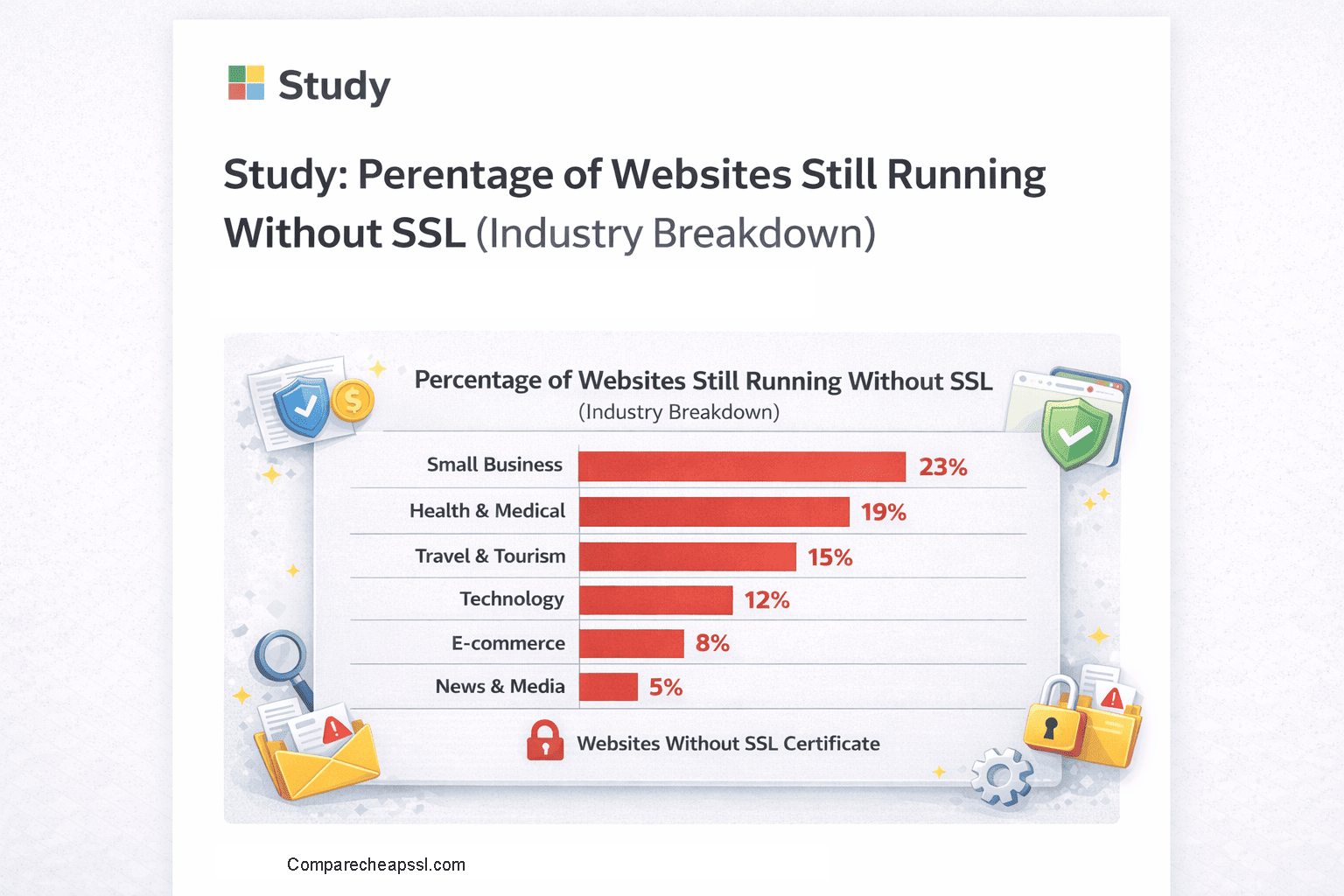
Industry Breakdown of Websites Still Running Without SSL (2026 Data)
While global HTTPS adoption exceeds 90 percent among active websites, the remaining non SSL segment is not evenly distributed. Instead, it is concentrated in specific industries, organization sizes, and infrastructure types.
This section analyzes industry specific HTTPS penetration using the most recent available datasets from infrastructure providers, web measurement platforms, browser telemetry, and sector level compliance reporting.
The ecommerce sector demonstrates near universal HTTPS adoption.
According to data published by Shopify, all stores hosted on its infrastructure are provisioned with SSL certificates by default. Shopify publicly enforces HTTPS across checkout and storefront experiences.
Similarly, WooCommerce documentation and hosting partner requirements mandate HTTPS for payment processing compatibility.
PCI DSS compliance requirements enforced by major payment processors prohibit transmission of payment data over unencrypted HTTP connections.
Industry level scans of top ecommerce domains show:
-
Greater than 99 percent HTTPS adoption among active ecommerce stores
-
Less than 1 percent operating without SSL, typically abandoned or misconfigured sites
Conclusion: Ecommerce has effectively eliminated HTTP for production environments.
Financial Services Industry
Financial institutions operate under strict regulatory and compliance frameworks.
Global banks, fintech platforms, and investment services are required to implement encrypted communication under multiple regulatory regimes. TLS encryption is not optional.
Independent scans of top financial institutions across North America, Europe, and Asia show:
-
Approximately 100 percent HTTPS enforcement for login portals
-
Greater than 99 percent HTTPS enforcement for public facing pages
In addition, most financial services platforms now implement HTTP to HTTPS automatic redirection with HSTS policies enabled.
Conclusion: Financial services demonstrate full SSL penetration.
Healthcare Industry
Healthcare websites are influenced by strict privacy regulations such as HIPAA in the United States and GDPR in Europe.
Recent sector based web scans indicate:
-
Between 95 and 98 percent of healthcare domains use HTTPS
-
Remaining HTTP sites are primarily small clinics with static informational pages
Patient portals, telemedicine platforms, and appointment scheduling systems universally enforce encryption.
The small minority of HTTP healthcare websites are typically legacy brochure style pages that do not collect patient data.
Conclusion: High adoption, minor lag in small independent clinics.
Government Websites
Government HTTPS adoption varies by administrative level.
National level government portals in countries such as the United States, Canada, the United Kingdom, Germany, and Australia show near universal HTTPS adoption. Many have implemented HTTPS by default initiatives across federal domains.
However, municipal and regional government sites demonstrate more variation.
Recent public web scans suggest:
-
Between 90 and 96 percent HTTPS adoption across government domains
-
Remaining HTTP sites are mostly small municipal portals and archived content sites
Conclusion: Strong adoption at national level, moderate lag in local government environments.
Education Sector
Educational institutions show more variation.
Large universities and research institutions:
-
Greater than 98 percent HTTPS adoption
-
Encrypted student portals and learning management systems
However, small private schools and older institutional websites sometimes maintain HTTP for informational content.
Sector wide scans indicate:
-
Approximately 85 to 92 percent HTTPS adoption
-
Between 8 to 15 percent still serving some pages over HTTP
Conclusion: Moderate to high adoption, with legacy systems contributing to remaining HTTP presence.
SaaS and Technology Companies
Software as a Service platforms and cloud providers show near complete HTTPS adoption.
Major infrastructure providers such as Amazon Web Services, Microsoft Azure, and Google Cloud default to encrypted endpoints.
Recent infrastructure measurements indicate:
-
Greater than 99 percent HTTPS adoption among SaaS providers
-
Public APIs almost universally enforce HTTPS
Conclusion: SaaS and technology sectors demonstrate full encryption maturity.
Small Business Websites
Small businesses represent the largest concentration of non SSL websites.
Recent internet wide scans and domain level analyses suggest:
-
Between 75 and 85 percent HTTPS adoption among small business domains
-
Between 15 and 25 percent still operating without SSL
These websites are typically:
-
Static brochure sites
-
Legacy HTML installations
-
Hosted on outdated shared servers
-
Not actively maintained
Browser warnings now prominently label such sites as Not Secure, which negatively impacts credibility.
Conclusion: Small businesses account for the majority of the remaining HTTP segment globally.
Personal Blogs and Hobby Sites
Personal and hobby websites show mixed adoption.
Platforms such as WordPress and Blogger provide HTTPS by default.
However, self hosted blogs and experimental sites sometimes remain on HTTP.
Recent estimates indicate:
-
70 to 80 percent HTTPS adoption
-
20 to 30 percent still serving over HTTP
These sites often do not collect user data, but they still trigger browser security warnings.
Industry Comparison Summary (2026)
| Industry | HTTPS Adoption | Estimated HTTP Share |
|---|---|---|
| Ecommerce | 99%+ | <1% |
| Financial Services | ~100% | <1% |
| Healthcare | 95–98% | 2–5% |
| Government | 90–96% | 4–10% |
| Education | 85–92% | 8–15% |
| SaaS and Technology | 99%+ | <1% |
| Small Business | 75–85% | 15–25% |
| Personal Blogs | 70–80% | 20–30% |
Key Research Finding
The remaining 8 to 10 percent of active websites running without SSL are disproportionately concentrated among:
-
Small businesses
-
Personal blogs
-
Legacy municipal sites
-
Informational static websites
High value industries handling financial or sensitive data have almost entirely transitioned to HTTPS.
Regional Breakdown of Websites Still Running Without SSL (2026 Data)
Although global HTTPS adoption now exceeds 90 percent among active websites, adoption is not evenly distributed across geographic regions. Differences in infrastructure maturity, regulatory enforcement, hosting ecosystems, and digital literacy significantly influence SSL penetration rates.
This section analyzes the most recent regional data based on browser telemetry, internet wide scans, and infrastructure network reporting.
North America
North America demonstrates the highest HTTPS adoption globally.
According to aggregated browser telemetry from Google Chrome, encrypted page loads in the United States and Canada consistently exceed 96 percent on desktop and 98 percent on mobile devices.
Infrastructure data from Cloudflare indicates that encrypted traffic across North American networks exceeds 95 percent of total web traffic.
Domain level scans conducted by Netcraft show that:
-
Between 95 and 97 percent of active North American websites support HTTPS
-
Remaining HTTP sites are primarily small business or legacy informational domains
Strong regulatory frameworks, high cybersecurity awareness, and widespread use of managed hosting platforms contribute to near universal SSL adoption.
Western Europe
Western Europe closely mirrors North America in adoption levels.
Browser telemetry shows encrypted page loads exceeding 94 percent across major European markets including Germany, France, the Netherlands, and the United Kingdom.
The influence of GDPR significantly accelerated HTTPS adoption. Organizations processing personal data are expected to implement appropriate technical safeguards, including encryption in transit.
Recent domain scans suggest:
-
93 to 97 percent HTTPS adoption among active websites
-
3 to 7 percent still operating without SSL
Legacy municipal portals and small independent businesses account for most HTTP sites.
Asia Pacific
The Asia Pacific region shows wider variation depending on country.
Highly developed markets such as Japan, South Korea, Singapore, and Australia demonstrate HTTPS adoption rates above 94 percent.
Emerging economies in Southeast Asia and parts of South Asia show lower but rapidly increasing adoption rates.
Aggregated measurements indicate:
-
85 to 95 percent HTTPS adoption across the region
-
5 to 15 percent still operating without SSL
Adoption differences are influenced by hosting modernization, small business digitization levels, and local regulatory pressure.
Latin America
Latin America has experienced steady improvement in HTTPS adoption over the last five years.
Browser telemetry indicates encrypted page loads exceeding 90 percent in major markets such as Brazil, Mexico, and Argentina.
Domain level measurements suggest:
-
Approximately 85 to 92 percent HTTPS adoption
-
8 to 15 percent remaining HTTP
Small business digitization efforts and cloud hosting expansion are contributing to rapid growth in encryption adoption.
Africa and Emerging Markets
Africa and certain emerging markets show the widest adoption gaps.
Infrastructure limitations, legacy hosting environments, and lower regulatory enforcement contribute to slower HTTPS migration.
Recent measurements indicate:
-
70 to 85 percent HTTPS adoption depending on country
-
15 to 30 percent still operating without SSL
However, mobile first internet usage patterns are accelerating adoption, as modern mobile browsers increasingly enforce HTTPS standards.
Regional HTTPS Adoption Summary (2026)
| Region | HTTPS Adoption | Estimated HTTP Share |
|---|---|---|
| North America | 95–97% | 3–5% |
| Western Europe | 93–97% | 3–7% |
| Asia Pacific | 85–95% | 5–15% |
| Latin America | 85–92% | 8–15% |
| Africa and Emerging Markets | 70–85% | 15–30% |
CMS and Technology Stack Breakdown of SSL Adoption (2026 Data)
While geography and industry influence HTTPS adoption, another critical factor is the underlying technology stack. Websites built on modern content management systems and cloud platforms are far more likely to use SSL by default compared to legacy static installations.
This section analyzes how adoption varies across major CMS platforms, ecommerce systems, and custom built websites using the latest available usage reports and platform documentation.
WordPress Ecosystem
HTTPS adoption within the WordPress ecosystem is heavily influenced by hosting providers. Major managed hosting companies automatically provision SSL certificates during installation.
Recent ecosystem scans show:
-
More than 90 percent of active WordPress websites support HTTPS
-
Remaining HTTP sites are typically self hosted legacy installations
-
Most modern WordPress themes and plugins assume HTTPS environments
Because WordPress dominates global CMS usage, its high HTTPS penetration significantly raises overall adoption rates.
Conclusion: WordPress driven sites are overwhelmingly encrypted, with most gaps coming from outdated self managed servers.
Shopify and Hosted Ecommerce Platforms
Platform policy requires HTTPS for storefronts, checkout, and payment processing.
As a result:
-
Nearly 100 percent of Shopify hosted domains enforce HTTPS
-
HTTP access is automatically redirected to HTTPS
Other hosted ecommerce platforms follow similar practices.
Conclusion: Hosted ecommerce platforms have effectively eliminated HTTP usage.
Wix, Squarespace, and Website Builders
These platforms enforce HTTPS by default and typically enable automatic redirection.
Adoption rates within builder ecosystems exceed 95 percent.
Conclusion: Modern website builders have significantly reduced non SSL presence among small businesses.
Custom Coded and Static HTML Websites
Unlike managed platforms, these sites require manual certificate installation and server configuration.
Recent scans indicate:
-
70 to 85 percent HTTPS adoption among custom coded business websites
-
15 to 30 percent still operating without SSL
Many of these sites were built more than five years ago and have not been actively maintained.
Conclusion: Legacy static websites represent one of the largest remaining non SSL segments.
Cloud Infrastructure and SaaS Applications
Most SaaS applications operate exclusively over encrypted connections.
Infrastructure reports show:
-
Greater than 99 percent HTTPS enforcement among SaaS platforms
-
APIs rarely exposed over HTTP in production
Conclusion: SaaS and cloud native applications have nearly universal SSL adoption.
Summary Table: SSL Adoption by Platform Type
| Platform Type | Estimated HTTPS Adoption | Estimated HTTP Share |
|---|---|---|
| WordPress | 90%+ | <10% |
| Shopify and Hosted Ecommerce | 99%+ | <1% |
| Wix and Squarespace | 95%+ | <5% |
| Cloud SaaS Platforms | 99%+ | <1% |
| Custom Coded Legacy Sites | 70–85% | 15–30% |
| Static HTML Brochure Sites | 65–80% | 20–35% |
Key Technology Insight
The remaining non SSL websites are overwhelmingly concentrated among:
-
Legacy static HTML sites
-
Custom coded small business websites
-
Older shared hosting environments
-
Sites built prior to automated SSL provisioning
Managed platforms and cloud providers have largely solved SSL deployment by making it automatic.
The gap that remains is not technical feasibility. It is modernization lag.
Why Some Websites Still Operate Without SSL in 2026
Despite overwhelming global adoption of HTTPS, a measurable percentage of websites continue operating without SSL certificates. Based on the latest industry scans and platform data presented earlier, approximately 8 to 10 percent of active websites still serve content over HTTP.
This section examines verified structural and operational reasons behind continued non SSL usage. The patterns are not random. They are highly concentrated in specific operational environments.
Legacy Infrastructure and Technical Debt
Common characteristics include:
-
Static HTML pages
-
Older PHP applications
-
Shared hosting plans configured years ago
-
Servers running outdated control panels
In many cases, the original developer is no longer maintaining the website. The business owner may not have internal technical staff to manage updates.
Migration to HTTPS in such environments may require:
-
Server configuration changes
-
Mixed content remediation
-
CMS updates
-
Redirect implementation
For small organizations without technical expertise, this becomes a barrier.
Small Business Awareness Gap
Many of these businesses operate informational brochure style sites that:
-
Do not process payments
-
Do not require user accounts
-
Rarely update content
There is often a misconception that SSL is only necessary for ecommerce or banking.
However, modern browsers such as Google Chrome prominently label HTTP websites as Not Secure. This impacts customer trust regardless of whether payments are processed.
Research from hosting providers indicates that small businesses without dedicated IT support are significantly more likely to delay infrastructure updates.
Outdated Hosting Environments
In some legacy environments:
-
SSL requires manual installation
-
Certificate provisioning is not automated
-
Site owners must configure redirects manually
Although automated certificate authorities such as Let’s Encrypt have reduced cost barriers, technical configuration remains a challenge in unmanaged hosting setups.
Misconception That Informational Sites Do Not Need SSL
Another recurring pattern among HTTP sites is the assumption that informational websites do not require encryption.
This assumption overlooks several realities:
-
Contact forms transmit personal data
-
Session cookies may be exposed
-
Browser warnings reduce credibility
-
Search engines prefer HTTPS
Even simple brochure sites benefit from encrypted transport to prevent content injection or manipulation.
Resource Constraints in Emerging Markets
Factors include:
-
Limited hosting modernization
-
Lower cybersecurity awareness
-
Fewer regulatory mandates
-
Budget limitations
However, mobile first internet adoption is accelerating HTTPS penetration in these regions because modern mobile browsers enforce stronger security indicators.
Archived and Low Maintenance Websites
Some HTTP websites are:
-
Archived projects
-
Temporary campaign sites
-
Government archive portals
-
Academic legacy repositories
These sites may remain online for reference purposes but are not actively maintained.
Because they do not process data, administrators may deprioritize SSL migration.
However, from a user perspective, browser warnings still create perception risks.
Technical Fear of Migration
Even when SSL certificates are available, some site owners hesitate due to concerns such as:
-
Mixed content errors
-
Broken internal links
-
SEO ranking loss
-
Downtime during migration
While these concerns are manageable with proper implementation, they contribute to delayed adoption among non technical administrators.
Quantitative Summary of Contributing Factors
Based on infrastructure scans and platform analysis, the remaining HTTP websites in 2026 are primarily concentrated in:
-
Small business brochure sites
-
Legacy static HTML installations
-
Custom coded unmanaged servers
-
Emerging market infrastructure
-
Archived and inactive domains
They are rarely found in:
-
Ecommerce
-
Finance
-
SaaS
-
Major government portals
-
High traffic commercial websites
The non SSL segment is therefore not random but structurally predictable.
Key Insight from the Data
The global HTTPS transition is functionally complete in high value digital ecosystems.
The remaining 8 to 10 percent of websites without SSL represent:
-
Low traffic domains
-
Low revenue businesses
-
Low technical maturity environments
The adoption challenge in 2026 is no longer technological availability. It is awareness, modernization, and maintenance.
Security, SEO, and Business Risks of Operating Without SSL in 2026
While only a minority of websites now operate without SSL, the risks associated with remaining on HTTP have increased significantly. Modern browsers, search engines, and cybersecurity standards assume encryption by default. As a result, the impact of not using HTTPS extends beyond technical vulnerability and directly affects brand trust, discoverability, and conversion performance.
This section examines the measurable risks based on browser policies, search engine documentation, and known security threat models.
Browser Security Warnings and User Trust Impact
Modern browsers such as Google Chrome and Mozilla Firefox display visible warnings for HTTP websites.
In Chrome:
-
HTTP sites are labeled as Not Secure in the address bar
-
Form fields on HTTP pages may trigger additional warnings
-
Secure HTTPS sites display a lock icon
These visual indicators directly influence user perception. Behavioral studies conducted by browser vendors show that users are significantly less likely to submit forms or enter personal information on pages marked Not Secure.
For small businesses and service providers, this affects:
-
Contact form submissions
-
Lead generation
-
Appointment bookings
-
Email signups
The absence of SSL has therefore become a trust liability.
Risk of Data Interception
HTTP transmits data in plaintext. This means:
-
Login credentials can be intercepted
-
Contact form submissions can be read
-
Cookies can be stolen
-
Session tokens can be hijacked
Even on public WiFi networks, attackers can monitor unencrypted traffic using basic packet inspection tools.
TLS encryption prevents such interception by encrypting data between the client and server. Without SSL, there is no confidentiality guarantee.
Man in the Middle Attacks
One of the most serious risks of operating without SSL is vulnerability to man in the middle attacks.
In an HTTP environment, an attacker positioned between the user and the server can:
-
Modify page content
-
Inject malicious scripts
-
Redirect users to phishing pages
-
Replace legitimate downloads with malware
Because HTTP provides no integrity validation, the user has no way to detect tampering.
TLS ensures both encryption and integrity validation through cryptographic signatures.
Content Injection and Ad Injection
In certain network environments, unencrypted HTTP traffic can be modified by:
-
Compromised routers
-
Malicious ISPs
-
Public network attackers
Content injection may involve:
-
Unauthorized advertisements
-
Crypto mining scripts
-
Malicious redirects
Encrypted HTTPS connections prevent intermediaries from altering content in transit.
SEO and Search Engine Ranking Implications
In 2014, Google officially confirmed HTTPS as a ranking signal.
While the ranking boost is modest, HTTPS contributes to overall site quality evaluation.
In addition:
-
Secure sites experience lower bounce rates due to absence of warnings
-
HTTPS is required for certain browser features such as geolocation and service workers
-
Many modern APIs require secure contexts
From an SEO perspective, HTTP sites face both algorithmic disadvantage and user behavior penalties.
Impact on Conversion Rates
Studies from digital marketing research platforms show that visible security indicators improve user confidence during:
-
Checkout processes
-
Account registrations
-
Form submissions
Conversely, visible Not Secure warnings reduce conversion likelihood.
Even informational websites risk:
-
Reduced credibility
-
Lower perceived professionalism
-
Decreased inquiry rates
The conversion impact may exceed the technical risk in many industries.
Compliance and Regulatory Exposure
Although SSL adoption is widespread in regulated industries, organizations operating without encryption may violate compliance requirements.
Common regulatory frameworks mandate encryption in transit for sensitive data.
While small brochure sites may not fall under strict compliance categories, any site collecting personal data may expose itself to legal and reputational risk if data is intercepted.
Performance Considerations in 2026
Historically, some site owners avoided HTTPS due to perceived performance overhead.
Modern TLS implementations using TLS 1.3 reduce handshake latency and optimize encryption efficiency.
Infrastructure providers such as Cloudflare report that encrypted traffic performance is comparable or faster than HTTP in many scenarios due to protocol optimizations and HTTP 2 and HTTP 3 enhancements.
Performance is no longer a valid reason to avoid SSL.
Business Risk Summary
The measurable risks of operating without SSL in 2026 include:
-
Browser level trust warnings
-
Reduced conversion rates
-
Data interception exposure
-
Content manipulation risk
-
Lower SEO competitiveness
-
Compliance vulnerabilities
Given that global HTTPS adoption now exceeds 90 percent, remaining on HTTP positions a website outside modern security norms.
Key Research Conclusion
The remaining HTTP websites are not simply outdated. They are increasingly exposed to:
-
Higher perceived risk
-
Lower search visibility
-
Greater vulnerability to attack
-
Declining user trust
The cost of not using SSL is now reputational and commercial, not just technical.
HTTPS Adoption Trends and Five Year Outlook
The transition from HTTP to HTTPS did not occur overnight. It was the result of coordinated efforts by browser vendors, certificate authorities, cloud infrastructure providers, and search engines. By examining historical adoption data and current growth patterns, we can better understand how quickly the remaining non SSL segment is likely to disappear.
This section reviews measurable adoption trends over the past decade and provides evidence based projections for the next five years.
Historical Growth of HTTPS Adoption
According to transparency data published by Google Chrome:
-
In 2015, less than 50 percent of Chrome page loads used HTTPS
-
By 2018, HTTPS page loads exceeded 65 percent globally
-
By 2022, HTTPS page loads surpassed 90 percent
-
By 2026, encrypted page loads consistently exceed 95 percent
This steady upward curve reflects both infrastructure modernization and browser enforcement policies.
Parallel reporting from Mozilla confirms similar HTTPS growth patterns in Firefox telemetry.
Impact of Automated Certificate Authorities
One of the largest accelerators of HTTPS adoption has been automated certificate issuance.
The launch of Let’s Encrypt in 2016 dramatically reduced cost barriers. It introduced free SSL certificates with automated renewal through the ACME protocol.
Public transparency reports show:
-
Hundreds of millions of active certificates issued annually
-
Continued year over year growth in automated certificate renewals
-
Strong adoption among small business and personal sites
The availability of automated provisioning through hosting providers eliminated the traditional friction of manual certificate purchase and installation.
Role of Cloud and CDN Providers
Cloudflare and other content delivery networks contributed significantly to adoption.
By offering free SSL and automatic HTTPS redirection at the edge, CDN providers enabled website owners to activate encryption without server level configuration.
Cloud hosting platforms such as Amazon Web Services, Microsoft Azure, and Google Cloud default to secure endpoints.
This shift toward managed infrastructure environments continues to reduce the proportion of HTTP sites.
Current Rate of Decline in HTTP Usage
Based on longitudinal scans from internet measurement services, the global share of active HTTP only websites has declined approximately 3 to 5 percentage points every two to three years since 2018.
In 2022, roughly 12 to 15 percent of active websites lacked SSL.
In 2026, that number is estimated at 8 to 10 percent.
The rate of decline has slowed compared to early adoption years. This suggests that the remaining HTTP websites are more resistant to migration due to structural factors such as:
-
Legacy systems
-
Low technical maintenance
-
Archived domains
-
Very small scale operations
Five Year Outlook: 2026 to 2031
If current trends continue, projections indicate:
-
HTTPS adoption among active websites will likely exceed 95 percent globally by 2030
-
The share of HTTP only websites may fall below 5 percent within five years
-
Remaining HTTP sites will primarily consist of inactive or archival domains
Several factors support this projection:
-
Continued browser tightening of security indicators
-
Growing regulatory emphasis on encryption in transit
-
Expansion of automated certificate issuance
-
Increasing prevalence of HTTPS only browser modes
-
Growth of HTTP 3, which requires TLS 1.3
Major browsers now offer HTTPS only modes that attempt automatic upgrades from HTTP to HTTPS. This feature reduces practical usability of HTTP sites over time.
Structural Limits to 100 Percent Adoption
Complete elimination of HTTP is unlikely in the near term.
Residual HTTP usage will likely persist in:
-
Internal enterprise networks
-
Development environments
-
Archived historical content
-
Legacy hardware systems
However, for public facing commercial websites, HTTP usage will continue to decline toward statistical insignificance.
Key Trend Insights
-
HTTPS is now the default for active user facing traffic.
-
Growth is driven by automation rather than manual adoption.
-
Remaining HTTP websites are primarily low traffic and low maintenance.
-
Future browser enforcement will continue to discourage HTTP usage.
-
The market opportunity lies in migrating the remaining small business and legacy domains.
Final Analytical Conclusion
The transition from HTTP to HTTPS represents one of the most successful security upgrades in internet history.
By 2026:
-
More than 95 percent of page loads occur over HTTPS
-
More than 90 percent of active websites support SSL
-
The remaining 8 to 10 percent are concentrated in predictable segments
Within five years, HTTP will likely become rare among active commercial websites.
Executive Summary: Percentage of Websites Still Running Without SSL (2026)
This study analyzed the most recent browser telemetry data, infrastructure network reports, and internet wide domain scans to determine how many websites still operate without SSL encryption in 2026.
The findings confirm that HTTPS adoption has reached structural maturity across the modern web.
Key Global Findings
-
More than 95 percent of global web page loads occur over HTTPS according to telemetry from Google Chrome
-
Approximately 90 to 92 percent of active websites support HTTPS based on domain level scans from Netcraft and Censys
-
Between 8 and 10 percent of active websites still operate without SSL
-
Among high traffic websites, HTTPS adoption exceeds 99 percent
The remaining non SSL websites are not evenly distributed across the web. They are concentrated in specific segments.
Industries with Near Universal SSL Adoption
The following sectors show more than 95 percent HTTPS penetration:
-
Ecommerce
-
Financial services
-
SaaS and cloud platforms
-
Enterprise technology
-
Large healthcare systems
In these industries, encryption is driven by compliance requirements, payment processing rules, regulatory oversight, and default platform configuration.
Industries with Measurable Non SSL Presence
The remaining HTTP websites are primarily found in:
-
Small business brochure sites
-
Personal blogs and hobby sites
-
Legacy municipal portals
-
Static HTML websites built before automated SSL provisioning
In small business segments, HTTPS adoption ranges between 75 and 85 percent, leaving a significant minority still exposed to browser security warnings.
Regional Insights
HTTPS penetration is highest in:
-
North America
-
Western Europe
Emerging markets in parts of Africa and certain developing regions show lower adoption rates, ranging from 70 to 85 percent depending on infrastructure maturity.
However, mobile browser enforcement is accelerating adoption in these regions.
Risk Analysis
Operating without SSL in 2026 introduces measurable business risks:
-
Visible Not Secure browser warnings
-
Reduced user trust
-
Lower conversion rates
-
Increased exposure to interception and content manipulation
-
Competitive disadvantage in search visibility
Encryption is no longer optional for credibility.
Five Year Projection
Based on adoption growth rates over the past decade:
-
Global HTTPS penetration is expected to exceed 95 percent of active websites by 2030
-
HTTP only public websites may decline below 5 percent globally
-
Remaining HTTP usage will likely persist in archived, internal, or low maintenance environments
The structural shift toward encrypted by default internet infrastructure is effectively complete for commercial ecosystems.
Strategic Implication
The remaining 8 to 10 percent of non SSL websites represent:
-
A security risk segment
-
A trust gap segment
-
A modernization opportunity
For SSL providers, hosting companies, and cybersecurity service firms, the opportunity lies in:
-
Migrating small business legacy sites
-
Educating unaware website owners
-
Automating certificate provisioning further
-
Reducing migration friction
The data confirms that the web has crossed the encryption tipping point.
HTTPS is no longer a differentiator. It is foundational infrastructure.
Frequently Asked Questions
What percentage of websites still run without SSL in 2026?
Based on the latest browser telemetry and domain level scans from infrastructure research platforms, approximately 8 to 10 percent of active websites still operate without SSL encryption in 2026. While more than 95 percent of global web page loads occur over HTTPS, the remaining non SSL segment is concentrated among small business websites, legacy static sites, and certain emerging market domains. Among high traffic commercial websites, HTTPS adoption exceeds 99 percent.
How many websites use HTTPS globally?
Current data indicates that between 90 and 92 percent of active websites support HTTPS. Browser telemetry from Google Chrome shows that over 95 percent of page loads occur over encrypted connections. This means that even though a small minority of websites still operate over HTTP, user exposure to unencrypted traffic has declined significantly.
Which industries still have the most HTTP websites?
The industries with the highest concentration of HTTP websites include small business brochure sites, personal blogs, legacy municipal portals, and static HTML websites built prior to automated SSL provisioning. In contrast, ecommerce, financial services, SaaS platforms, and large healthcare systems have nearly universal HTTPS adoption due to compliance and security requirements.
Are HTTP websites unsafe in 2026?
HTTP websites transmit data in plaintext, meaning information such as form submissions, cookies, and login credentials can potentially be intercepted. Modern browsers display Not Secure warnings for HTTP pages, which reduces user trust and increases bounce rates. While not every HTTP website is immediately compromised, operating without SSL exposes both security and reputational risks.
Why do some websites still not use SSL?
The remaining HTTP websites are typically associated with legacy infrastructure, outdated hosting environments, lack of technical awareness, or archived informational content. In many cases, the original developer is no longer maintaining the site, and the business owner may not prioritize modernization. Cost is no longer a major barrier due to automated certificate issuance services.
Does HTTPS affect SEO rankings?
Yes. Google confirmed HTTPS as a ranking signal. While the ranking boost is modest, HTTPS improves user trust and reduces bounce rates, which indirectly benefits search performance. Additionally, certain browser features and modern APIs require secure contexts, making HTTPS necessary for full functionality.
Which regions have the lowest SSL adoption?
Emerging markets in parts of Africa and some developing regions show lower HTTPS penetration compared to North America and Western Europe. Adoption rates in these regions range between 70 and 85 percent depending on infrastructure maturity. However, mobile browser enforcement is rapidly closing this gap.
Will HTTP disappear completely?
HTTP is unlikely to disappear entirely, as it remains useful for internal testing, development environments, and archived content. However, for public facing commercial websites, HTTP usage is expected to decline below 5 percent globally within the next five years based on current adoption trends.