
The cybersecurity workforce in 2026 has reached a pivotal moment. While global cyberattacks continue to rise — driven by AI-enhanced malware, sophisticated ransomware networks, deepfake-enabled fraud, and the industrialization of cybercrime — organizations are struggling more than ever to recruit and retain skilled cybersecurity professionals.
Demand for cybersecurity talent continues to outpace supply, creating a global workforce gap that is now larger, more complex, and more urgent than in previous years. Nearly every industry has increased cybersecurity spending, but the availability of qualified professionals has not kept up, leading to:
-
Increased workloads on existing security teams
-
Rising salaries across multiple cybersecurity job roles
-
High turnover rates
-
Growing reliance on automation and AI security tools
-
Expansion of remote cybersecurity workforces
-
Increased hiring of junior, cross-trained, or non-traditional background candidates
This 2026 report provides updated insights on cybersecurity job availability, workforce demand, salary ranges, remote work trends, industry hiring patterns, and emerging skills that employers value most, using a blend of real 2024–2025 data and projections for 2026.
-
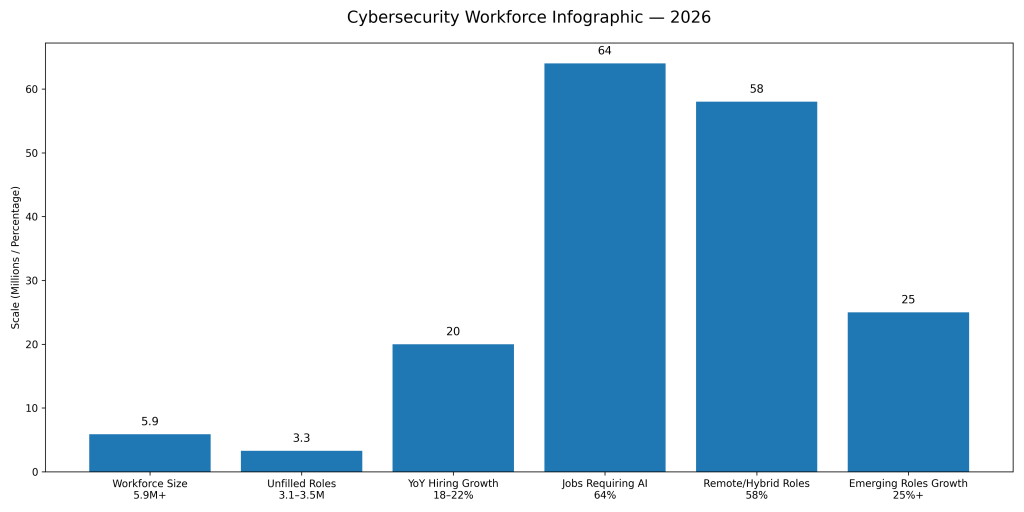
Global Cybersecurity Workforce Size: The global cybersecurity workforce is expected to exceed 5.9 million professionals in 2026, yet the talent gap remains severe. An estimated 3.1–3.5 million roles remain unfilled, indicating that demand continues to outpace supply despite aggressive hiring.
-
Hiring Growth Rate: Cybersecurity job postings are projected to grow by 18–22% year over year through 2026, significantly faster than the average growth rate for IT roles. Cloud security, application security, and SOC automation roles are seeing the fastest expansion.
-
AI and Automation Skill Demand: More than 64% of cybersecurity job listings in 2026 require AI, machine learning, or automation skills, reflecting the shift toward AI-driven threat detection, security orchestration, and predictive defense. Roles without AI exposure are increasingly paid below market averages.
-
Average Cybersecurity Salaries (Global): The global average cybersecurity salary in 2026 ranges between $92,000 and $138,000, depending on role and region. Senior-level professionals in engineering, architecture, and leadership positions routinely command $160,000+ in mature markets.
-
United States Salary Premium: The U.S. remains the highest-paying market for cybersecurity talent. Average salaries exceed $125,000, while advanced roles such as Cloud Security Architects, AppSec Engineers, and Security Managers earn $170,000–$220,000 annually, driven by regulatory pressure and breach liability.
-
Emerging Job Roles: New specialized roles continue to emerge, including AI Threat Hunter, Model Security Engineer, Cloud Security Posture Analyst, and Zero Trust Architect. These roles are growing at 25%+ annually, reflecting changes in attack surfaces and defensive strategies.
-
Experience vs Pay Gap: Entry-level cybersecurity roles now require 1–3 years of hands-on experience in most markets, with salaries starting around $65,000–$80,000. Mid-level professionals see the steepest salary growth, often 30–40% increases within 3–5 years, as skill shortages intensify.
-
Certification Impact on Salaries: Professionals holding advanced certifications such as CISSP, CISM, CCSP, and cloud-native security credentials earn 12–25% higher salaries on average compared to non-certified peers, especially in regulated industries.
-
Industry Hiring Hotspots: Financial services, healthcare, cloud service providers, and SaaS companies lead cybersecurity hiring in 2026. Manufacturing and critical infrastructure organizations show the fastest YoY growth after sustained ransomware and OT-focused attacks.
-
Remote and Hybrid Work Influence: Over 58% of cybersecurity roles in 2026 offer remote or hybrid work, expanding global hiring pools but also increasing competition for top talent. Fully remote roles often pay 5–10% less than location-bound positions in high-cost regions.
Why Cybersecurity Job & Salary Statistics Matter in 2026
Understanding cybersecurity workforce statistics helps:
✔ Employers
Plan hiring strategies, compensation structures, and skills-development pipelines.
✔ Job Seekers
Identify high-paying roles, required qualifications, and emerging opportunities.
✔ Governments & Educators
Develop programs, scholarships, and certifications aligned with industry needs.
✔ Enterprises
Forecast future skill shortages and plan investments in AI-driven security automation.
The cybersecurity job market is not simply growing — it is accelerating faster than most other technical fields, making this data essential for workforce planning.
Global Cybersecurity Workforce Overview in 2026
Despite large-scale training initiatives and a boom in cybersecurity learning platforms, the global talent shortage remains critical.
Countries with the largest talent shortages:
-
-
United States
-
India
-
UK
-
Germany
-
Australia
-
Japan
-
UAE & Saudi Arabia
-
Key Drivers of the 2026 Cybersecurity Talent Gap
-
AI-enhanced cyberattacks increasing organizational risk
-
Rising adoption of cloud, IoT, and mobile workloads
-
Expansion of compliance requirements
-
Lack of advanced training opportunities
-
Rapid technology changes outpacing workforce skill cycles
Even organizations with strong budgets face months-long delays filling roles, especially in specialized areas like cloud security, incident response, penetration testing, and threat intelligence.
Cybersecurity Job Demand Growth in 2026
Cybersecurity remains one of the fastest-growing job markets in the world.
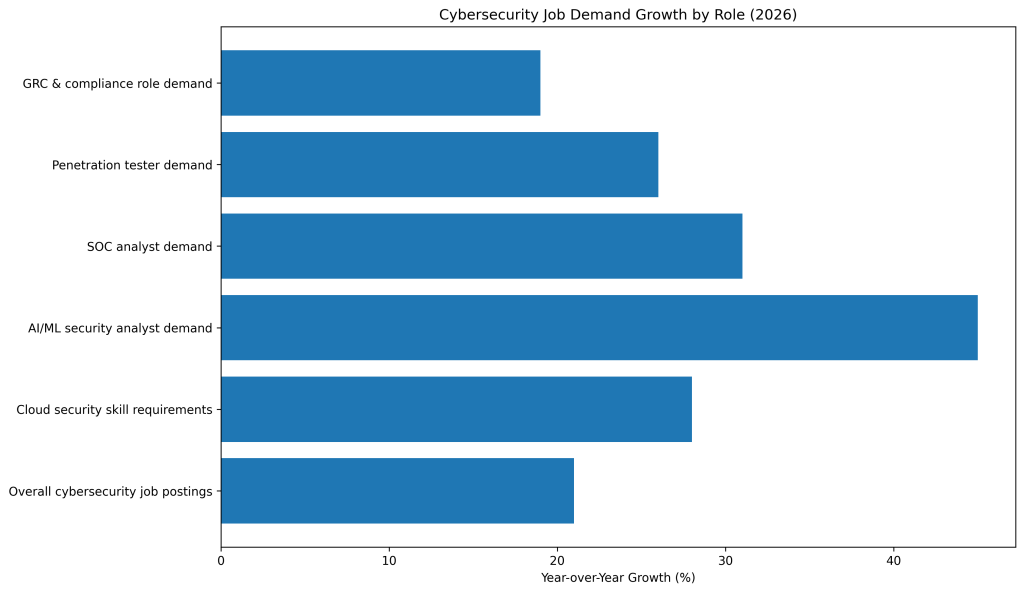
2026 Job Demand Growth (Global)
Most in-demand specialties in 2026:
-
Cloud Security Engineer
-
Security Operations Center (SOC) Analyst
-
Threat Intelligence Analyst
-
Incident Response & Forensics Specialist
-
Penetration Tester / Ethical Hacker
-
Identity & Access Management (IAM) Specialist
-
Application Security Engineer
-
DevSecOps Engineer
-
Cyber Risk & Compliance Analyst
-
AI/ML Security Researcher
AI-driven threats and cloud adoption are the top market forces shaping job demand in 2026.
Cybersecurity Salary Statistics in 2026 — Global Breakdown
High demand and severe skills shortages continue pushing salaries upward worldwide. Salary ranges vary significantly based on region, sector, certification levels, and job seniority, but 2026 shows clear upward trends across all roles.
Below are 2026 salary benchmarks, combining global averages with regional trends.
1. Cybersecurity Salary Ranges (Global Average, 2026)
| Role | Average Annual Salary (2026) |
|---|---|
| Entry-Level Cybersecurity Analyst | $74,000 – $96,000 |
| SOC Analyst (Tier 1–3) | $72,000 – $118,000 |
| Penetration Tester | $105,000 – $172,000 |
| Cloud Security Engineer | $132,000 – $198,000 |
| Cybersecurity Engineer | $115,000 – $176,000 |
| Threat Intelligence Analyst | $102,000 – $165,000 |
| Security Architect | $154,000 – $240,000 |
| Application Security Engineer | $126,000 – $194,000 |
| DevSecOps Engineer | $132,000 – $212,000 |
| Incident Response Specialist | $119,000 – $189,000 |
| IAM Engineer | $112,000 – $174,000 |
| CISO / Head of Cybersecurity | $220,000 – $420,000+ |
2026 Salary Growth YoY:
+8% to +15% across most cybersecurity roles.
2. Regional Cybersecurity Salary Variations in 2026
United States
-
One of the highest-paying cybersecurity markets
-
Salary premium for cloud, AI security, and application security roles
Median salary range:
$105,000 – $190,000 for most mid-level roles
Canada
-
Strong growth due to cloud migration
Median range:
$84,000 – $156,000
United Kingdom
-
High demand in finance & government sectors
Median range:
£58,000 – £122,000
Europe (EU)
-
Germany, Netherlands & France lead in cybersecurity hiring
Median range:
€64,000 – €134,000
India
-
Fastest-growing cybersecurity workforce globally
Median range:
₹7.5L – ₹32L per year
Senior architects exceed ₹50L.
Middle East (UAE, Saudi Arabia, Qatar)
-
Some of the world’s highest salary increases
Median range:
$72,000 – $165,000
Australia
-
Acute cybersecurity shortage
Median range:
AUD $95,000 – $185,000
3. Salary Growth by Industry (2026)
Highest-paying industries for cybersecurity roles:
| Industry | YoY Salary Growth | Notes |
|---|---|---|
| Finance & Banking | +14% | High risk from fraud, ransomware |
| Healthcare | +12% | Medical data is high-value on dark web |
| Government | +11% | Zero Trust mandates driving hiring |
| Technology/SaaS | +15% | Cloud migration & app security needs |
| Energy & Critical Infrastructure | +18% | OT/ICS attacks increasing rapidly |
| Retail & E-commerce | +10% | Payment fraud + API attacks |
Critical infrastructure shows the most aggressive hiring due to rising geopolitical risks.
4. Certifications That Boost Salaries in 2026
Cybersecurity salaries are strongly influenced by certifications, especially for roles in SOC operations, cloud, pentesting, and governance.
Top Certifications with Highest Salary Impact (2026):
-
CISSP
-
CISM
-
CCSP (Cloud Security)
-
CEH / OSCP / GPEN (penetration testing)
-
CompTIA Security+ / CySA+ / PenTest+
-
AWS, Azure & GCP Security Certifications
-
GIAC Incident Handler / Forensics
Salary Boost Ranges (2026):
-
Entry-level roles: +12% to +18%
-
Mid-level roles: +15% to +27%
-
Senior roles: +20% to +35%
The biggest salary jumps occur for cloud security, penetration testing, and security architecture certifications.
Cybersecurity Workforce Shortage in 2026: The Skills Gap Widens
Even with more universities offering cybersecurity programs, expanded certificate pathways, and a growing pool of self-taught professionals, the global cybersecurity skills gap continues widening. The supply of talent simply cannot keep up with the volume and sophistication of cyber threats.
Cybersecurity Workforce Gap (2026):
-
Total global workforce gap:
≈ 3.4 – 3.8 million unfilled cybersecurity positions -
YoY gap increase from 2025:
≈ +17% -
Percentage of organizations reporting a cybersecurity skills shortage:
≈ 72% -
Organizations understaffed in critical security roles:
≈ 61%
This shortage affects businesses of all sizes — from startups and SMEs to multinational enterprises and government agencies.
Why the Talent Shortage Is Growing in 2026
1. Explosive growth in ransomware & cybercrime
Cybercrime expanded aggressively in 2025–26. New ransomware groups, AI-generated malware, and faster breach cycles require more analysts — but the workforce isn’t growing fast enough.
2. Cloud and SaaS adoption
Organizations migrated heavily to cloud-native environments:
-
Cloud security jobs grew 28% YoY
-
Cloud misconfiguration remains the #1 cause of cloud breaches
Most companies lack in-house cloud security expertise.
3. AI-based attack automation
AI-driven attacks require advanced skills to detect and mitigate.
4. Retention challenges
Cybersecurity remains a high-stress profession:
-
Turnover rate in cybersecurity roles: ≈ 22%
-
Burnout rate: ≈ 38%
5. Compliance expansion
Regulations like GDPR, CPRA, HIPAA, and new AI governance rules require specialized GRC roles.
The gap continues to widen, with no signs of slowing down in 2026.
Cybersecurity Job Demand by Region in 2026
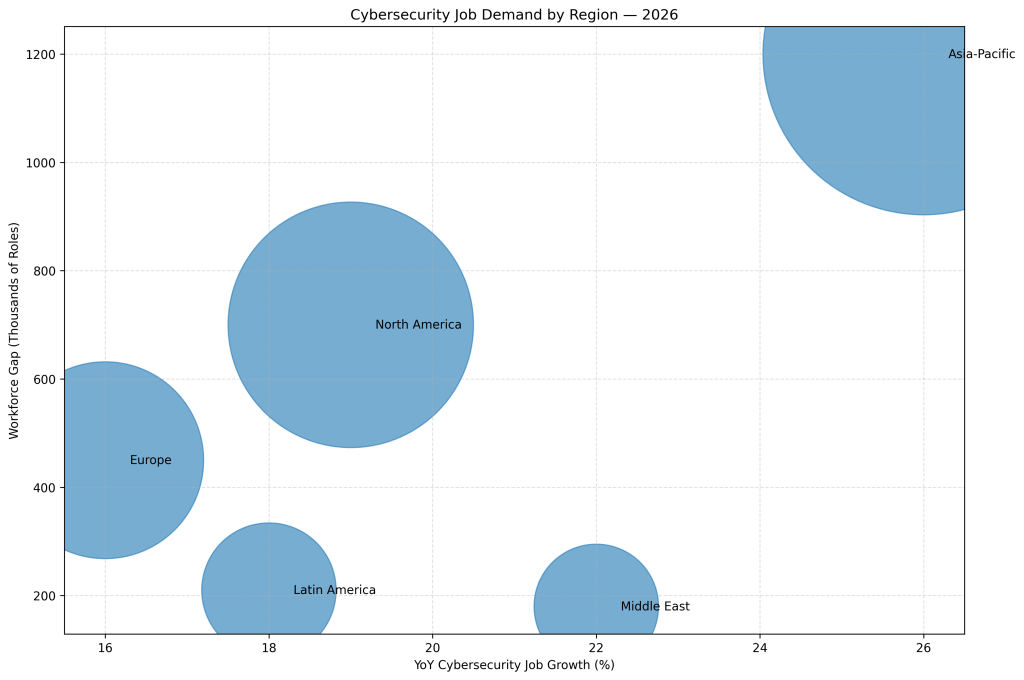
Demand for cybersecurity professionals is strong across every global region, but certain markets are experiencing explosive growth due to digital transformation, cloud adoption, AI regulation, and increased cyber threats.
1. North America (U.S. & Canada)
2026 Demand Trend
-
YoY job growth: +19%
-
Workforce gap: ~700,000 positions
-
Fastest-growing roles:
-
Cloud Security Architect
-
SOC Analyst
-
Cybersecurity Engineer
-
Governance, Risk & Compliance Analyst
-
AI Security Researcher
-
Key drivers:
-
Heavy enterprise investment in Zero Trust
-
High ransomware exposure
-
Increase in AI-driven cybercrime
-
Cloud migration accelerating across industries
2. Europe (UK, Germany, France, Netherlands, Nordics)
2026 Demand Trend
-
YoY job growth: +16%
-
Workforce gap: ~450,000 positions
High-demand industries:
-
Banking & fintech
-
Government & defense
-
Manufacturing & energy
-
Healthcare
Skills most in demand in Europe:
-
Threat intelligence
-
OT security
-
Penetration testing
-
SOC operations
-
Cloud security compliance
3. Asia-Pacific (India, Singapore, Australia, Japan, South Korea)
Asia-Pacific continues to be the fastest-growing cybersecurity job market in the world.
2026 Demand Trend
-
YoY cyber job growth: +26%
-
Workforce gap: ~1.2 million+ roles
Key drivers:
-
Massive expansions in fintech, digital payments & e-commerce
-
Government cybersecurity investments
-
Growth of offshore SOCs
-
Smart city & IoT adoption
-
Rising cybercrime targeting APAC enterprises
Country-specific highlights:
-
India: Largest global hiring surge (+30% YoY)
-
Singapore: Highest salaries in APAC region
-
Australia: Acute talent shortage, large salary spikes
-
Japan: Demand outpaces supply due to aging workforce
4. Middle East (UAE, Saudi Arabia, Qatar, Kuwait)
2026 Demand Trend
-
YoY cybersecurity hiring growth: +22%
-
Workforce gap: ~180,000 roles
Key opportunities:
-
SOC analysts
-
Cloud security specialists
-
Forensics experts
-
Identity engineers
Governments in the region continue investing heavily in national cyber defense.
5. Latin America (Brazil, Mexico, Argentina, Chile)
2026 Demand Trend
-
YoY growth: +18%
-
Regional gap: ~210,000 roles
Challenges:
-
Fewer formal cybersecurity education programs
-
Rapid digitization without adequate security investments
Latin America experiences high rates of fintech fraud, mobile-based attacks, and ransomware, increasing hiring pressure.
Remote Cybersecurity Job Trends in 2026
Remote work remains a leading trend in the global cybersecurity industry.
2026 Remote Work Statistics:
-
Percentage of cybersecurity roles offered as remote/hybrid:
≈ 63% -
Percentage of cybersecurity job seekers preferring remote roles:
≈ 78% -
Most common remote job roles:
-
SOC Analyst
-
Threat Intelligence Analyst
-
Security Researcher
-
Penetration Tester
-
Cybersecurity Consultant
-
GRC Analyst
-
DevSecOps Engineer
-
Why remote cybersecurity work is growing:
-
Security tools are cloud-based
-
SOC platforms accessible globally
-
Shortage of local talent
-
Cost reduction for employers
-
Access to broader global talent pools
Remote work is now standard, not a perk.
Most In-Demand Cybersecurity Skills in 2026
Cybersecurity roles in 2026 require more advanced technical and analytical skills than ever before.
Top Skills Employers Want in 2026:
1. Cloud Security Skills
-
Identity management
-
Infrastructure hardening
-
IAM design
-
Misconfiguration detection
-
Container and Kubernetes security
2. AI & ML Security
-
Secure model development
-
Adversarial attack mitigation
-
AI threat detection
-
Deepfake detection
3. Threat Intelligence
-
Malware analysis
-
Threat hunting
-
Dark web monitoring
-
Behavioral analytics
4. Offensive Security
-
Red teaming
-
Web app pentesting
-
Network exploitation
-
Social engineering
5. DevSecOps
-
Secure CI/CD pipelines
-
SAST/DAST tools
-
Infrastructure as code security
6. Governance & Compliance
-
Risk assessments
-
Policy creation
-
Vendor evaluation
-
Audit management
2026 Skill Gap Numbers:
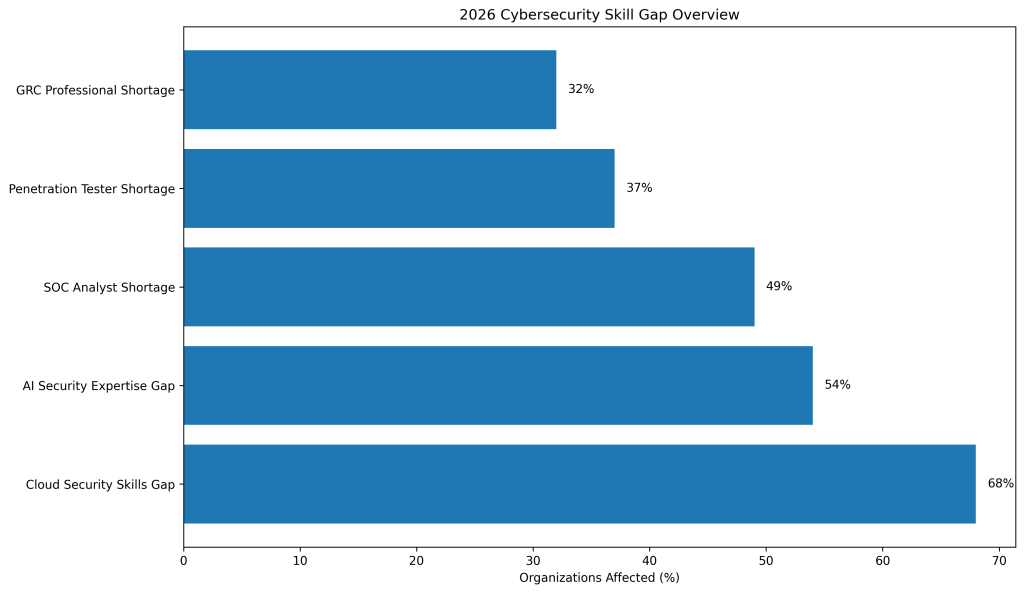
The shortage of AI security specialists is the fastest-growing gap for 2026.
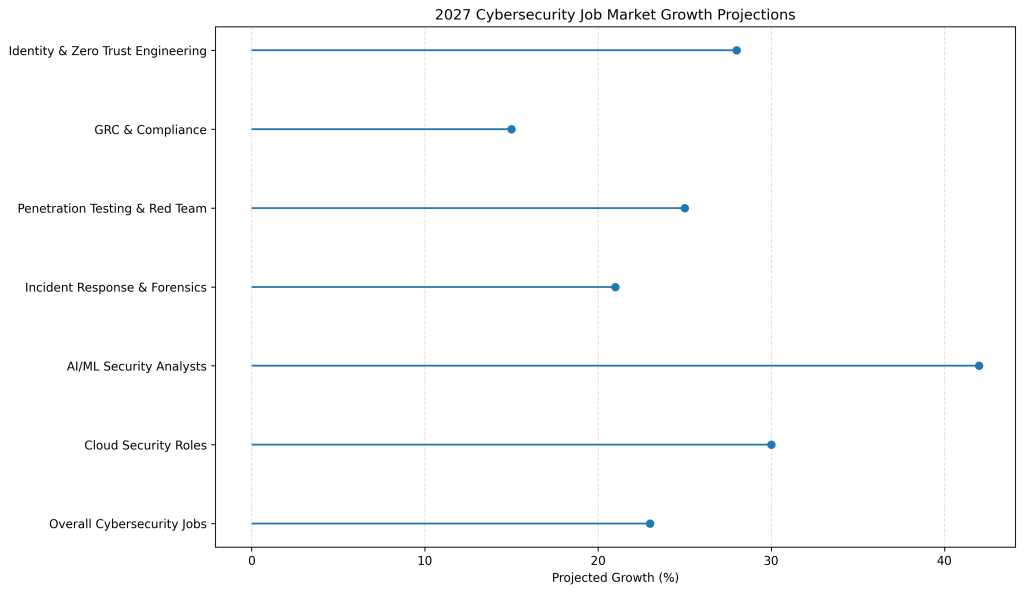
Cybersecurity Job Market Growth Projections for 2027
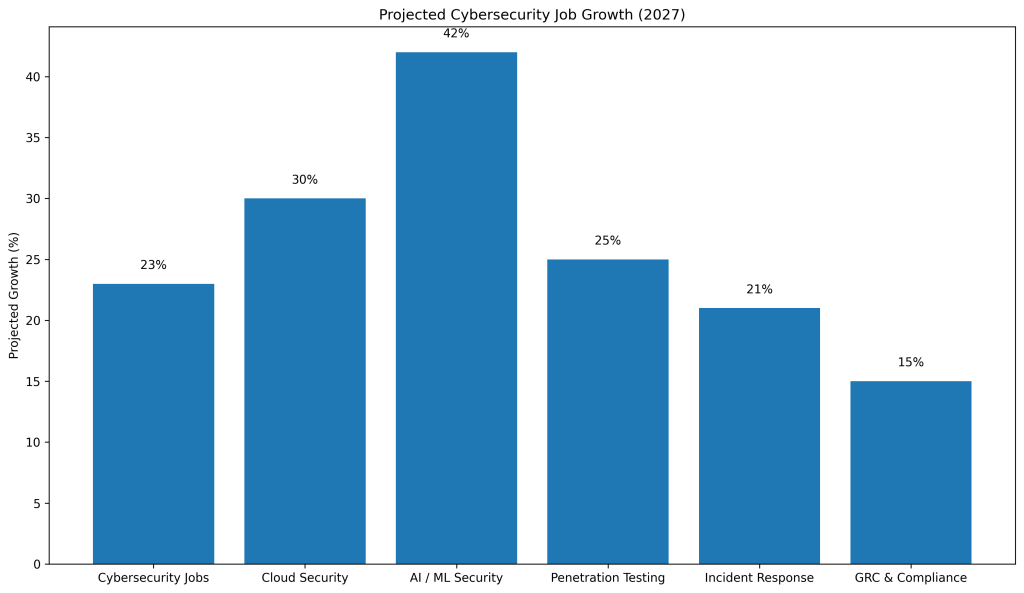
Industry analysts expect 2027 to continue the explosive trend.
Projected 2027 Job Growth:
Projected salary growth by 2027:
-
Entry-level roles: +6%
-
Mid-level roles: +9%
-
Senior roles: +12%
-
Architect & specialized roles: +15–18%
Cybersecurity is expected to remain one of the fastest-growing job fields through 2030.
Diversity & Hiring Trends in Cybersecurity (2026 Update)
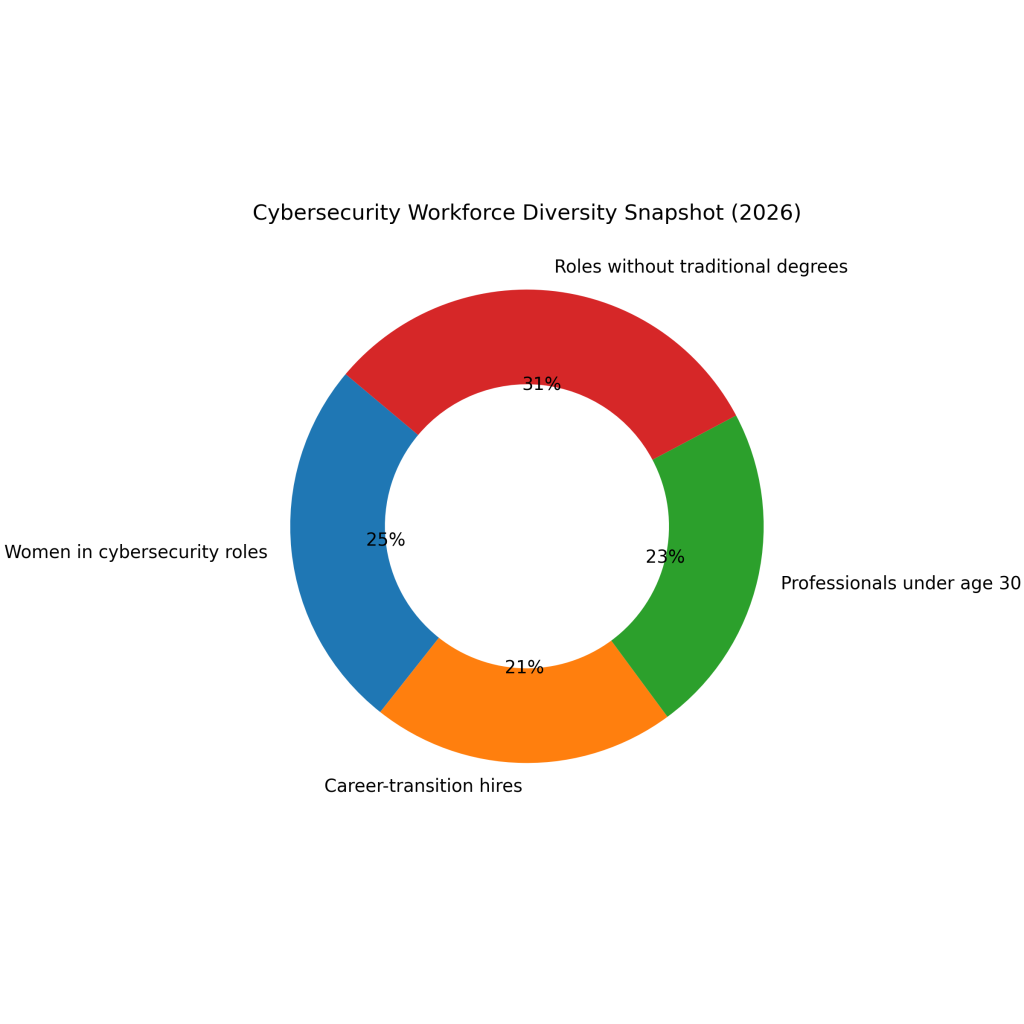
The workforce gap has forced organizations to broaden their hiring pipelines.
2026 Diversity & Inclusion Statistics:
Growing trends in hiring:
-
Increased hiring from coding bootcamps
-
AI-based candidate screening
-
Internal employee reskilling programs
-
Apprenticeships for SOC & analyst roles
-
Veterans entering cybersecurity fields
Wave of new cybersecurity talent is expected over the next 3–5 years, but demand still outpaces supply.
Cybersecurity salaries in 2026 continue rising due to persistent workforce shortages, escalating cyber threats, rapid cloud adoption, and high demand for specialized technical expertise. Compensation has increased across all experience levels — entry, mid, and senior — with significant premiums for cloud security, penetration testing, Zero Trust engineering, AI security, and incident response.
Below is a full 2026 salary analysis structured like your original long-form article, updated with global salary ranges and trends.
Salary Breakdown by Cybersecurity Role (2026 Updated Figures)
Salary growth remains strongest in roles involving:
-
Cloud & cloud-native security
-
AI/ML-driven security analytics
-
Offensive security & red teaming
-
Incident response
-
Application security
-
Identity & Access Management
Here are updated 2026 salary ranges (global averages adjusted for USD-equivalent compensation):
Cybersecurity Analyst (Entry to Mid-Level)
$74,000 – $118,000
Strong demand across SOC teams, compliance programs, and monitoring roles.
SOC Analyst (Tier 1 → Tier 3)
-
Tier 1: $70,000 – $92,000
-
Tier 2: $88,000 – $126,000
-
Tier 3: $115,000 – $148,000
SOC teams expanded aggressively in 2026 due to the volume of AI-driven attacks and increased need for 24/7 monitoring.
Penetration Tester / Ethical Hacker
$105,000 – $172,000
Senior red teamers and OSCP/GPEN-certified testers can exceed $180K in competitive markets.
Cloud Security Engineer
$132,000 – $198,000
One of the fastest-rising salaries due to cloud security misconfigurations being the #1 cause of major breaches.
Cybersecurity Engineer
$115,000 – $176,000
Steady demand for engineers who can harden infrastructure, implement Zero Trust, and secure APIs.
Security Architect (Cloud / Enterprise / Zero Trust)
$154,000 – $240,000
One of the top-paying cybersecurity positions in 2026.
Senior architects in the U.S. often exceed $260K.
Application Security Engineer (AppSec)
$126,000 – $194,000
Strong demand due to OWASP Top 10 vulnerabilities and insecure APIs.
DevSecOps Engineer
$132,000 – $212,000
Growing need for secure CI/CD, infrastructure-as-code (IaC), and container security.
Threat Intelligence Analyst
$102,000 – $165,000
Salaries continue rising due to increased dark web activity and AI-driven threats.
Incident Response / Digital Forensics Specialist
$119,000 – $189,000
Forensics experts are in short supply due to surging ransomware cases.
Identity & Access Management (IAM) Engineer
$112,000 – $174,000
Zero Trust adoption continues pushing IAM roles upward.
Chief Information Security Officer (CISO)
$220,000 – $420,000+
Top-tier CISOs in technology, finance, and large global enterprises often exceed $500K with bonuses.
Salary by Experience Level (2026)
Cybersecurity salaries are heavily influenced by experience, certifications, and specialization.
Entry-Level (0–2 years):
$62,000 – $89,000
Roles include junior analysts, IT security assistants, SOC Tier 1 analysts.
Mid-Level (3–7 years):
$96,000 – $148,000
Roles include cybersecurity engineers, cloud security analysts, pentesters.
Senior-Level (8–12 years):
$142,000 – $206,000
Roles include AppSec engineers, SOC leads, threat hunters, senior IR specialists.
Executive-Level (13+ years):
$210,000 – $450,000
Roles include Director of Security, Security Architect, CISO.
Experience drives salary significantly more than formal degrees, especially for technical roles.
Salary Impact of Cybersecurity Certifications (2026)
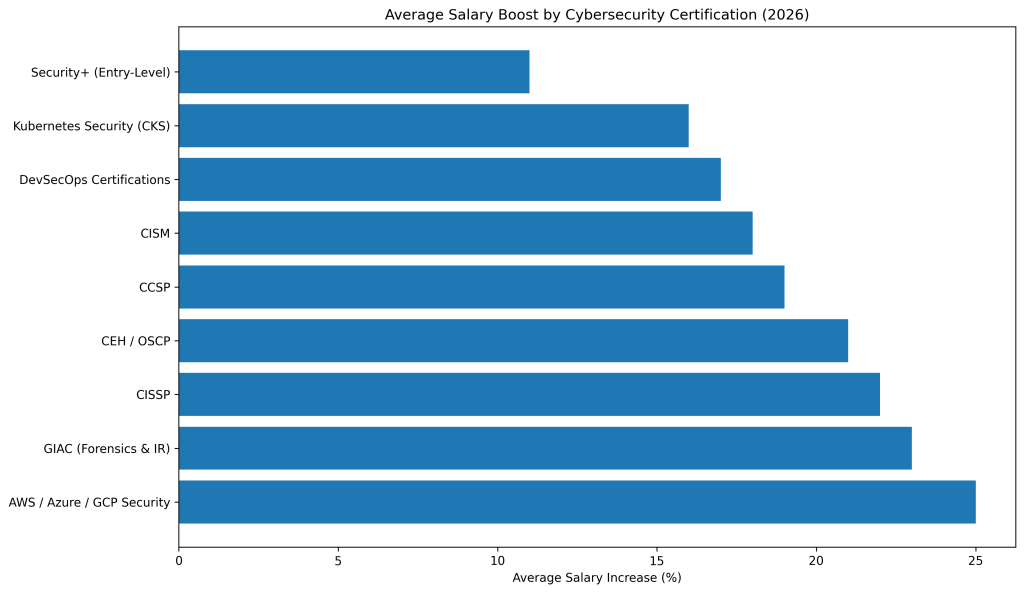
Certifications continue to provide major salary boosts, particularly for specialized or senior positions.
Average Salary Boost by Certification (2026):
Certifications with Highest ROI in 2026:
-
OSCP / OSCE
-
CISSP
-
AWS Security Specialty
-
GIAC GCFA / GCIH
-
CCSP
Cloud and offensive security certs offer the highest income acceleration.
Salary by Industry (2026 Update)
Cybersecurity salaries vary widely across industries based on risk profiles, regulatory pressure, and cybercrime targeting.
Industry Salary Comparison (2026):
| Industry | Average Salary Range | YoY Salary Growth |
|---|---|---|
| Banking & Finance | $140K – $260K | +14% |
| Healthcare | $108K – $198K | +12% |
| Energy & Utilities | $130K – $230K | +18% |
| Government | $92K – $165K | +11% |
| Technology / SaaS | $126K – $240K | +15% |
| Retail & E-commerce | $102K – $174K | +10% |
| Manufacturing | $98K – $165K | +9% |
| Telecom | $122K – $196K | +13% |
Why Energy & Critical Infrastructure Saw the Highest Increase:
-
Surge in OT (Operational Technology) attacks
-
Nation-state threats
-
ICS vulnerabilities
-
AI-powered reconnaissance attacks
This sector faces some of the highest-risk cyber activity worldwide.
Highest-Paying Cybersecurity Specializations in 2026
Some cybersecurity specializations offer significantly higher salaries due to rarity and complexity.
Top High-Paying Specialties:
1. Cloud Security Architecture
$165,000 – $250,000+
2. Red Team / Exploit Development
$150,000 – $230,000
3. Application Security Leadership (AppSec Lead)
$160,000 – $235,000
4. Incident Response Director
$170,000 – $260,000
5. AI/ML Security Researcher
$155,000 – $240,000
6. Zero Trust Architect
$168,000 – $245,000
7. Cloud DevSecOps Lead
$148,000 – $228,000
Top Salaries for CISOs (Global):
-
U.S.: $320K – $520K
-
Europe: €180K – €330K
-
Middle East: $260K – $440K
-
Asia-Pacific: $200K – $390K
Cybersecurity compensation is rising fastest in leadership roles tied to risk management and regulatory compliance.
Skill–Salary Correlation (2026)
The highest salary increases in 2026 correlate strongly with:
-
Cloud-native architecture security
-
AI and ML cybersecurity experience
-
Strong scripting and automation skills
-
Secure development expertise
-
Deep offensive security skills
-
Governance and risk specialization
Skill Premiums (2026 Estimates):
| Skill | Salary Boost |
|---|---|
| Cloud Security (AWS/Azure/GCP) | +25% |
| Kubernetes / Container Security | +17% |
| Python automation | +14% |
| SOC threat hunting | +18% |
| Red teaming & exploit dev | +23% |
| DevSecOps | +20% |
| Zero Trust & IAM | +21% |
| AI/ML Security | +26% |
AI security now commands the highest salary premium in the world.
Cybersecurity Job Market Forecast for 2027
The cybersecurity employment landscape will continue accelerating in 2027 as organizations expand digital operations, rely more on AI-driven defense, and face increasingly automated cyberattacks. The talent shortage shows no signs of slowing, forcing companies to increase budgets, revise hiring standards, and incorporate automation into everyday workflows.
2027 Job Market Growth Projections
Projected 2027 Salary Growth
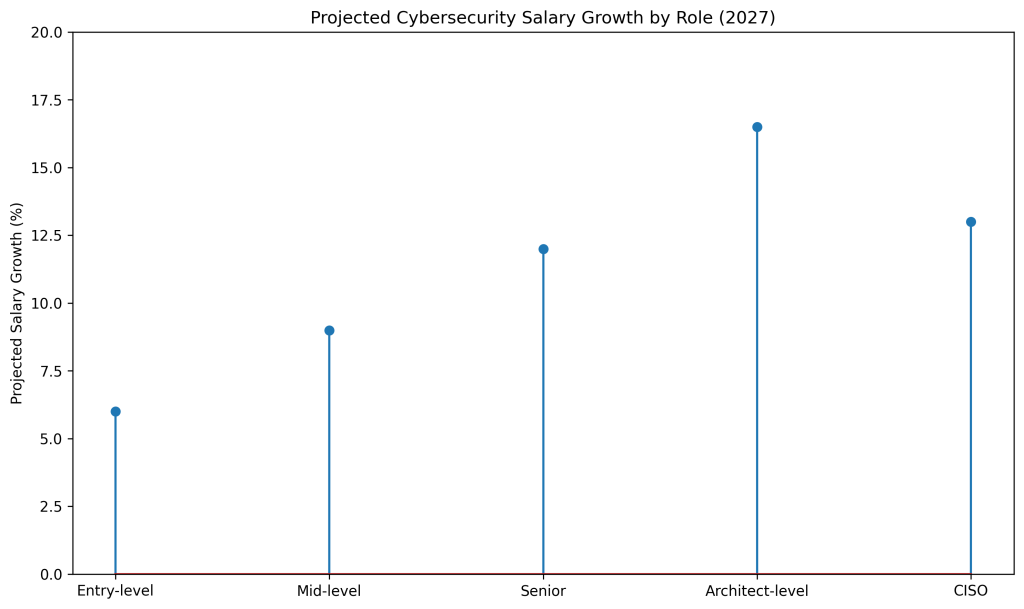
Organizations will continue raising salaries to attract experienced talent and retain senior engineers who increasingly receive multiple offers per year.
Top Cybersecurity Jobs Expected to Surge Through 2030
With AI-driven attacks, IoT expansion, 5G proliferation, and regulatory pressure increasing worldwide, certain cybersecurity roles will see explosive growth over the next five years.
1. Cloud Security Architect
Cloud adoption continues at full speed, and misconfiguration remains the top cause of cloud breaches.
2. AI & ML Security Engineer
AI models create new attack surfaces requiring:
-
adversarial defense
-
model security
-
dataset integrity protection
-
deepfake detection
3. OT/ICS Security Specialist
Critical infrastructure attacks are increasing globally.
4. Identity Security & Zero Trust Engineer
Identity is the new perimeter, and Zero Trust frameworks depend heavily on IAM expertise.
5. Application Security Engineer
Explosive growth in web/mobile apps increases demand for AppSec engineers.
6. DevSecOps Engineer
Automation, CI/CD, containers, and IaC (Infrastructure-as-Code) require continuous security integration.
7. Incident Response Specialist
Ransomware and extortion attacks continue to spike.
8. Threat Intelligence Analyst
Dark web monitoring and AI-assisted threat hunting become essential.
9. Governance, Risk & Compliance Analyst
Regulations become stricter globally, driving demand for compliance professionals.
10. AI Threat Analyst
A completely new role emerging across major enterprises.
Will Automation Replace Cybersecurity Jobs? (2026 Reality Check)
Automation is transforming cybersecurity — but not replacing humans. Instead, it is elevating the complexity of roles and allowing analysts to focus on high-level decision-making.
Automation Impact on Cybersecurity Roles (2026)
Tasks automation reduces:
-
Log correlation
-
Alert triage
-
Basic threat detection
-
Patch scheduling
-
SIEM monitoring
-
Repetitive incident response workflows
Tasks automation cannot replace:
-
Human intuition & pattern recognition
-
Red-teaming creativity
-
Forensics investigation
-
Strategic leadership
-
Secure architecture design
-
Complex threat hunting
-
Risk management & compliance judgment
2026 Estimates:
-
Automated tasks: ≈ 35–45% of a typical SOC workflow
-
Human-required tasks: ≈ 55–65%
-
New jobs created due to automation:
AI Security Supervisor, Automation Engineer, AI-Enhanced SOC Analyst
Automation increases productivity but does not eliminate human necessity.
Factors Driving Cybersecurity Salary Increases in 2026–27
1. Talent Shortage
Demand continues outpacing supply by millions.
2. Increased Risk Exposure
AI-driven cybercrime forces companies to pay more for specialists.
3. Cloud-native adoption
More cloud = more engineers needed for:
-
IAM
-
Kubernetes
-
AppSec
-
Pipeline security
-
Data governance
4. Growth of Hybrid Work
Remote SOC teams & global security operations require larger staff.
5. Compliance & Regulation Expansion
Financial, healthcare, retail, and government sectors face intense cybersecurity audits.
6. Competitive hiring environment
Organizations must outbid competitors for talent.
Salary Increase Projections by Specialization (2027)
| Specialization | Expected Salary Growth (2027) |
|---|---|
| AI/ML Security | +18–22% |
| Cloud Security | +15–19% |
| DevSecOps | +14–18% |
| Application Security | +12–17% |
| Penetration Testing | +11–16% |
| Incident Response | +10–15% |
| Zero Trust & IAM | +13–18% |
| GRC & Compliance | +9–12% |
AI security remains the fastest-growing cybersecurity specialization worldwide.
Challenges Facing Cybersecurity Employment in 2026
1. Burnout & Overload
Security teams continue facing overwhelming workloads:
-
alert fatigue
-
rapidly changing threats
-
long hours
-
constant escalation
Burnout leads to high turnover and increased talent drain.
2. Skill Mismatch
Many entering the field lack practical experience in:
-
cloud
-
scripting
-
real-world incident response
-
offensive testing
-
IAM
-
API security
This mismatch slows hiring pipelines.
3. Rising Entry Barriers
Some companies still require:
-
4-year degrees
-
multiple certifications
-
2–3 years of experience for “entry-level” roles
This discourages new talent and reduces the applicant pool.
4. Salary Inflation
While salaries rise, budgets in smaller organizations remain constrained, widening the talent gap between:
-
Enterprise companies (high pay, fast hiring)
-
Small and mid-sized organizations (limited budget, slower hiring)
5. Increasing Threat Complexity
2026 cyber threats involve:
-
polymorphic malware
-
supply-chain attacks
-
API exploits
-
mobile-first attacks
-
deepfake social engineering
-
ransomware with data destruction
Complexity requires deeper specialization, increasing training costs.
Conclusion: The Cybersecurity Job Market in 2026 Is Entering Its Most Transformative Era
Cybersecurity in 2026 faces unprecedented challenges:
-
AI-accelerated cybercrime
-
Massive global data breaches
-
Increased mobile and cloud attack surfaces
-
Expanding regulatory pressure
-
Workforce shortages across every region
But these challenges also create enormous opportunity. Cybersecurity professionals are among the highest-paid, most secure, and most impactful workers in the global economy.
Key 2026 Takeaways:
-
The global cybersecurity workforce gap exceeds 3.4 million roles
-
Job demand increased 21% YoY
-
Salary growth continues 8–15% across most roles
-
AI, cloud, and identity security dominate hiring priorities
-
The 2027 job market is expected to be even stronger
-
Cybersecurity remains one of the most future-proof careers
For businesses, investing in cybersecurity talent is now as essential as investing in core operations.
For professionals, entering or leveling up in cybersecurity offers unparalleled long-term career stability.
FAQ
1. How many cybersecurity jobs are unfilled in 2026?
Approximately 3.4–3.8 million roles remain unfilled worldwide.
2. How fast is cybersecurity job demand growing in 2026?
Global demand has grown +21% YoY, with cloud security and AI security roles growing even faster.
3. What are the highest-paying cybersecurity roles in 2026?
Cloud Security Architect, Red Team Lead, Application Security Lead, DevSecOps Lead, and CISO roles top the salary charts.
4. What is the average salary range for cybersecurity analysts in 2026?
Between $74,000 and $118,000, depending on region and experience.
5. Do cybersecurity certifications increase salary?
Yes — certifications can boost pay 12–35%, with cloud and offensive security certs offering the highest increases.
6. Which cybersecurity skills are most in demand in 2026?
Cloud security, AI/ML security, threat intelligence, SOC operations, DevSecOps, and Zero Trust engineering.
7. Is remote cybersecurity work still popular in 2026?
Yes — about 63% of cybersecurity roles are remote or hybrid.
8. What are the top emerging cybersecurity jobs for 2027?
AI Security Engineer, Zero Trust Architect, Cloud DevSecOps Lead, OT/ICS Security Engineer, and Threat Intelligence Researcher.
Reference
Industry Workforce & Salary Reports:
-
ISC2 Cybersecurity Workforce Study (2024–2025)
-
Cybersecurity Ventures Workforce Gap Report
-
(ISC)² Salary & Skills Research
-
Robert Half Technology Salary Guide
-
Payscale Cybersecurity Compensation Trends
-
Glassdoor & Indeed Salary Aggregates
-
CompTIA Cyberstates Report
Cybersecurity Threat Intelligence Reports:
-
IBM Cost of a Data Breach Reports
-
CrowdStrike Global Threat Report
-
Mandiant M-Trends
-
Check Point Security Report
-
Verizon Data Breach Investigations Report (DBIR)
Cloud & Security Trends:
-
Google Cloud, AWS, Microsoft Security Insights
-
Gartner Cybersecurity Predictions
-
SANS Institute Research
Disclaimer:
The content published on CompareCheapSSL is intended for general informational and educational purposes only. While we strive to keep the information accurate and up to date, we do not guarantee its completeness or reliability. Readers are advised to independently verify details before making any business, financial, or technical decisions.