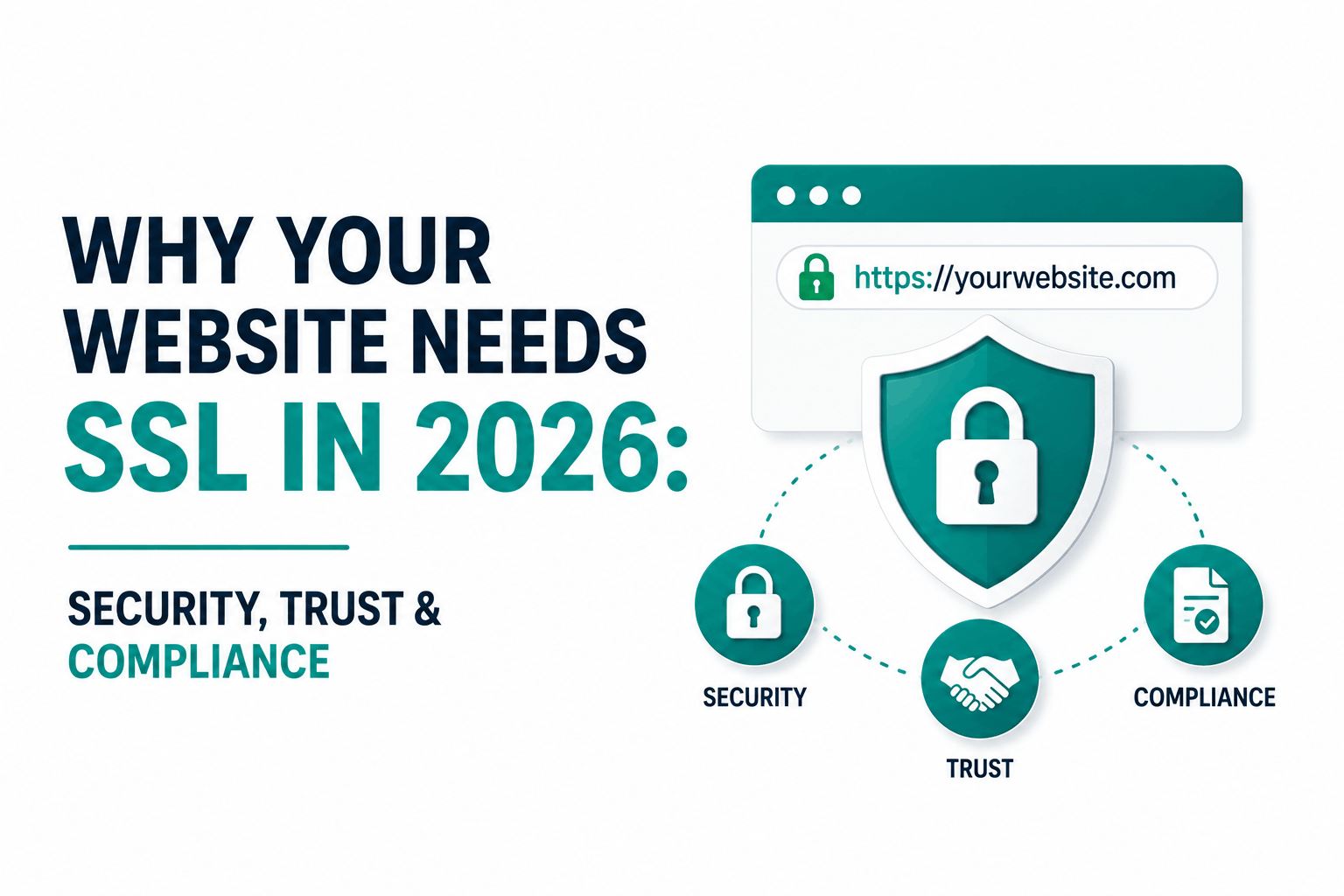
Your website may look professional, load fast, and rank on the first page of Google today. Without an SSL certificate, all of that work is at serious risk.
In 2026, a missing SSL certificate does not just create a vague security concern. It triggers browser warnings that block visitors, signals Google that your site is unsafe, puts you on the wrong side of data protection laws, and locks you out of modern web features your competitors are already using.
This is not theoretical risk. Chrome, Firefox, Safari, and Edge actively flag HTTP sites as “Not Secure” in the address bar. Research consistently shows that 85% of online users leave websites flagged with that warning (Giant Creates, 2024). Once they leave, most do not return.
This guide explains exactly why an SSL certificate is essential in 2026, what has changed in the industry this year, and how to choose the right certificate for your site at comparecheapssl.com.
What Is an SSL Certificate?
An SSL (Secure Sockets Layer) certificate is a digital file installed on a web server that encrypts the connection between your server and a visitor’s browser. When SSL is active, your URL switches from http:// to https://, a padlock appears in the address bar, and all data transferred during that session is unreadable to anyone who intercepts it. The certificate also confirms that your website is genuinely owned by the entity it claims to represent.
Modern SSL certificates actually use TLS (Transport Layer Security), a newer and stronger protocol. The term “SSL” has stuck because of industry familiarity, but when you buy an SSL certificate today, you are installing TLS encryption.
The practical effect: any data your visitors submit — passwords, email addresses, payment details, contact forms — travels as encrypted ciphertext. Even if a hacker intercepts it, they cannot read or use it.
1. Google Uses HTTPS as a Ranking Signal — and Has Since 2014
Google announced HTTPS as a ranking signal in 2014. More than a decade later, that signal has only grown in importance.
According to Google’s Transparency Report, over 89% of pages loaded by Chrome now use HTTPS (SSL.com, 2024). That means the majority of pages you are competing against in search results are already secure.
Research from The SSL Store suggests that an SSL certificate can contribute up to a 5% rankings boost in competitive keyword spaces. In tight SERPs, that difference determines whether your site appears on page one or page two — the difference between being found and being invisible.
Beyond direct ranking signals, SSL affects SEO through user behavior. When visitors see “Not Secure” in the browser address bar, bounce rates increase. Shorter sessions, higher bounce rates, and fewer page interactions all send negative engagement signals back to Google. Your content may be excellent; the security warning will undermine it.
If you are investing in content, backlinks, and technical SEO while skipping SSL, you are spending money to rank a site that Google is simultaneously downgrading.
2. Browser Warnings Kill Conversions Before They Start
Chrome holds over 65% of the global browser market. When Chrome detects an HTTP site, it displays “Not Secure” next to the URL — visible before the user has read a single word of your content.
For some pages and site types, browsers escalate beyond the label. They display full-page interstitial warnings that tell users the site may be dangerous and offer them a prominent option to go back. For a potential customer who found you through a paid ad or an organic search result, that warning is often the last thing they see.
The padlock icon does the opposite. Studies show visitors are significantly more likely to complete purchases, submit contact forms, and return to websites that display the padlock. The visual trust signal does measurable conversion work before any copy, design, or offer has a chance to influence the user.
E-commerce sites face the sharpest impact. No online shopper enters credit card details on a site their browser has just told them is insecure.
3. Data Encryption Protects Your Visitors — and Your Business
Without SSL, data travels between a user’s browser and your server in plain text. Any network-level attacker — on a shared Wi-Fi network, a compromised router, or an ISP — can read it through a technique called a man-in-the-middle attack.
With SSL installed, intercepted data appears as random, unreadable characters. The attacker has the ciphertext but not the private key required to decrypt it.
This protection matters even for sites that do not process payments. Contact forms collect names, email addresses, and sometimes phone numbers. Newsletter signups collect email addresses. Login pages collect usernames and passwords. Each of these data points has value to attackers, and each represents a liability for your business if intercepted.
SSL is also a prerequisite for the padlock’s second function: identity verification. SSL certificates bind your domain name to your organization. Visitors can confirm, by inspecting the certificate, that the site they are on is operated by the entity it claims to be — not a phishing replica.
4. Compliance with GDPR, PCI DSS, and Data Protection Laws
If your website collects any data from users in the European Union, GDPR requires you to implement appropriate technical measures to protect that data. SSL encryption is considered a baseline requirement under this standard.
For any site processing card payments, PCI DSS (Payment Card Industry Data Security Standard) mandates HTTPS. Operating a payment-capable website without SSL is not just risky; it is a direct violation of card network rules and can result in the loss of your ability to accept card payments.
Various national data protection laws — including the UK GDPR, Australia’s Privacy Act, and California’s CPRA — carry similar requirements. The common thread: businesses that collect personal data must secure it during transmission. SSL is the mechanism for doing that.
Non-compliance penalties are not abstract. GDPR fines can reach 4% of global annual turnover. PCI DSS non-compliance can result in card processing termination. Reputational damage from a breach of unencrypted data frequently exceeds the direct fines.
5. The 2026 Rule Change: SSL Certificate Validity Is Now 200 Days
This is the most significant SSL development of 2026, and most website owners are not aware of it.
On March 15, 2026, the CA/Browser Forum’s Ballot SC-081v3 came into force. Approved unanimously by Apple, Google, Mozilla, and Microsoft, the rule reduced the maximum validity period for public SSL certificates from 398 days to 200 days (SSL Insights, 2026).
DigiCert, one of the largest certificate authorities, began enforcing a 199-day limit as early as February 24, 2026.
What this means for website owners:
Certificates issued before March 15, 2026 under the old 398-day maximum remain valid until their natural expiry. Any certificate issued after that date is limited to 200 days. You will now need to renew your certificate approximately twice per year instead of once.
This is not a cost increase. Most certificate providers charge on an annual subscription basis, with free reissuances included. What changes is the renewal frequency, not the price.
The roadmap continues:
- March 15, 2027: Maximum validity drops to 100 days
- March 15, 2029: Maximum validity drops to 47 days
The industry direction is clear. If you manage SSL certificates manually with calendar reminders, start planning for automated renewal now. The 200-day cycle doubles your current workload. The 47-day cycle will make manual management completely impractical.
At comparecheapssl.com, you can compare certificates from leading authorities and identify providers with strong automated renewal support, protecting you as validity periods continue to shorten.
6. SSL Unlocks Modern Web Technologies Your Site Needs
HTTP/2 and HTTP/3 — the protocols that dramatically improve site loading speed — both require HTTPS to function. Without SSL, your site operates on the older HTTP/1.1 protocol and cannot access the performance improvements that H2 and H3 provide. That directly affects page speed, which is a confirmed Google ranking factor.
Beyond speed protocols, the following browser features require a secure context (HTTPS) to operate:
- Progressive Web App (PWA) functionality
- Geolocation access
- Camera and microphone access
- Service workers (used for offline capability and push notifications)
- Web Share API
- Payment Request API
Any website aiming to deliver a competitive user experience in 2026 needs these capabilities. SSL is the entry point to all of them. Running an HTTP site is not just a security issue; it is a technical ceiling that blocks your site from the features the modern web is built on.
7. Types of SSL Certificates: Choosing the Right One
Not every website needs the same level of certificate. There are three validation levels, each suited to a different use case.
Domain Validated (DV): The certificate authority confirms you control the domain. No company verification is required. DV certificates are issued quickly, often within minutes, and are suitable for blogs, informational sites, and personal portfolios. Encryption strength is identical to higher-level certificates.
Organization Validated (OV): The certificate authority verifies your domain control and confirms your organization’s legal existence and physical address. OV certificates display your verified organization name in certificate details, adding a layer of credibility for business websites. Issuance typically takes one to three business days.
Extended Validation (EV): The highest validation level. The certificate authority conducts a comprehensive background check of your business. EV certificates are recommended for e-commerce platforms, financial services, healthcare portals, and any site where users are completing high-value transactions. They provide the strongest trust signal for users who inspect certificate details.
Specialty certificate types by scope:
- Single-domain: Secures one domain (example.com)
- Wildcard: Secures a domain and all its subdomains (*.example.com) — ideal for sites with login portals, blog subdomains, or regional subdomains
- Multi-domain (SAN/UCC): Secures multiple distinct domains under one certificate — suited for businesses managing several web properties
Choosing the wrong certificate type is one of the most common mistakes website owners make. An e-commerce site purchasing a DV certificate for its payment pages, or a multi-site business buying individual single-domain certificates when a multi-domain certificate would be cheaper and simpler — both are common and avoidable errors.
At comparecheapssl.com, you can compare all certificate types, validation levels, and providers side by side so you pay for exactly what your site needs — not more, not less.
8. The Hidden Cost of Not Having SSL in 2026
Running a website without SSL in 2026 carries costs that never appear on an invoice but show up clearly in your metrics.
Lost organic traffic. Google’s ranking penalty for HTTP sites is cumulative. Over time, secure competitors pull further ahead in rankings, and recovering lost positions requires more effort than maintaining them.
Reduced ad effectiveness. If you run Google Ads, Facebook Ads, or any paid traffic, you are paying to send visitors to a landing page that immediately triggers a security warning. Conversion rates on HTTP landing pages are measurably lower, increasing your effective cost per acquisition.
Abandoned checkouts. For e-commerce sites, a “Not Secure” label during checkout is effectively a sign reading “do not enter your card here.” Cart abandonment rates on unsecured sites are substantially higher.
Legal and compliance risk. GDPR, PCI DSS, and national data protection laws carry real enforcement consequences. The cost of a single regulatory action dwarfs the annual cost of even a premium SSL certificate.
Free SSL certificates — notably those from Let’s Encrypt — provide the same encryption strength as paid alternatives and are a legitimate option for personal sites and blogs. For business sites, particularly those handling transactions or user accounts, paid certificates from established certificate authorities offer stronger warranty protection, dedicated customer support, and OV or EV validation options that free certificates do not provide.
How to Get an SSL Certificate for Your Website
Getting started with SSL takes less time than most website owners expect.
- Identify your certificate type. Based on your site’s purpose — informational, business, e-commerce, multi-domain — choose the appropriate validation level and scope.
- Compare providers and pricing. Certificate prices vary significantly between providers for identical products. Using a comparison tool ensures you are not overpaying.
- Generate a CSR (Certificate Signing Request). This file is created on your server and submitted to the certificate authority. Most hosting control panels (cPanel, Plesk) have a built-in CSR generator.
- Complete domain validation. The certificate authority verifies your domain control via an email, DNS record, or HTTP file. For OV and EV certificates, additional business documentation is required.
- Install the certificate. Upload the issued certificate to your server and configure your web server to redirect all HTTP traffic to HTTPS. Most hosting providers offer one-click SSL installation.
- Verify the installation. Confirm that all pages load over HTTPS with no mixed content errors (HTTP resources loading on an HTTPS page) and that HTTP URLs redirect correctly.
With certificate validity now capped at 200 days, building an automated renewal process into step six is strongly recommended. Manual renewal every six months is manageable but leaves room for expiration errors.
Why Use comparecheapssl.com?
SSL certificates are a commoditized product. The underlying encryption technology is identical across providers. What differs is price, warranty coverage, customer support, reissuance policies, and the quality of the management interface.
comparecheapssl.com aggregates pricing and features from leading certificate authorities and resellers so you can compare DV, OV, and EV options across single-domain, wildcard, and multi-domain configurations in a single view. Whether you need a fast DV certificate for a new site or an EV certificate for an enterprise e-commerce platform, comparing before buying consistently saves money without compromising on protection.
Conclusion
SSL certificates crossed from recommendation to requirement years ago. In 2026, they are foundational infrastructure, as necessary as a domain name and hosting.
The 200-day validity change that took effect in March 2026 adds urgency to how sites manage certificate renewals. The trajectory toward 47-day certificates by 2029 makes automated, well-managed SSL a business continuity issue, not just a security checklist item.
The stakes are straightforward: no SSL means Google ranking penalties, browser warnings that drive away visitors, legal exposure under GDPR and PCI DSS, and exclusion from the modern web features your competitors are already using.
Getting SSL right does not have to be expensive or complicated. Start by comparing your options at comparecheapssl.com — and protect your site before the next Google crawl, the next visitor, and the next compliance audit.