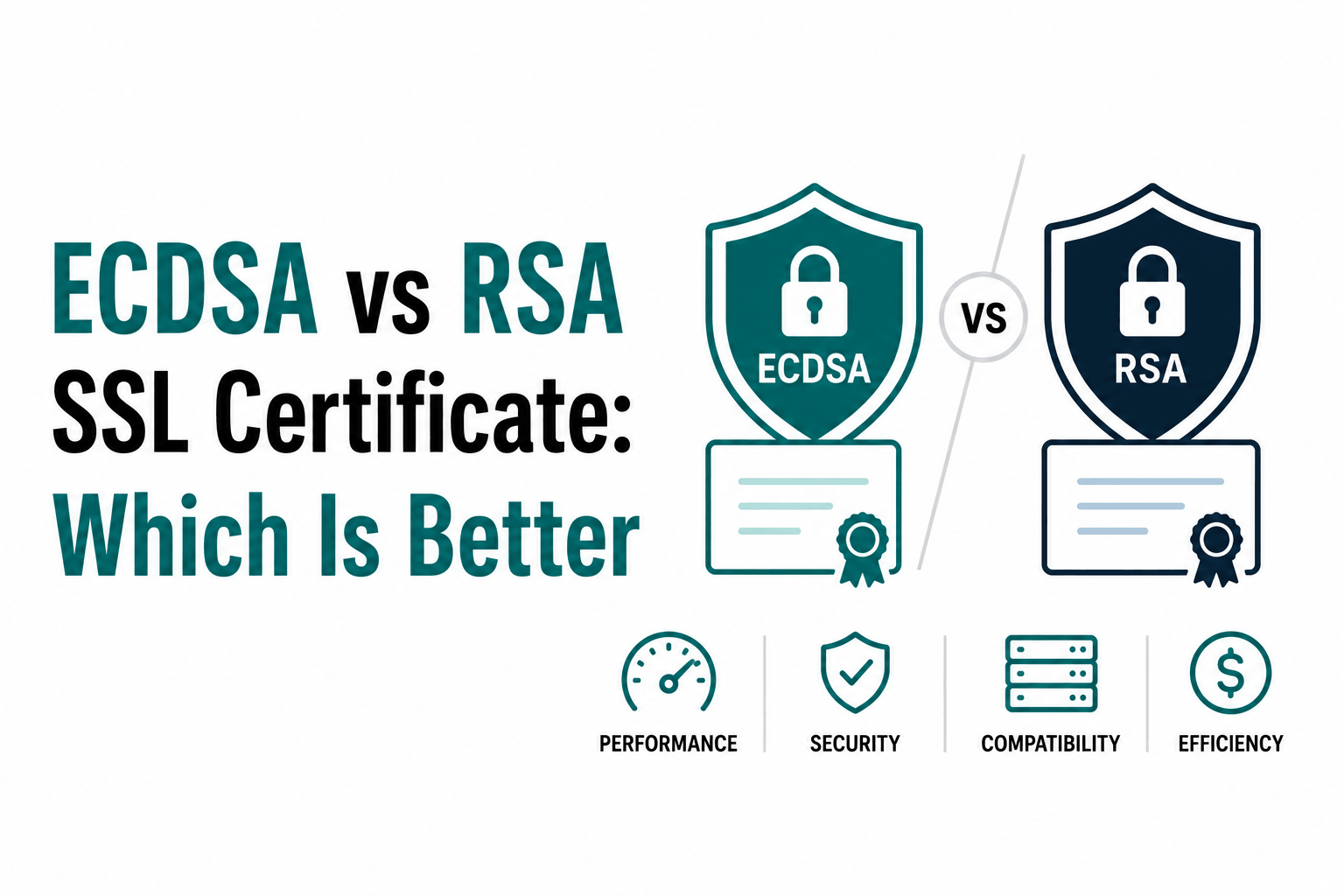
Buy ECDSA P-256 for any new certificate purchase on a public-facing server in 2026. The performance advantage is real and measurable. The compatibility exceptions are negligible for public web traffic. The market has already decided: ECDSA reached 42.9% of all active certificates in Q1 2026 and 49% of all new issuance in April 2026, closing 14.5 percentage points of its gap with RSA in just six months.
This article explains why ECDSA is the right choice, what RSA is still appropriate for, and the specific configuration to use when you order.
The Market Has Already Decided: Q1 2026 Data
Certificate Transparency log analysis from TechnologyChecker.io covering 8.7 billion active SSL certificates in Q1 2026:
- ECDSA reached 42.9% of all active certificates in Q1 2026, up from 34.5% in Q4 2025, a gain of 8.4 percentage points in a single quarter
- ECDSA reached 49.0% of all new certificate issuance in April 2026 (Cloudflare Radar CT data)
- At April 2026’s pace, ECDSA will surpass RSA in active certificate share before the end of 2026
- ZeroSSL’s ECDSA issuer surged 51.1% in Q1 2026, the fastest growth of any major issuing CA
- Let’s Encrypt’s RSA issuers (R12 and R13) each dropped over 32% while its ECDSA issuers (E7 and E8) grew 16.2%
The migration is not a prediction. It is happening now and is accelerating. The question is not whether the industry is moving to ECDSA but whether your certificate configuration is moving with it.
What ECDSA and RSA Actually Are: The Plain-Language Version
Both RSA and ECDSA are asymmetric cryptography algorithms. They each generate a key pair: a public key embedded in the certificate that anyone can see, and a private key that stays on the server and is never shared. The fundamental job is identical: prove to the browser that this server holds the private key that matches the public key in the certificate.
The difference is the mathematical structure:
- RSA (Rivest-Shamir-Adleman, 1977): based on the difficulty of factoring large integers. Security scales with key length. Longer keys = harder to break = more CPU to compute. The current minimum: RSA-2048. Equivalent security to RSA-2048 for post-quantum purposes would require RSA-3072 or RSA-4096, which are slower.
- ECDSA (Elliptic Curve Digital Signature Algorithm): based on the algebraic structure of elliptic curves over finite fields. Security scales more efficiently with key length. An ECDSA P-256 key (256-bit) provides security equivalent to RSA-3072 (3072-bit). The key is approximately 12x smaller for equivalent security. Smaller key = faster computation.
The practical implication: ECDSA P-256 gives you better-than-RSA-2048 security in a key that takes significantly less CPU to process. For a web server handling thousands of TLS handshakes per second, this matters.
The Performance Difference: What the Numbers Actually Say
Gcore published a detailed ECDSA vs RSA performance comparison in December 2025 measuring real-world TLS handshake performance across server configurations. Key findings:
- ECDSA P-256 reduces TLS handshake CPU by 15 to 20% compared to RSA-2048
- Certificate file size: ECDSA P-256 certificate is approximately 1.5-2x smaller than RSA-2048 certificate. For TLS handshake payload, this reduces bandwidth and latency, particularly significant on mobile networks.
- Server-side signature generation: ECDSA P-256 is significantly faster than RSA-2048 for the signature operation performed during each TLS handshake
- Client-side verification: similar performance for both algorithms on modern hardware
The 15-20% CPU reduction translates to: higher request throughput on the same server hardware; lower server costs at scale; faster Time to First Byte particularly on high-latency connections (mobile, international); and lower battery consumption on mobile devices initiating TLS connections.
At current TLS handshake volumes, a 15-20% CPU reduction in TLS operations is a measurable infrastructure cost saving for any server handling meaningful traffic. For a server at 1,000 TLS handshakes per second, switching from RSA-2048 to ECDSA P-256 is roughly equivalent to adding 15-20% TLS capacity without any hardware change. This is not a marginal improvement.
ECDSA P-256 vs RSA-2048: Complete Comparison
| Dimension | ECDSA P-256 | RSA-2048 | Winner |
| Key size | 256 bits | 2048 bits | ECDSA: 8x smaller key |
| Equivalent classical security level | ~128-bit security (~RSA-3072 equivalent) | ~112-bit security | ECDSA: stronger security per bit |
| TLS handshake CPU | Lower (~15-20% less than RSA-2048 per Gcore Dec 2025) | Higher baseline | ECDSA |
| Certificate file size | Smaller (~400 bytes smaller certificate chain) | Larger | ECDSA: less bandwidth |
| Time to First Byte impact | Better on high-latency connections | Slightly worse | ECDSA |
| Browser compatibility (modern) | Supported by Chrome 6+, Firefox 4+, Safari 5+, IE 11+ | Universal | Tie (both supported by all modern browsers) |
| Legacy compatibility (old clients) | Not supported by IE 8-10, Java 6, Android < 4.0 | Universal | RSA: better for legacy |
| Post-quantum resistance | Both will require migration to ML-DSA (FIPS 204) | Both will require migration to ML-DSA (FIPS 204) | Tie (neither is PQC-safe) |
| Market adoption 2026 | 42.9% of active certs Q1 2026; 49% of new issuance April 2026 | Declining: majority still but losing ~8 pts/quarter | ECDSA: direction of travel |
| CA availability | All major CAs: Let’s Encrypt E7/E8, Sectigo, DigiCert | All major CAs | Tie |
The Compatibility Question: Who Cannot Use ECDSA
The compatibility concern for ECDSA is real but the population affected is very small for public web servers in 2026. The clients that do not support ECDSA:
- Internet Explorer 8, 9, 10 (Windows XP and Vista): these browsers require RSA certificates. As of 2026, IE 8-10 on Windows XP/Vista represents under 0.01% of public web traffic. For most public websites, this is an acceptable trade-off.
- Java 6 and earlier: Java 6 does not support ECDSA in its default TLS stack without specific configuration. Java applications running on Java 6 servers that make outbound HTTPS connections to servers with ECDSA certificates will fail to connect. If your application stack includes Java 6 components making HTTPS calls, RSA may be required.
- Android 2.x and 3.x (Android < 4.0): devices running Android versions released before 2011-2012 do not fully support ECDSA in their TLS stack. Android < 4.0 market share is effectively zero on the public internet in 2026.
- Some embedded systems and IoT devices: older embedded TLS implementations (older versions of mbedTLS, wolfSSL before certain versions, some Symbian-era mobile devices) may not support ECDSA. If your server is accessed by embedded devices with constrained TLS stacks, verify ECDSA compatibility before switching.
- Some older enterprise network equipment: certain TLS inspection proxies and network security appliances running older firmware versions may have limited ECDSA support. If your server traffic passes through enterprise TLS inspection, verify that the inspection appliance supports ECDSA.
For consumer-facing public websites: switch to ECDSA. The non-supporting population is negligible. For B2B services accessed by enterprise clients with TLS inspection appliances: verify appliance ECDSA support before switching. For systems accessed by legacy Java applications or specific IoT devices: test ECDSA compatibility in a staging environment first or maintain RSA for those specific endpoints.
Dual Certificate Configuration: ECDSA for Modern Clients, RSA for Legacy
For servers where legacy compatibility cannot be ignored, Nginx and Apache both support presenting different certificates to different clients. Modern clients that support ECDSA cipher suites receive the ECDSA certificate. Legacy clients that only support RSA receive the RSA certificate. This is the belt-and-suspenders approach.
Nginx dual certificate configuration:
ssl_certificate /etc/ssl/certs/example_ecdsa.crt;
ssl_certificate_key /etc/ssl/private/example_ecdsa.key;
ssl_certificate /etc/ssl/certs/example_rsa.crt;
ssl_certificate_key /etc/ssl/private/example_rsa.key;
Nginx selects the ECDSA certificate for clients that offer ECDSA cipher suites in their Client Hello, and falls back to RSA for clients that do not. Both certificates must be from the same CA (or a CA trusted by all target clients). The TLS negotiation handles the selection automatically.
The dual certificate approach requires purchasing and maintaining two certificates rather than one. For most organizations, the simpler operational path is to switch entirely to ECDSA and accept the negligible legacy client trade-off. The dual certificate configuration is valuable for organizations with documented legacy client requirements where RSA cannot be removed entirely.
How to Order an ECDSA Certificate
When purchasing a certificate from an authorized reseller, the algorithm choice is made at CSR generation, not at the reseller’s checkout. The CSR (Certificate Signing Request) contains the public key, and the key type determines the certificate algorithm.
Generate an ECDSA P-256 private key and CSR:
openssl ecparam -name prime256v1 -genkey -noout -out private_ecdsa.key
openssl req -new -key private_ecdsa.key -out certificate.csr \
-subj “/CN=yourdomain.com/O=Your Organization/C=US”
For P-384 (higher security, slightly lower performance than P-256):
openssl ecparam -name secp384r1 -genkey -noout -out private_ecdsa_p384.key
Submit the CSR to the reseller. Most major resellers (Certera, Namecheap, SSL Dragon) accept ECDSA CSRs for DV, OV, and EV certificates. The issued certificate will be an ECDSA certificate; the encryption of TLS sessions is handled separately by the cipher suite negotiation.
For Let’s Encrypt via Certbot (ECDSA by default since Certbot 1.10.0):
certbot certonly –key-type ecdsa -d yourdomain.com
For acme.sh (ECDSA P-256):
acme.sh –issue -d yourdomain.com –keylength ec-256
The Post-Quantum Context: Does Algorithm Choice Matter for PQC?
Both RSA and ECDSA will eventually require migration to post-quantum algorithms. NIST finalized ML-DSA (FIPS 204) for digital signatures in August 2024. Neither RSA nor ECDSA provides security against quantum computers capable of running Shor’s algorithm at scale.
For current certificate purchases in 2026:
- Neither RSA nor ECDSA certificates offer post-quantum protection for the TLS session key exchange. PQC protection for session keys is provided by PQC hybrid key exchange (X25519Kyber768 in Chrome since August 2023), which is a separate layer from the certificate algorithm.
- The certificate signature algorithm (RSA or ECDSA) is what authenticates the server’s identity. ML-DSA certificates will eventually replace both, but no commercial CA is currently issuing ML-DSA certificates for public TLS use. The timeline for this migration is medium-term.
- Choosing ECDSA over RSA today does not accelerate or delay the PQC migration. Both algorithms will need to be replaced with ML-DSA when the ecosystem is ready. Choose ECDSA for the performance and efficiency benefits available now.
The harvest-now-decrypt-later threat: adversaries recording TLS sessions today cannot decrypt the session content if forward secrecy (ECDHE key exchange) was used, regardless of whether the certificate is RSA or ECDSA. The quantum threat to certificates is specifically about server identity forgery once quantum computers capable of breaking RSA or ECDSA become available. This threat is distant and will be addressed by ML-DSA certificate migration before it becomes practical.
Frequently Asked Questions
If I buy an OV or EV certificate, can I choose ECDSA?
Yes. DV, OV, and EV certificate validation levels are independent of the key algorithm. All three validation levels are available with ECDSA key type. When you generate the CSR using an ECDSA key (openssl ecparam -name prime256v1), the CA issues an ECDSA certificate regardless of whether the certificate is DV, OV, or EV. Confirm ECDSA CSR support with your reseller before ordering; all major authorized resellers support ECDSA CSRs as of June 2026.
Does the Qualys SSL Labs grade differ between ECDSA and RSA certificates?
Qualys SSL Labs does not penalize RSA-2048 or reward ECDSA P-256 directly in its grading. Both achieve equivalent grades at current standards. The SSL Labs report includes cipher suite scoring and key exchange scoring, which can affect the grade, but these are determined by TLS configuration (cipher suite ordering, TLS version support) rather than by whether the certificate itself is RSA or ECDSA. Switching to ECDSA will not change your SSL Labs grade unless the switch also changes which cipher suites your server prioritizes.
P-256 vs P-384: which curve should I choose?
P-256 (prime256v1) is the correct choice for almost all use cases in 2026. P-256 provides approximately 128-bit security, which is the NSA Suite B standard for protecting SECRET-level information. P-384 provides approximately 192-bit security, which is the NSA Suite B standard for TOP SECRET information. For a public commercial website, P-256 provides more than adequate security with better performance than P-384. P-384 is appropriate for government systems, military applications, or environments with documented requirements for NSA Suite B compliance at the 192-bit level. If you are not sure which to choose, choose P-256.