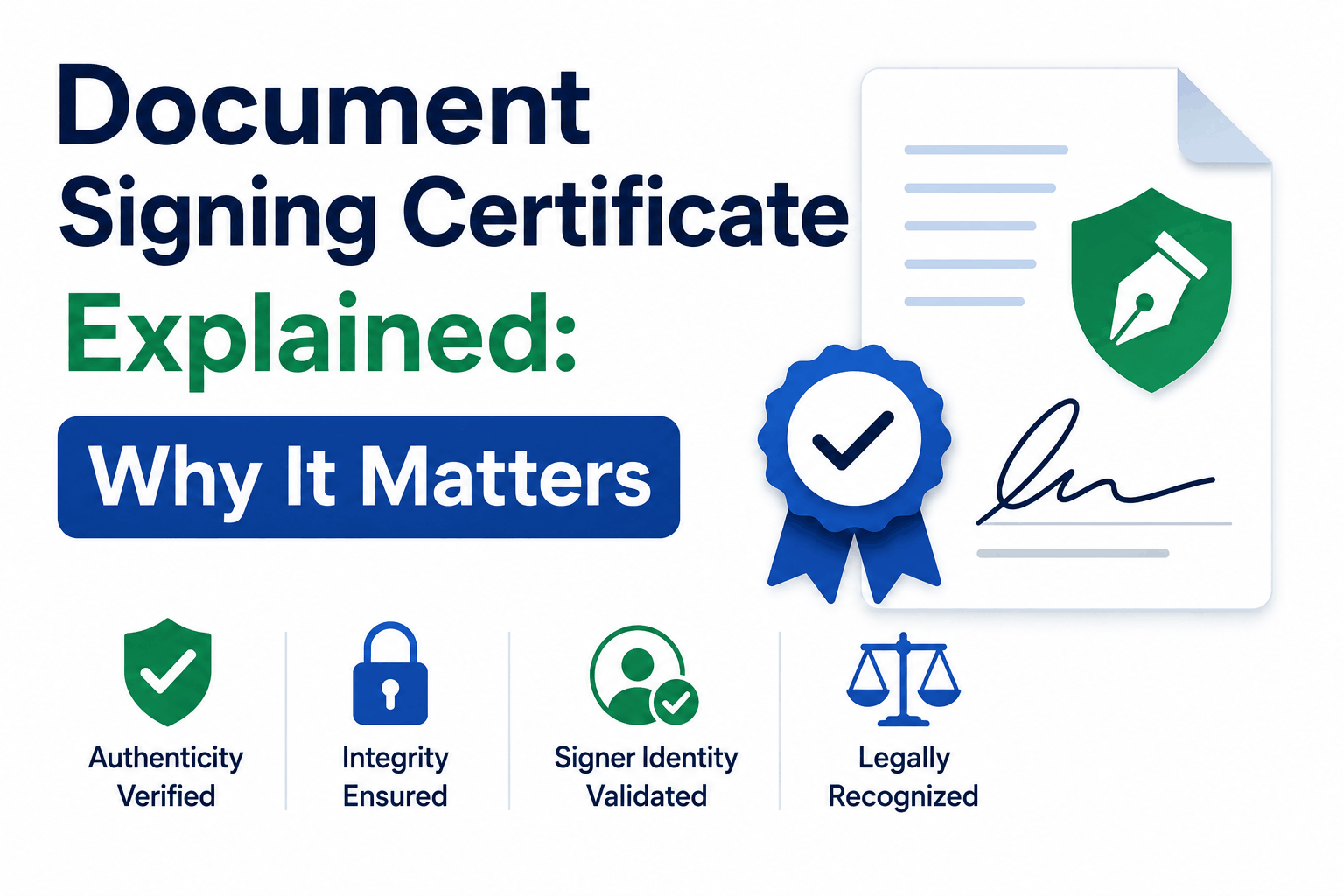
A document signing certificate is a digital certificate issued by a Certificate Authority that enables an individual or organization to apply a cryptographically verifiable digital signature to electronic documents. When a document is signed with a document signing certificate, recipients can independently confirm that the document was signed by the identified party and that the document content has not been modified since signing.
Document signing certificates use the same underlying PKI infrastructure as SSL certificates, S/MIME email certificates, and code signing certificates. What distinguishes them is their extended key usage (EKU) designation for document signing and, critically, which trust programs the issuing CA participates in. A document signing certificate must chain to a CA root that is trusted by the specific application used to verify the signature: Adobe Acrobat requires membership in the Adobe Approved Trust List (AATL); Microsoft Office requires membership in the Microsoft Trusted Root Certificate Program. These are separate trust programs with separate requirements, and most competing articles ignore this distinction.
This guide covers what document signing certificates are, the trust programs and why they matter, the two fundamentally different use cases (individual eSignature and organizational eSeal), the PDF signature types defined in ISO 32000, private key storage requirements, and how signed documents remain valid long-term.
What a Document Signing Certificate Does
When a signer applies a digital signature to a document using a document signing certificate, the signing application performs the hash-then-sign operation: it computes a cryptographic hash of the document content, signs that hash with the signer’s private key, and embeds the signature, the signer’s certificate, and optionally a trusted timestamp into the document file.
Any recipient who opens the signed document in a compatible application can verify the signature without contacting the signer or any signing service. The verification process checks that the signature was produced by the private key corresponding to the certificate’s public key, that the document content matches the hash that was signed (detecting any post-signing modifications), that the certificate chains to a trusted CA root (confirming the CA vouched for the signer’s identity), and that the certificate was valid at the time of signing (using the embedded timestamp).
The result is a document with cryptographically proven provenance and integrity. This is materially different from an electronic signature that relies on an audit trail. See the electronic signature vs digital signature article in this series for a detailed comparison; document signing certificates produce the digital signature category of the two.
Trust Programs: Why Adobe AATL and Microsoft Trusted Root Both Matter
The practical trust of a signed document depends on whether the CA that issued the signing certificate is on the trust list used by the application verifying the signature. This is the most important operational detail that competing articles consistently omit.
Adobe Approved Trust List (AATL)
Adobe Acrobat, Adobe Reader, and other Adobe products verify document signatures against the Adobe Approved Trust List. AATL is a list of CAs that Adobe has reviewed and approved to issue document signing certificates that Adobe products will trust automatically. When a document is signed with a certificate from an AATL-member CA, Adobe Acrobat displays a green checkmark with the signer’s verified identity and a message confirming the signature is valid. When signed with a certificate not from the AATL, Adobe Acrobat displays a warning or an unknown signature status.
Adobe has specific requirements for AATL membership beyond standard CA accreditation: the signing certificate must be stored on hardware meeting FIPS 140-2 Level 2 minimum standards (hardware token or cloud HSM), the CA must meet Adobe’s certificate profile requirements, and the CA must periodically renew its AATL membership. Major CAs on the AATL include DigiCert, Sectigo, GlobalSign, and SSL.com.
Microsoft Trusted Root Certificate Program
Microsoft Word, Excel, PowerPoint, and Outlook verify digital signatures against the Microsoft Trusted Root Certificate Program. This is the same trust store that Windows uses for TLS certificates. A CA that is a member of the Microsoft Trusted Root Program can issue document signing certificates that create automatically trusted signatures in Microsoft Office applications.
The trust requirements differ from AATL: Microsoft’s root program is primarily designed for TLS certificates, and document signing certificates from Microsoft Trusted Root CAs are trusted in Office by extension. Some CAs are members of both AATL and the Microsoft Trusted Root Program; others are in one but not the other.
Before purchasing a document signing certificate, confirm the CA is on the specific trust list required for your use case. If you sign PDFs for recipients who use Adobe Acrobat or Adobe Reader, the CA must be AATL-trusted. If you sign Microsoft Office documents, the CA must be in the Microsoft Trusted Root Program. If both, the CA must be on both lists. A certificate not on the required trust list produces signature warnings or unknown signature status in the recipient’s application, defeating the purpose of the certificate.
| Application | Trust list used | Where to verify CA membership |
| Adobe Acrobat / Adobe Reader | Adobe Approved Trust List (AATL) | helpx.adobe.com; search for AATL member list |
| Microsoft Word / Excel / PowerPoint | Microsoft Trusted Root Certificate Program | ccadb.org; Microsoft’s public certificate database |
| LibreOffice | CA root in operating system trust store | Via OS trust store; major public CAs generally trusted |
| DocuSign, Adobe Sign, and similar platforms | Platform-specific; platform manages certificate trust | Check platform documentation for accepted certificate types |
| Custom applications / PDFium-based viewers | Depends on implementation; often OS trust store | Check the application’s certificate validation implementation |
Two Distinct Use Cases: eSignature and eSeal
Document signing certificates serve two fundamentally different operational purposes, and most guides describe only one of them.
eSignature: individual person signs a document
An eSignature use case involves a specific named individual applying their digital signature to a document to indicate their review, approval, or agreement. The signing certificate is issued to a person (identified by name and optionally by organization), and the signer manually initiates each signing event. Contracts, legal agreements, HR documents, purchase approvals, and patient consent forms are typical eSignature use cases.
The certificate validation level determines the identity assurance: an Individual Validated (IV) certificate requires the CA to verify the signer’s government-issued identity, providing strong personal identity assurance. An Organization Validated (OV) certificate verifies the organization but may list an individual name that the organization sponsors without government-level personal identity verification.
eSignature signing is typically performed through Adobe Acrobat, PDF signing software, or an e-signature platform that integrates with the signing certificate. The private key is held by the individual signer on a hardware token or cloud HSM account.
eSeal: organization applies automated document seals
An eSeal use case involves an organization’s systems automatically applying a cryptographic seal to documents they produce or authorize, without a specific human signer initiating each event. Invoices generated by an ERP system, contracts produced by contract management software, financial statements from accounting systems, and government-issued documents are typical eSeal use cases.
The certificate is issued to an organization rather than an individual, representing the organization as the sealing entity. The signing operation is automated in software pipelines, often through a cloud HSM API, not a human clicking a button. The private key is typically in a cloud HSM or server-side HSM, not on a personal hardware token.
eSeals are specifically addressed by EU eIDAS as a distinct category: electronic seals (not signatures) confirm a document’s origin and integrity without implying personal agreement by any individual. They are appropriate for machine-generated documents where organizational attribution is needed but individual signer identity is not.
The eSeal vs eSignature distinction matters for certificate procurement. Individual certificates are issued to named persons and stored on personal hardware tokens or personal cloud HSM accounts. Organization certificates for sealing are issued to the organization entity and stored on server-side HSM infrastructure with API access for automated signing. Attempting to use a personal eSignature certificate for high-volume automated eSeal operations is operationally awkward and may violate the certificate’s intended use. Confirm which use case applies before selecting a certificate type.
PDF Signature Types: Certification vs Approval (ISO 32000)
PDF digital signatures are defined by ISO 32000, the international standard for the PDF format (originally developed by Adobe and standardized in 2008). The standard defines two types of signatures with different purposes and properties:
Certification signatures
A certification signature is the first signature applied to a document and certifies it as the authoritative version. The certifying party can optionally specify what types of changes are permitted to the document after certification: no changes allowed at all, only form filling and digital signatures permitted, or form filling, digital signatures, and comments permitted. If any change outside the allowed type is made, the certification signature is invalidated.
Certification signatures are appropriate when an originating party wants to certify a document as the official version while still allowing recipients to complete and approve it. A contract sent for signature is a certification signature use case: the issuing organization certifies the contract terms, and the receiving party adds an approval signature to indicate agreement.
In Adobe Acrobat, certification signatures appear with a blue ribbon icon in the signature panel. They are more prominent and convey higher authority than approval signatures.
Approval signatures
An approval signature is any signature applied after the certification signature (or a first signature on an uncertified document). Approval signatures indicate that the signer reviewed and approved the document in its state at the time of signing. Multiple approval signatures can be applied in sequence to the same document.
Each approval signature is valid against the document state at the time of that signature. If the document was modified between signatures, each approval signature is still valid for the state it covered, and the modification is recorded in the signature history. This allows multi-party signing workflows where each party’s approval is independently verifiable.
Most document signing workflows in business contexts use approval signatures rather than certification signatures.
Private Key Storage Requirements
Document signing certificate private keys must be stored on hardware security modules under CA/B Forum requirements that have been in effect since 2023. This requirement applies to publicly trusted document signing certificates and is enforced by the issuing CA. Two practical options exist:
Hardware token
A physical USB security key (YubiKey FIPS, Thales SafeNet, or equivalent) stores the private key in tamper-resistant hardware. The key cannot be extracted from the device. Signing requires the physical token to be plugged in, which provides strong protection against remote key theft but creates operational constraints: the signer must have the physical token at hand, tokens are not suitable for automated signing workflows, and token loss requires immediate certificate revocation and reissuance.
Hardware tokens are appropriate for individual signers who sign manually from a fixed location and can maintain custody of the physical device.
Cloud HSM
A cloud HSM service stores the private key in a remotely accessible hardware security module operated by the CA or a trusted HSM provider. Signing operations are performed through an API without the key ever leaving the HSM. The signer authenticates to the cloud HSM service to authorize each signing event (for eSignature) or the organization’s signing system calls the API for automated events (for eSeal).
Cloud HSM signing enables signing from any device without carrying physical hardware, supports automated document sealing pipelines, and allows multiple authorized users or systems to sign using an organizational certificate. SSL.com’s eSigner, DigiCert KeyLocker, and GlobalSign AATL Cloud Signing are examples of cloud HSM signing services for document signing.
Cloud HSM is the preferred model for organizations with automated document generation pipelines, mobile signers, or distributed teams.
Long-Term Validity: Keeping Signed Documents Verifiable
Document signing certificates expire. When a certificate expires, a signed document would normally become unverifiable because the certificate is no longer valid. For documents that must remain legally valid for years or decades (contracts, financial records, legal filings), this creates a problem.
Trusted timestamping and Long Term Validation (LTV) solve this. When a document is signed with a trusted RFC 3161 timestamp from a trusted timestamping authority, the timestamp proves the signature existed while the certificate was valid. This preserves the signature’s validity after the certificate expires.
LTV (Long Term Validation) embeds all validation material into the PDF at signing time: the full certificate chains for all signers, OCSP responses or CRL data confirming revocation status at signing time, and the trusted timestamp. An LTV-enabled PDF can be verified in the future without any network access to CAs or OCSP servers, because all required validation data is embedded in the document.
For documents requiring long-term preservation, LTV is not optional. Any document that might need to be legally verified years after signing should be signed with LTV. Most enterprise document signing platforms enable LTV by default when using AATL-member CAs.
LTA (Long Term Archival) extends LTV by adding archive timestamps periodically, preserving verifiability as cryptographic algorithms age. This is covered in depth in the timestamping article in this series.
Not all signing workflows enable LTV by default. When evaluating a document signing certificate or platform, confirm whether LTV embedding is included in the signing process. A signed document without LTV that needs to be verified after the signing certificate expires will show signature warnings because the certificate chain cannot be validated without network access to CA infrastructure that may no longer be available.
Document Signing Certificates vs Related Certificate Types
| Certificate Type | Signs What | Primary Trust Program | Identity Level | Revocation |
| Document Signing Certificate | PDF, Office documents, any document format | Adobe AATL and/or Microsoft Trusted Root | Person (IV) or Organization (OV/Sponsored) | CRL/OCSP from issuing CA |
| S/MIME Email Certificate | Email messages (body and attachments) | Mozilla, Microsoft, Apple OS trust stores (email client dependent) | Mailbox, Individual, Organization, or Sponsored | CRL/OCSP from issuing CA |
| Code Signing Certificate | Executables, scripts, drivers, software packages | Microsoft Authenticode, macOS notarization | Organization (OV) or Extended Validation (EV) | CRL/OCSP; EV immediately trusted in SmartScreen (changed 2024) |
| TLS/SSL Certificate | Server identity for HTTPS connections | Browser/OS CA trust stores (Chrome Root Store, Mozilla NSS, etc.) | Domain (DV), Organization (OV), Extended (EV) | CRL/OCSP/CRLSets; Let’s Encrypt OCSP discontinued 2025 |
Why Document Signing Certificates Matter: Specific Use Cases
Legal contracts and agreements
Document signing certificates produce signatures that satisfy digital signature requirements under multiple legal frameworks: the US ESIGN Act and UETA, EU eIDAS (at the Advanced Electronic Signature level, or Qualified when using a QES-level certificate), and equivalent frameworks in most jurisdictions. A digitally signed contract is admissible as evidence in most courts, with the cryptographic proof of who signed it and that it was not modified being significantly stronger than an audit-trail-based electronic signature.
Financial documents and regulatory filings
Financial institutions, auditors, and regulated entities use document signing certificates for digitally signing financial statements, audit reports, tax filings, and regulatory submissions. Many regulatory frameworks (SEC filings, XBRL submissions, regulatory reporting in banking and insurance) specify that electronic submissions must include a digital signature from a certificate-based identity. The certificate’s OV or IV validation level provides the identity assurance regulators require.
Healthcare document workflows
Prescriptions, clinical notes, consent forms, and lab results all benefit from cryptographically verifiable authorship. Healthcare providers using document signing certificates on clinical documentation create an immutable audit trail of who authorized each document and that the content has not been altered. Under HIPAA and HITECH requirements for electronic health record integrity, document signing certificates provide a technically robust control.
Government-issued documents
Government agencies issuing certificates, licenses, permits, and official documents increasingly apply digital signatures to allow recipients and third parties to verify authenticity. A government-issued document with an eSeal from an official agency certificate allows a recipient to verify the document is genuine without contacting the issuing agency.
Frequently Asked Questions
What is a document signing certificate?
A document signing certificate is a digital certificate issued by a Certificate Authority that enables an individual or organization to apply cryptographically verifiable digital signatures to electronic documents. When a document is signed with a document signing certificate, any recipient with appropriate software can verify that the document came from the identified signer and has not been modified since signing. The certificate must chain to a CA root trusted by the application used to verify the signature: Adobe Acrobat requires AATL membership; Microsoft Office requires Microsoft Trusted Root Program membership.
What is the Adobe Approved Trust List (AATL) and why does it matter?
The AATL is Adobe’s root certificate program for document signing. Adobe Acrobat and Adobe Reader automatically verify PDF digital signatures against this list. A signature created with a certificate from an AATL-member CA displays as trusted with a green checkmark and the signer’s verified identity. A signature created with a certificate not from the AATL displays as unknown or with a warning, even if the certificate is technically valid. If you sign PDFs that recipients open in Adobe products, the signing certificate must be from an AATL-member CA. Major AATL members include DigiCert, Sectigo, GlobalSign, and SSL.com.
What is the difference between eSignature and eSeal?
An eSignature is a digital signature applied by a named individual to a document, indicating their personal review, approval, or agreement. The signer initiates each signing event. An eSeal is an automated cryptographic seal applied by an organization’s systems to documents they produce, without a specific individual initiating each event. Invoices, generated contracts, and machine-produced certificates use eSeals. The certificate for an eSignature is issued to a person; the certificate for an eSeal is issued to the organization. EU eIDAS specifically distinguishes electronic signatures (personal) from electronic seals (organizational).
Do I need a hardware token to use a document signing certificate?
Document signing certificate private keys must be stored on hardware meeting FIPS 140-2 Level 2 minimum standards under CA/B Forum requirements. This is satisfied by either a physical USB hardware token (YubiKey FIPS, SafeNet) or a cloud HSM service. Cloud HSM signing services like SSL.com eSigner, DigiCert KeyLocker, and GlobalSign Cloud Signing allow signing from any device without carrying physical hardware and support automated document sealing pipelines. For individual manual signers, a hardware token is the traditional approach. For automated workflows or distributed teams, cloud HSM is the practical choice.
How long is a signed document valid after the signing certificate expires?
With a trusted timestamp embedded at signing time, the signature remains valid after the certificate expires because the timestamp proves the signature was created when the certificate was valid. With Long Term Validation (LTV) enabled, all certificate chain and revocation data is embedded in the document at signing time, allowing the signature to be verified in the future without network access to CA infrastructure. Without a timestamp, the signature becomes unverifiable when the certificate expires. Any document that may need legal or regulatory verification years after signing should be signed with both a trusted timestamp and LTV enabled.