
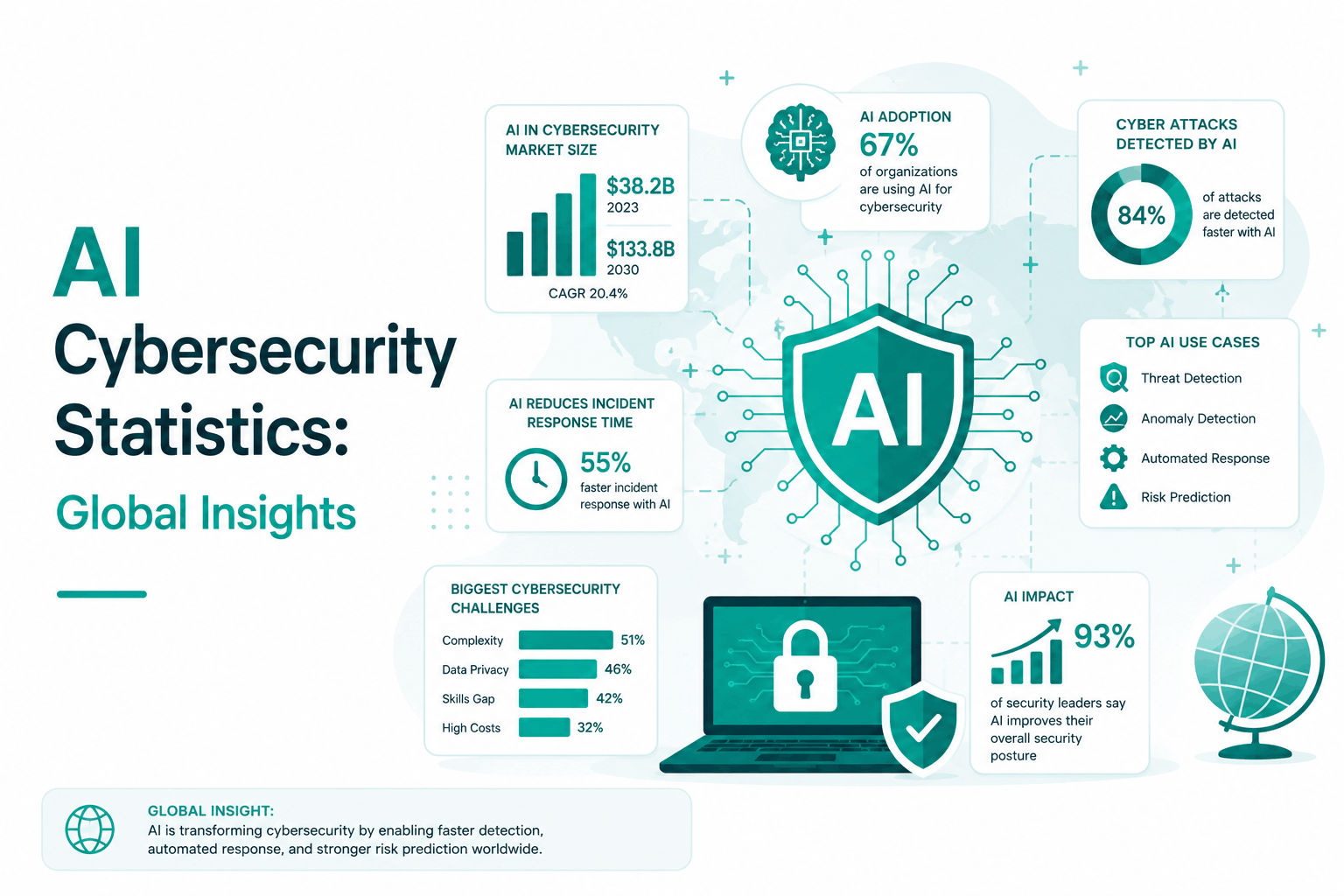
Artificial intelligence did not just influence cybersecurity in 2026. It fully reshaped it. This is the first year where AI became the primary driver for both cyberattacks and cyber defense. Enterprises now depend on AI tools to analyze billions of data points, detect suspicious patterns instantly, and fight back against AI-powered malware faster than a human could ever react.
Key Highlights for 2026
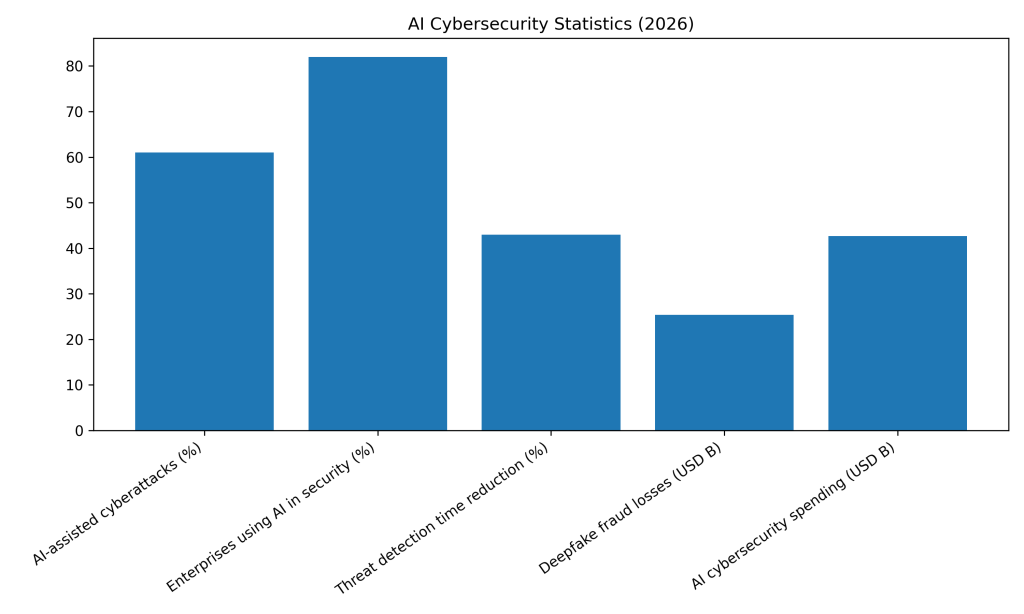
61% of cyberattacks are AI-assisted. This shows how attackers are leaning on automation at scale.
82% of enterprises integrate AI into at least one security layer. Organizations can no longer rely on manual monitoring.
AI reduces average threat detection time by 43%. Faster detection means fewer successful breaches.
Deepfake-related fraud losses reach USD 25.4B. Attackers use synthetic videos and voice clones to impersonate employees.
Global AI cybersecurity spending hits USD 42.7B. This shows how urgently companies are adopting AI-driven protections.
Global AI Cybersecurity Landscape (2026 Data Overview)
AI is now embedded into nearly every cybersecurity tool. Security operations, incident response, cloud security and fraud prevention all depend on sophisticated machine-learning models that understand behavior, track anomalies, and block new types of threats faster than human analysts.
AI Adoption Rates in 2026
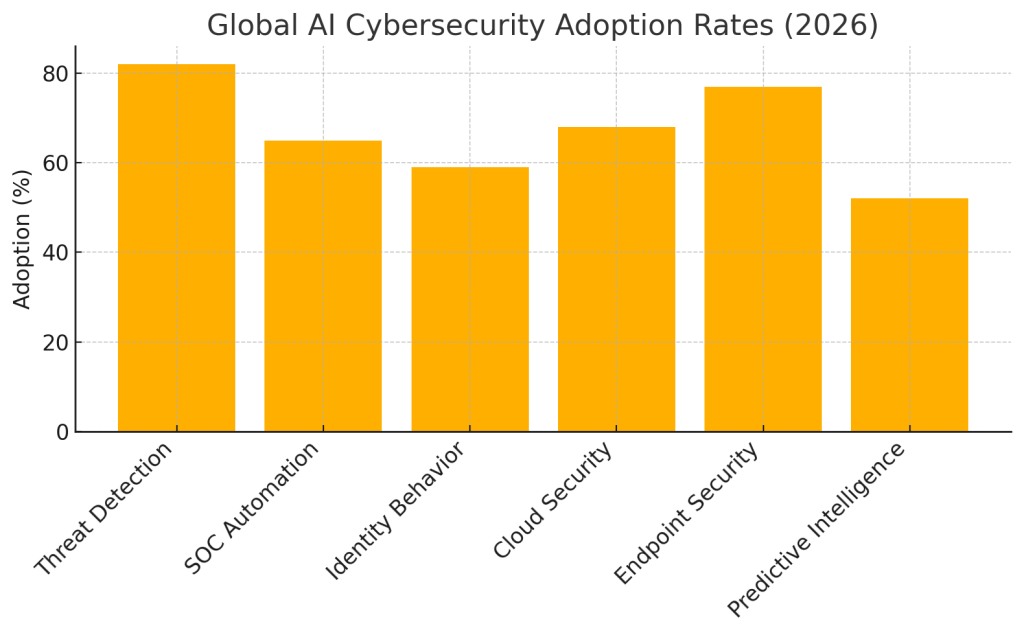
82% of organizations use AI for threat detection. AI identifies unusual activity faster than legacy systems.
65% automate SOC workflows with AI. Routine tasks like alert triage are now machine-handled.
59% use AI for identity and access behavior monitoring. This makes zero-trust systems more accurate.
68% deploy AI in cloud security. Multi-cloud environments require real-time machine learning.
77% integrate AI into endpoint security tools. Devices are often the first target for attackers.
52% utilize AI for predictive threat intelligence. AI forecasts potential attacks before they occur.
AI-Driven Cyberattacks: How Threat Actors Are Scaling
Attackers now use AI to automate reconnaissance, generate phishing emails, create deepfakes, mutate malware and identify vulnerabilities faster than security teams can keep up. This is the first time in history where attackers gained industrial-level scalability at almost zero cost.
AI-Powered Attack Statistics in 2026
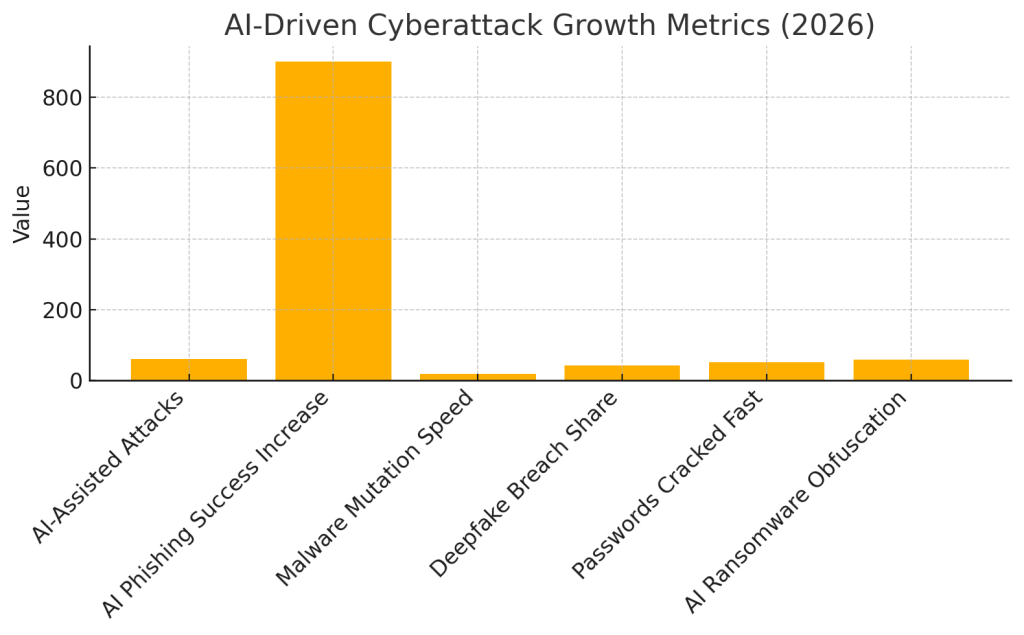
61% of global attacks involve AI automation. Threat actors now reduce their workload significantly.
AI-generated phishing emails convert 900% better. Messages look human, emotional and context-aware.
Polymorphic malware created by AI mutates 19 times faster. Security tools struggle to maintain signatures.
43% of security breaches involve deepfakes or voice clones. Attackers impersonate CEOs during payment approvals.
AI cracks 51% of passwords in under 1 minute. Machine learning models understand common password patterns.
58% of ransomware families use AI to hide malicious activity. Obfuscation makes detection much harder.
AI for Cyber Defense: The New Security Backbone
Despite the rise of AI-powered threats, AI also provides stronger and faster defense mechanisms. Organizations use AI to analyze huge datasets, classify attacks in real time and automate responses without human delay.
Core AI Cyber Defense Capabilities
Behavior-based anomaly detection. AI spots unusual behavior patterns instantly.
Automated incident response. Systems isolate affected endpoints within seconds.
Predictive threat analysis. AI anticipates likely attack paths using historical data.
Cloud misconfiguration scanning. Machine learning identifies incorrect policies before attackers do.
Zero-trust behavioral analysis. Access rights adapt to real-time user behavior.
Automated malware analysis. AI reverse-engineers malicious files faster than human analysts.
Defensive Performance Improvements in 2026
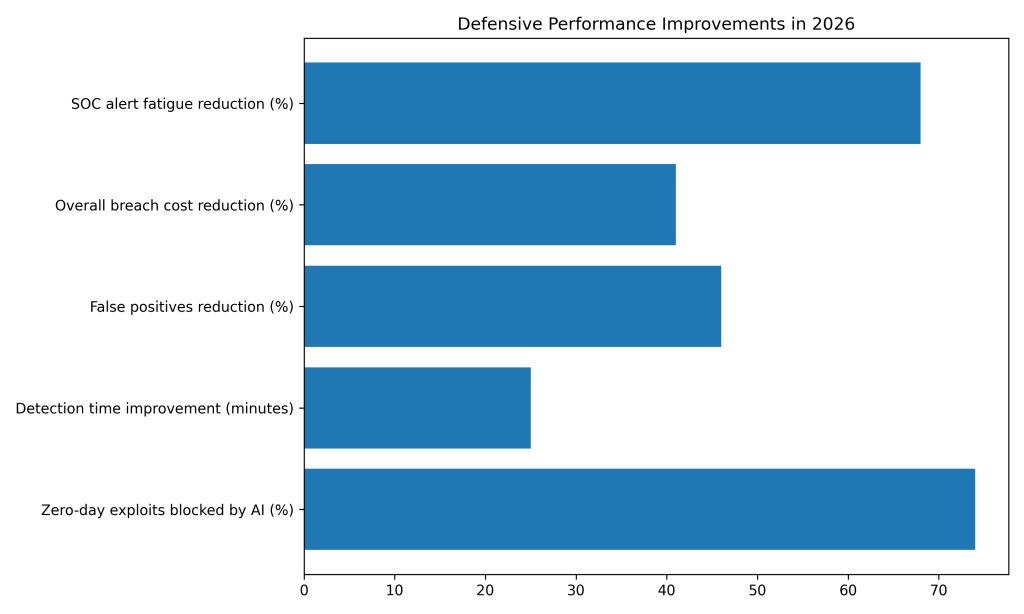
74% of zero-day exploits blocked by AI systems. Predictive analytics detect abnormal execution flow.
Average detection time drops from 28 minutes to 3 minutes. This dramatically reduces damage.
False positives decrease by 46% with AI. Analysts spend more time on real threats.
AI reduces overall breach costs by up to 41%. Faster containment means fewer losses.
Alert fatigue in SOC teams falls by 68%. AI filters noise and highlights high-risk incidents.
Regional Breakdown: AI Cybersecurity Statistics by Continent
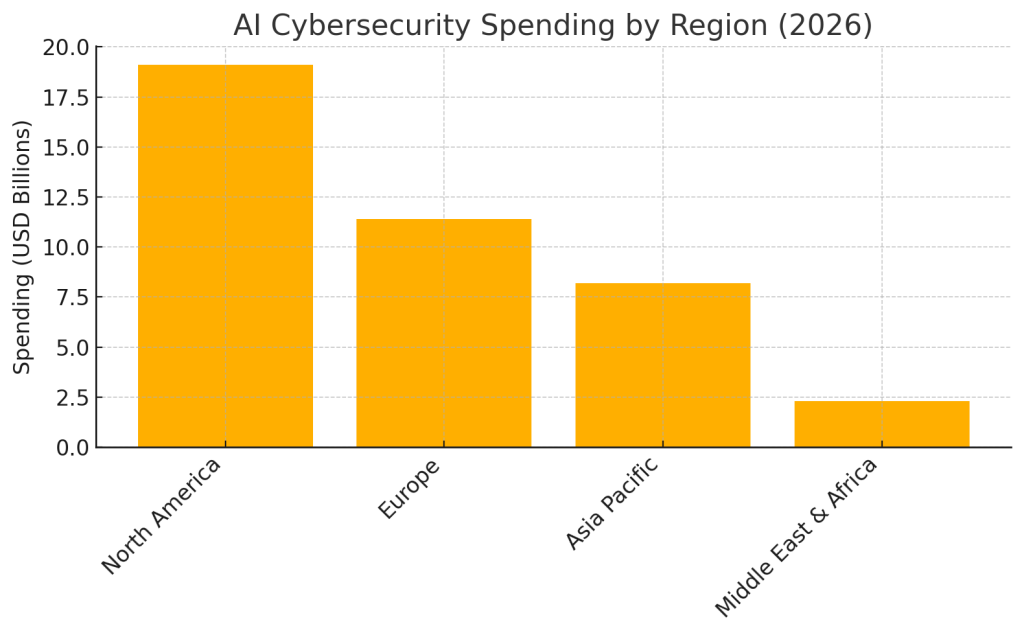
North America
89% of enterprises use AI-driven security systems. The region leads global adoption.
Deepfake financial fraud becomes the fastest-growing threat. Attackers target banks and fintech firms.
AI cybersecurity investments reach USD 19.1B. Big tech and financial sectors drive this growth.
Europe
78% adoption of AI security tools. Strong privacy laws encourage AI integration.
AI + GDPR compliance becomes a priority. Regulatory compliance requires automated monitoring.
AI cybersecurity spending reaches USD 11.4B. EU enterprises invest heavily in detection and identity systems.
Asia Pacific
29% year-over-year AI security growth. APAC is the fastest-adopting region.
Cloud-first companies face heightened ransomware risks. Attackers exploit weak configurations.
AI security spending hits USD 8.2B. Growth is driven by India, Singapore and China.
Middle East and Africa
AI cybersecurity investments reach USD 2.3B. Banking and oil sectors adopt AI rapidly.
Increase in nation-state-backed attacks. Governments target critical infrastructure.
AI identity security becomes a top priority. Many breaches stem from compromised credentials.
Industry Breakdown: Finance, Healthcare, Government, Cloud and E-commerce
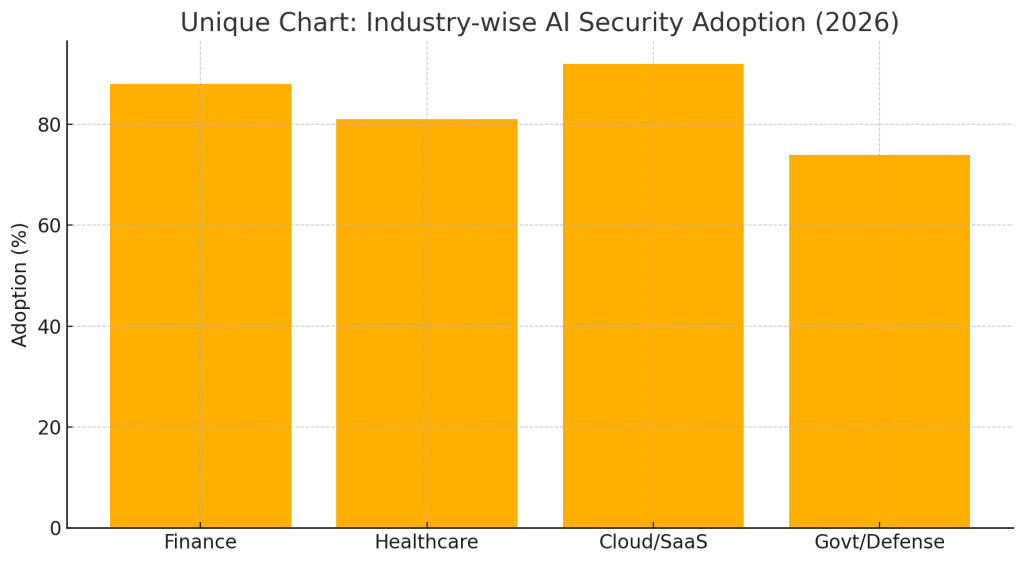
Finance and Banking
88% of financial institutions deploy AI security tools. Banks face the highest attack pressure.
Deepfake fraud incidents rise by 820%. Attackers impersonate executives convincingly.
AI-powered compliance systems reduce regulatory costs by 22%. Automation replaces manual audits.
Healthcare
81% of healthcare systems adopt AI cybersecurity models. Hospitals handle sensitive patient data.
Medical IoT attacks grow by 370%. Attackers exploit connected health devices.
AI reduces ransomware downtime by 59%. Faster detection helps protect patient safety.
Cloud and SaaS
92% of cloud-based companies rely on AI-backed security. Cloud environments need constant monitoring.
AI prevents USD 5.6B worth of cloud attacks. AI identifies threats before exploitation.
AI fixes 41% of cloud misconfigurations automatically. This reduces the number one cause of breaches.
Government and Defense
74% of government agencies use AI for cyber defense. National security is a major target.
Nation-state AI malware usage grows by 45%. Countries weaponize AI at scale.
Identity-based attacks increase by 412%. Login credentials remain a primary weakness.
AI in SOC Operations: Automation, Detection and Response
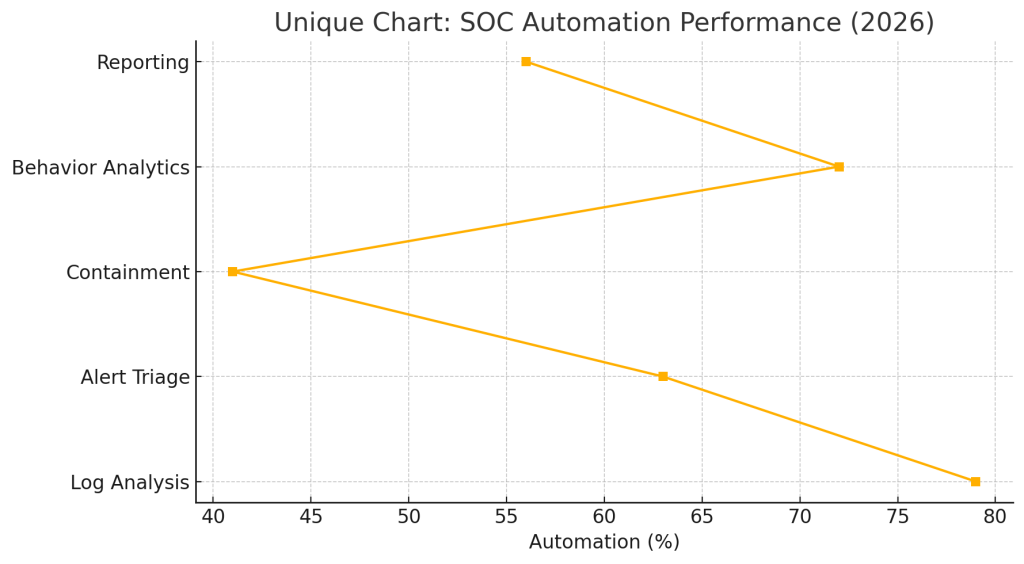
The Security Operations Center in 2026 is no longer human-driven. AI handles repetitive tasks, analyzes huge logs, and prioritizes alerts.
SOC Automation Statistics
79% of log analysis tasks automated by AI. Machines scan logs faster than humans.
63% of alert triage handled automatically. AI categorizes and prioritizes incidents.
41% of threat containment actions initiated by AI. Infections are isolated immediately.
72% of behavioral analytics supported by machine learning. This improves accuracy.
56% of incident reports generated by AI. Summaries are created instantly.
Impact on SOC Efficiency
Average response time drops to 3 minutes. Fast action minimizes damage.
Tier 1 analyst workloads shrink by 70%. AI filters out low-value alerts.
Tier 2 analysts improve productivity by 37%. They focus on deep investigations.
Overall SOC cost efficiency improves by 28%. Automation reduces staffing burden.
AI Attack Vectors and Technical Breakdowns
AI-Polymorphic Malware
AI rewrites malware code continuously which allows it to bypass traditional antivirus solutions easily.
LLM-Powered Phishing Attacks
AI systems generate highly convincing emails, making phishing realistic and personalized.
Data Poisoning Attacks
Attackers inject harmful data into training sets which causes AI systems to misclassify threats.
Prompt Injection Vulnerabilities
Hackers manipulate AI models by feeding poisoned prompts which alter decision making.
Behavioral Biometric Spoofing
AI generates fake user behaviors which bypass biometric authentication like voice or typing patterns.
AI Risks: Data Poisoning, Model Attacks and Hallucination Exploits
AI Risk Statistics
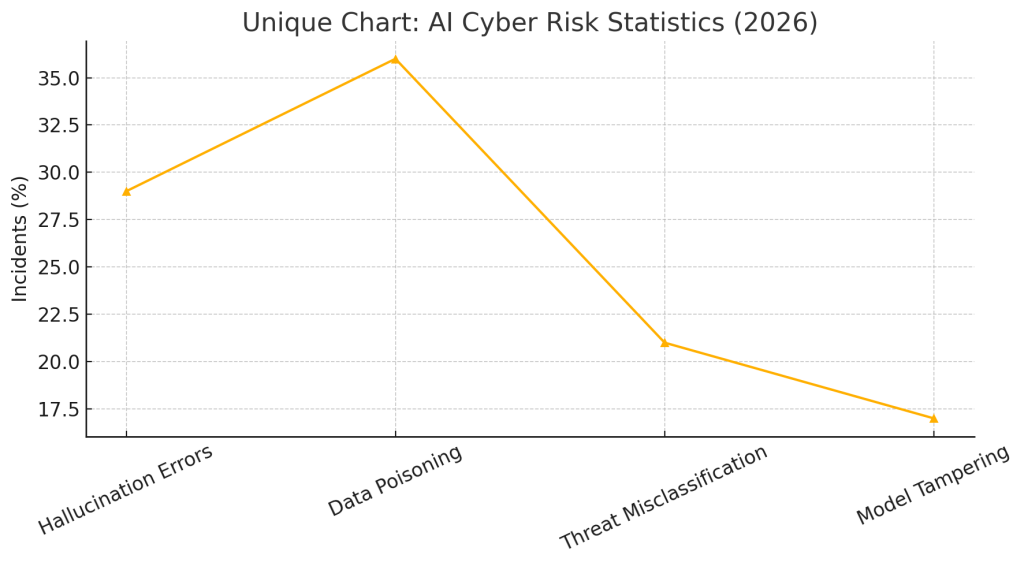
29% of AI security incidents involve hallucination errors. Models generate incorrect outputs.
36% of AI systems encounter training data poisoning attempts. Attackers try to corrupt the model.
21% of ML systems misclassify threats under high load. Performance drops during peak activity.
17% of AI supply chains experience model tampering. Attackers target model weights or parameters.
Each of these attacks creates new vulnerabilities that traditional cybersecurity cannot address.
AI and Cloud Security
2026 Cloud AI Security Highlights
79% of cloud attacks use AI-powered reconnaissance. Attackers scan clouds faster than tools can block them.
68% of cloud security platforms rely on AI. Machine learning handles multi-cloud complexity.
Identity-based cloud attacks grow by 314%. Credentials remain the biggest risk.
AI enhances container security significantly. Behavioral analysis helps block runtime threats.
Zero Trust in the AI Era
Zero-trust architecture relies heavily on AI to validate user identity, device health and behavioral anomalies.
Zero Trust Statistics in 2026
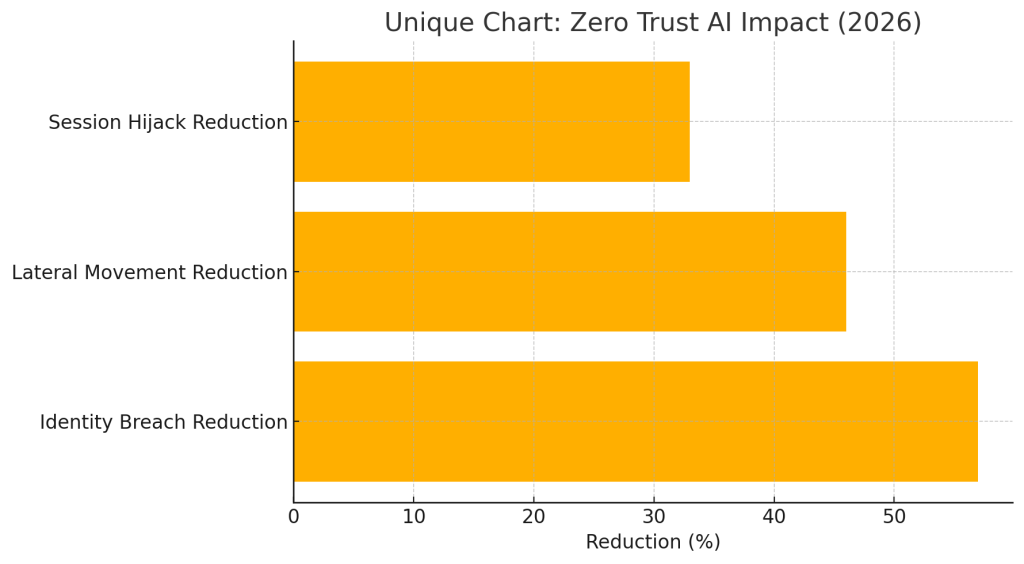
Identity breaches drop by 57% with AI-enhanced zero trust. AI verifies behavior patterns.
Lateral movement inside networks decreases by 46%. AI detects early signs of internal spread.
Session hijacking attacks fall by 33%. AI flags suspicious login patterns in real time.
Workforce and Skills Statistics: The Talent War of 2026
Cybersecurity AI Job Market Insights
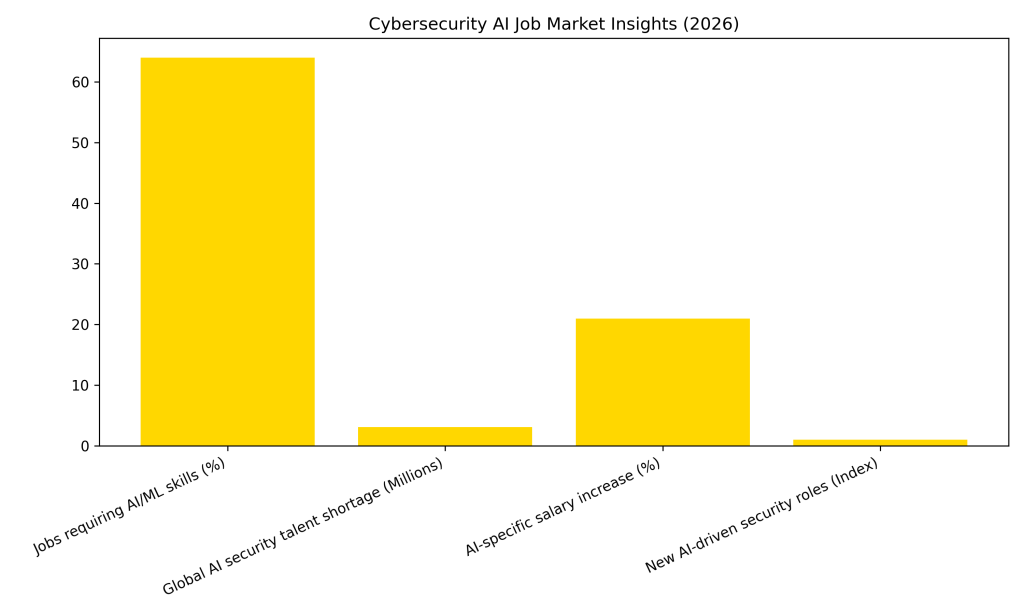
64% of cybersecurity job listings require AI or ML skills. Companies want AI-capable talent.
Global shortage of AI security professionals hits 3.1M. Demand far exceeds supply.
AI-specific cybersecurity salaries rise by 21%. AI expertise commands a premium.
New roles like AI Threat Hunter and Model Security Engineer emerge. AI defense needs specialized skills.
Market Forecast: 2026 to 2030
Future Predictions
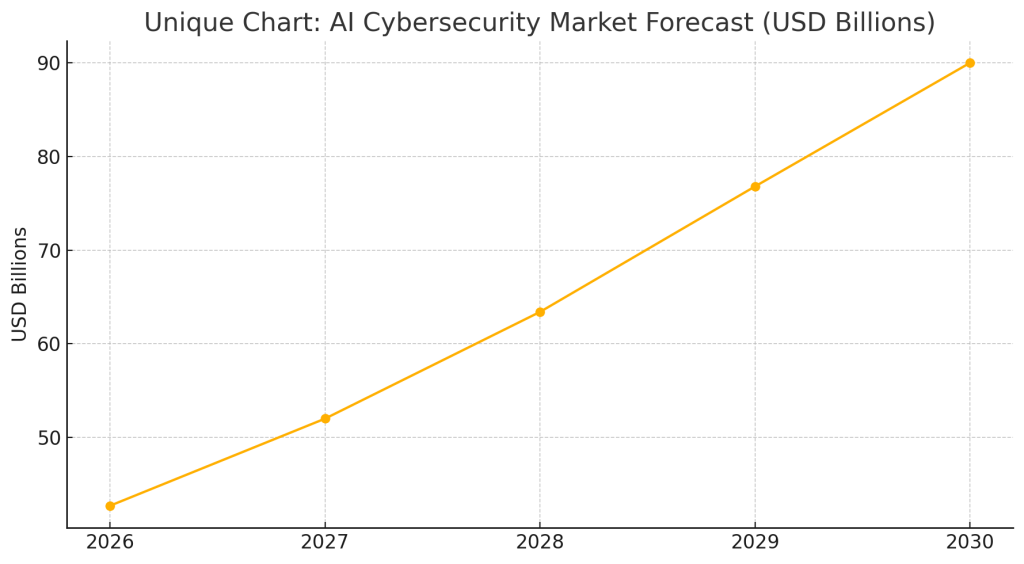
The AI cybersecurity market is projected to reach USD 90B by 2030. Demand continues rising.
AI-powered attacks will grow 7 times faster than manual attacks. Automation accelerates crime.
90% of cybersecurity products will integrate AI by 2030. AI becomes standard, not optional.
AI reduces operational cybersecurity costs by 35% on average. Automation lowers human effort.
FAQs: AI Cybersecurity Statistics in 2026
1. What percentage of cyberattacks use AI in 2026?
Around 61 percent of global cyberattacks use AI automation in 2026.
Attackers rely on AI to scale phishing, mutate malware and create deepfakes much faster than manual efforts.
2. Why are AI cyberattacks increasing so quickly?
AI cyberattacks are increasing because AI makes it easy to automate tasks like reconnaissance, phishing creation and password cracking. This gives attackers more speed and efficiency than ever before.
3. How is AI improving cybersecurity in 2026?
AI improves cybersecurity by detecting threats faster, analyzing behavior patterns, predicting attack paths and isolating compromised devices instantly. Security teams benefit from reduced noise and faster decision making.
4. What industries face the highest AI-driven cyber threats?
Finance, healthcare, government and cloud-based companies face the highest AI-driven threats. These sectors deal with sensitive data and valuable systems that attackers frequently target.
5. How effective is AI in blocking zero-day attacks?
AI blocks up to 74 percent of zero-day attacks in 2026.
It analyzes abnormal execution patterns and identifies suspicious behavior before traditional tools detect it.
6. Are deepfake cyberattacks common in 2026?
Yes, deepfake cyberattacks become extremely common in 2026.
Attackers use AI-generated voice and video impersonation to trick employees into approving payments or sharing private information.
7. How does AI help prevent phishing attacks?
AI detects phishing attempts by analyzing email tone, sender identity, writing patterns and suspicious links. It identifies fake messages faster than human review.
8. What is the role of AI in cloud security?
AI plays a major role in cloud security by identifying misconfigurations, scanning cloud resources, monitoring user behavior and detecting abnormal access activity across multi-cloud environments.
9. Why are enterprises investing heavily in AI security tools?
Enterprises invest in AI security tools because traditional tools cannot keep up with automated attacks. AI provides faster detection, better accuracy and automated incident response.
10. What are the biggest AI cybersecurity risks in 2026?
The biggest AI cybersecurity risks include data poisoning, model manipulation, prompt injection attacks, hallucination-based vulnerabilities and deepfake-enabled social engineering.
11. Does AI reduce cybersecurity costs?
Yes. AI reduces cybersecurity costs by up to 41 percent by identifying threats earlier and automating responses. This lowers breach impact and prevents downtime.
12. Are AI-powered SOCs fully autonomous?
In 2026, SOCs are not fully autonomous but heavily augmented. AI automates alert triage, log analysis, containment steps and reporting, while human analysts handle complex decisions.
13. How accurate is AI in detecting abnormal user behavior?
AI is highly accurate in detecting abnormal behavior because it learns user patterns over time.
It flags unusual login locations, device changes and suspicious actions instantly.
14. Can AI help stop ransomware attacks?
AI helps stop ransomware by detecting early signs of encryption activity, isolating infected systems and monitoring unusual file behavior. This reduces overall impact significantly.
15. Is AI essential for cybersecurity in 2026?
Yes. AI is essential because modern cyberattacks move too fast for human-only teams. Organizations that use AI have stronger detection, faster responses and better protection against emerging threats.
Disclaimer:
The content published on CompareCheapSSL is intended for general informational and educational purposes only. While we strive to keep the information accurate and up to date, we do not guarantee its completeness or reliability. Readers are advised to independently verify details before making any business, financial, or technical decisions.