
Reviewed by Raj Sharma, SSL/TLS Security Specialist with 10+ years of experience in HTTPS, SSL certificates, and web security optimization
TL;DR:
OCSP stapling is a TLS optimization feature that allows a web server to provide a pre-validated SSL certificate status directly during the handshake. This removes the need for browsers to contact the Certificate Authority (CA), resulting in faster HTTPS connections, improved privacy, and more reliable SSL performance.
Introduction: HTTPS Alone Is Not Enough
Many website owners assume that once an SSL certificate is installed, their website is fully optimized for security and performance. However, HTTPS involves more than just encryption — it also includes certificate validation, which can introduce hidden delays.
When a user visits your website, their browser must verify whether your SSL certificate is still valid or has been revoked. This verification typically happens through OCSP (Online Certificate Status Protocol), which requires an additional request to the Certificate Authority.
In practice, I’ve seen websites that invested heavily in CDN optimization and caching still struggle with slow initial connection times due to inefficient certificate validation.
This is where OCSP stapling becomes critical.
What Is OCSP Stapling? (Detailed Explanation)
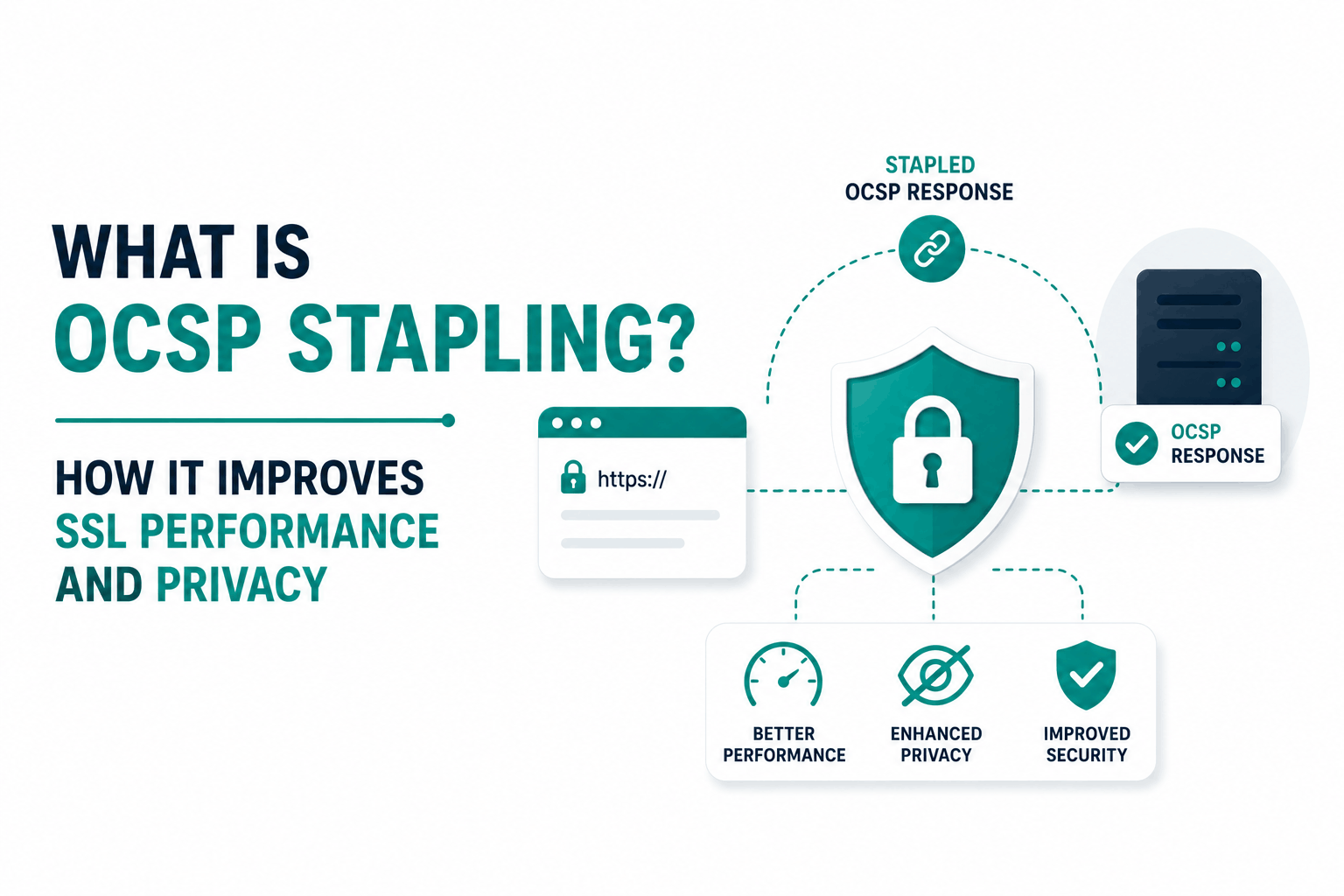
OCSP stapling is a feature of the TLS protocol that improves how SSL certificate validation is handled during a secure connection. Instead of requiring the browser to contact the Certificate Authority (CA) separately, the web server fetches the certificate status in advance and includes it in the SSL handshake.
This “stapled” response is digitally signed by the CA, ensuring that the browser can trust it without needing to verify it externally.
In simple terms:
- Without OCSP stapling → browser checks certificate validity
- With OCSP stapling → server provides validity proof
Why this matters
OCSP stapling solves three major issues in HTTPS:
- Performance delays caused by external OCSP requests
- Privacy risks where CAs can see user browsing behavior
- Reliability issues when OCSP servers are unavailable
Understanding OCSP (Before Stapling)
To fully understand OCSP stapling, you need to first understand how OCSP works without it.
OCSP (Online Certificate Status Protocol) is used by browsers to check whether an SSL certificate has been revoked before its expiration date.
Traditional OCSP Process
When OCSP stapling is not enabled, the validation process looks like this:
- User visits an HTTPS website
- Server sends SSL certificate
- Browser extracts OCSP responder URL
- Browser sends request to CA
- CA responds with certificate status
- Browser continues connection
Problems with Traditional OCSP
While OCSP ensures security, it introduces several real-world problems.
1. Increased Latency
Each OCSP request adds an extra network round trip. This can significantly slow down the SSL handshake, especially for users on mobile networks or in geographically distant regions.
2. Privacy Concerns
When a browser contacts the CA to verify a certificate, it effectively reveals which website the user is visiting. This creates a privacy concern, particularly for sensitive or confidential browsing.
3. Dependency on CA Availability
If the OCSP server is down or slow:
- Some browsers allow the connection (fail-open)
- Others block it (fail-closed)
Both scenarios create risk.
4. Scalability Challenges
High-traffic websites can generate millions of OCSP validation requests globally, increasing load on Certificate Authority infrastructure.
How OCSP Stapling Works (Step-by-Step)
OCSP stapling changes the validation process by shifting responsibility from the browser to the server.
Step-by-Step Workflow
1. Server Requests OCSP Response
The web server periodically contacts the Certificate Authority to fetch the certificate status.
2. CA Provides Signed Response
The CA returns a cryptographically signed OCSP response confirming certificate validity.
3. Server Caches the Response
The server stores this response locally and refreshes it before expiration.
4. SSL Handshake Begins
When a user connects, the server includes the OCSP response in the handshake.
5. Browser Verifies Instantly
The browser validates the signed response without contacting the CA.
Resulting Benefits
- No external OCSP request
- Faster connection
- Improved reliability
OCSP Stapling vs Traditional OCSP
| Feature | Traditional OCSP | OCSP Stapling |
|---|---|---|
| Validation Method | Browser contacts CA | Server provides response |
| Speed | Slower | Faster |
| Privacy | Low | High |
| Reliability | Depends on CA | More stable |
| Performance Impact | Negative | Positive |
Why OCSP Stapling Improves Website Performance
OCSP stapling has a direct impact on website speed and user experience because it eliminates unnecessary external communication during the SSL handshake.
Key Performance Benefits
- Reduced latency: Removes CA request delay
- Faster handshake: Speeds up HTTPS connection
- Better TTFB: Improves initial server response time
- Lower DNS overhead: Fewer lookups required
- Improved global performance: Especially for international users
Real-World Impact
In real deployments:
- Latency reduction: 100–300 ms
- Faster mobile experience
- Improved page load consistency
In practice, I’ve seen OCSP stapling deliver faster improvements than many front-end optimizations because it targets the connection layer directly.
Privacy Benefits of OCSP Stapling
Privacy is often overlooked in SSL discussions, but OCSP stapling significantly improves it.
Without stapling, every certificate validation request exposes user browsing activity to the Certificate Authority.
With stapling:
- No direct browser-to-CA communication
- Reduced tracking risk
- Better compliance with privacy standards
OCSP Stapling and SEO
OCSP stapling is not a direct ranking factor, but it strongly influences metrics that Google cares about.
Indirect SEO Benefits
- Faster page load time
- Improved Core Web Vitals
- Better user experience
- Lower bounce rates
Contrarian Insight
Most SEO strategies focus on content and backlinks.
However, technical optimizations like OCSP stapling can deliver measurable performance gains with minimal effort.
How to Enable OCSP Stapling (Complete Guide)
Apache Configuration
SSLStaplingCache shmcb:/var/run/ocsp(128000)
Steps:
- Enable
mod_ssl - Install full certificate chain
- Restart Apache
Nginx Configuration
ssl_stapling_verify on;
resolver 8.8.8.8 1.1.1.1;
LiteSpeed Server
- Enable via admin panel
- Turn ON OCSP stapling
CDN (Cloudflare)
Most CDNs automatically enable OCSP stapling by default.
How to Check if OCSP Stapling Is Working
Method 1: SSL Labs Tool
- Enter your domain
- Check OCSP stapling status
Method 2: OpenSSL Command
What to Look For
- “OCSP Response Status: successful”
- Valid response timestamps
Common OCSP Stapling Errors (And Fixes)
1. OCSP Stapling Not Enabled
Cause: Missing configuration
Fix: Enable in server settings
2. No OCSP Response
Cause: Server cannot reach CA
Fix: Check firewall and DNS
3. Invalid Response
Cause: Expired cached response
Fix: Adjust refresh interval
4. Missing Intermediate Certificate
Cause: Incomplete chain
Fix: Install full certificate bundle
OCSP Must-Staple Explained
OCSP Must-Staple is an extension that enforces strict validation.
How It Works
- Browser requires stapled response
- If missing → connection blocked
When to Use It
- High-security environments
- Financial or enterprise applications
Risks
- Misconfiguration can break your site
- Requires monitoring
Best Practices for OCSP Stapling
Implementation Tips
- Always install full certificate chain
- Monitor OCSP response validity
- Use reliable DNS resolver
- Test regularly
- Avoid Must-Staple unless confident
Operational Best Practices
- Automate monitoring
- Use uptime alerts
- Validate after certificate renewal
Conclusion
OCSP stapling is one of the most effective yet underutilized optimizations in HTTPS performance. It eliminates unnecessary certificate validation requests, improves privacy, and enhances reliability.
If your website is already running on HTTPS, enabling OCSP stapling is a simple change that can deliver measurable improvements in speed and user experience.
FAQs
What is OCSP stapling in simple terms?
OCSP stapling allows a server to provide certificate validation proof directly to the browser, eliminating the need for external verification.
Does OCSP stapling improve website speed?
Yes, it reduces latency during the SSL handshake and improves overall connection performance.
Is OCSP stapling necessary?
It is not mandatory but highly recommended for performance and privacy improvements.
How do I test OCSP stapling?
You can use SSL Labs or OpenSSL commands to verify if it is enabled.
What is OCSP Must-Staple?
It is a feature that forces servers to provide OCSP responses, otherwise connections fail.
Can OCSP stapling fail?
Yes, due to misconfiguration or expired responses, but it can be fixed easily.
Does OCSP stapling affect SEO?
Indirectly, yes — by improving speed and user experience.